
Indian Museum, Kolkata
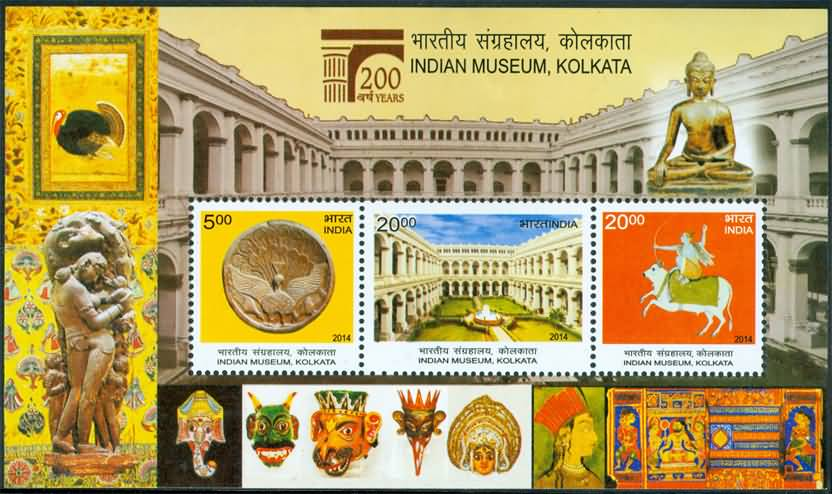
Technical Data
| Date of Issue | February 2, 2014 |
|---|---|
| Denomination | Rs. 45 |
| Quantity | 610,000 |
| Perforation | 13½ |
| Printer | Security Printing Press, Hyderabad |
| Printing Process | Wet Offset |
| Watermark | No Watermark |
| Colors | Multicolor |
| Credit (Designed By) | |
| Catalog Codes |
Michel IN BL122 Yvert et Tellier IN 2568-2570 Stanley Gibbons IN MS2997 |
| Themes | Anniversaries and Jubilees | Art | Buildings | Museums | Paintings |
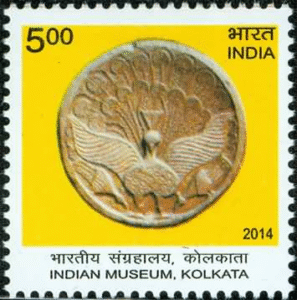
Stamps in this Souvenir Sheet


The Oldest Museum of India
Origins and Establishment
The foundation of the Indian Museum marks a significant milestone in India’s cultural heritage and preservation efforts. Emerging from the vision of the Asiatic Society of Bengal, the idea for a museum took concrete shape in 1808, when the Society occupied its premises at the corner of Park Street on land granted by the Government.
To lead this initiative, the Society appointed Dr. Nathaniel Wallich, a Danish botanist, as the Honorary Curator—and later Superintendent—of the Oriental Museum of the Asiatic Society. Under his guidance, the Society planned a museum with two main sections:
- One dedicated to archaeological, ethnological and technological collections
- The other devoted to geological and zoological specimens
Role of Dr. Nathaniel Wallich
Dr. Wallich, the Museum’s first Curator, was instrumental in nurturing the institution from its inception. He was not only an enthusiastic organizer but also one of its largest early donors. By 1816, out of 174 objects donated to the Museum, 42 botanical specimens came from Wallich himself.
He officially took charge on 1 June 1814, marking the inauguration of the Museum. Under his leadership and the contributions of individual collectors, the Museum grew rapidly.
Shift to the Present Building
The Museum was relocated to its present majestic building on Chowringhee Road, Kolkata, designed by architect Walter R. Granville.
On 1 April 1878, the building was opened to the public with two galleries.
In 1879, the Indian Museum also received a portion of the collection from the India Museum (South Kensington) when its collections were dispersed.
A Multipurpose Institution
Initially opened with only two galleries, the Museum gradually evolved into a major multidisciplinary institution. Today, it comprises six sections:
- Art
- Archaeology
- Anthropology
- Zoology
- Geology
- Botany
This transformation established the Indian Museum as a centre of learning, research and cultural enrichment.
From Asiatic Society Museum to ‘House of Wonders’
In its early days, the institution was known as the Asiatic Society Museum, later gaining prominence as the Imperial Museum. For the common public, however, it became fondly known as “Jadughar”, meaning the House of Wonders, reflecting the awe it inspired among visitors.
Legacy and Significance
Since its shift to the present building in 1878, the Indian Museum has served the nation as a premier centre for art, archaeology, science and culture. It stands today as one of the oldest and most respected museums in the world.
Philatelic Tribute
To honour this historic institution, the Department of Posts is pleased to release a Souvenir Sheet comprising three Commemorative Postage Stamps on the Indian Museum, Kolkata.
First Day Cover

Leave a Comment
You must be logged in to post a comment.