
Chhatrapati Shivaji International Airport
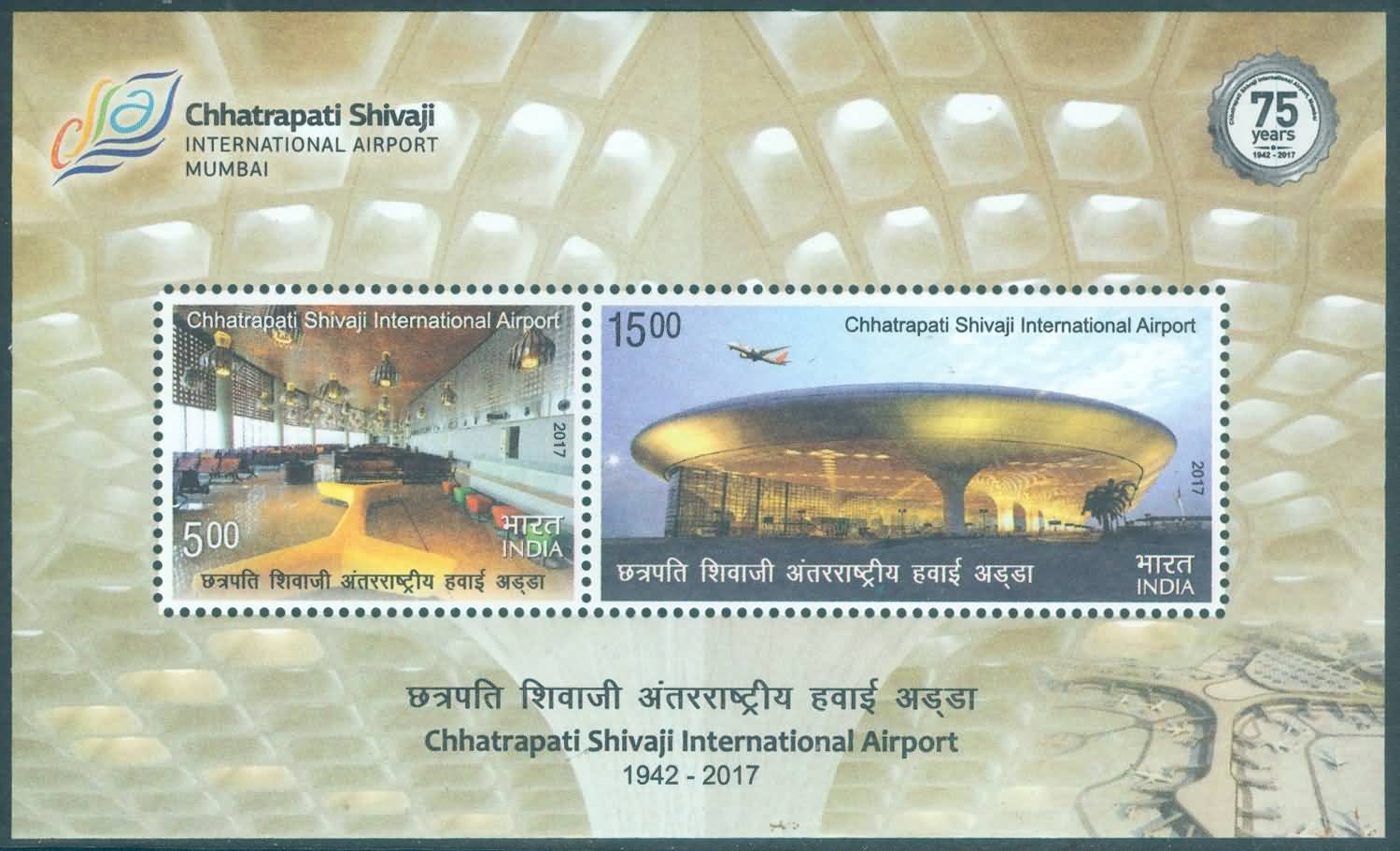
Technical Data
| Date of Issue | October 15, 2017 |
|---|---|
| Denomination | Rs. 20 |
| Quantity | 100,000 |
| Perforation | 13¾ |
| Printer | India Security Press, Nashik |
| Printing Process | Wet Offset |
| Watermark | No Watermark |
| Colors | Multicolor |
| Credit (Designed By) | Sh. Brahm Prakash |
| Catalog Codes |
Michel IN BL170 Yvert et Tellier IN BF158 Stanley Gibbons IN MS3363 |
| Themes | Aircraft | Airports | Anniversaries and Jubilees | Aviation |
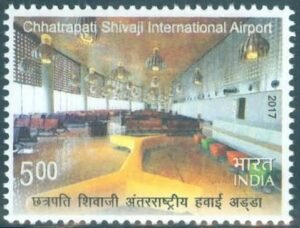
Stamps in this Miniature Sheet
Origins as a Military Airfield
The story of Mumbai’s aviation hub began in 1942 when the Royal Air Force Santacruz airfield was established for military operations. After India gained independence, the airfield was handed over to the Government of India for civil aviation and came to be known as Santacruz Airport. The RAF hangars were converted into passenger terminals—one serving domestic and the other international travellers. With time, increasing passenger footfall created a demand for a more structured and advanced airport infrastructure.
Expansion in the Jet Age
The arrival of the Jumbo Jet era in the 1970s transformed global aviation, and the Santacruz airport struggled to meet rising passenger and aircraft capacity. To streamline domestic and international travel, the International Airports Authority of India constructed a new terminal at Sahar in Andheri, marking the birth of the new international airport. In 1999, the airport was officially renamed Chhatrapati Shivaji International Airport (CSIA).
A Milestone of 75 Years
CSIA’s 75-year journey represents remarkable growth in Indian civil aviation. Passenger movements increased to such an extent that modern upgrades became essential. This evolution has been marked by continuous development and the creation of world-class aviation facilities.
Public–Private Partnership and Modernization
In 2006, under a Public–Private Partnership initiative, the operations of the airports were transferred to Mumbai International Airport Pvt. Ltd. (MIAL)—a joint venture between the GVK-led consortium and the Airports Authority of India. MIAL modernized the airport, enhanced terminal and airside infrastructure, and transformed passenger experience. The crowning achievement was the development of the state-of-the-art Terminal 2 (T2), setting new global benchmarks in efficiency, design, and service excellence.
Global Connectivity & Performance
Today, Mumbai Airport handles over 45 million passengers annually, connecting the city to more than 99 domestic and international destinations. Growth has been exceptional—rising from 22 million passengers and 584 flights per day in FY 2007 to 46 million passengers and 867 daily flights in FY 2017. CSIA holds a unique distinction as the only airport in the world to manage 935 flight movements on a single runway in a single day.
“Jaya He” – India’s Largest Public Art Programme
Terminal 2 hosts a spectacular cultural initiative, “Jaya He”, India’s largest public art programme. Designed to give travellers a visual journey through Indian heritage, this art museum-like installation houses over 7,000 artworks created by artisans from across the nation. It highlights Mumbai’s cultural identity and India’s artistic legacy through a multi-disciplinary display.
Awards and Global Recognition
CSIA has earned numerous accolades and international recognition:
- Inducted into ACI Director General’s Roll of Excellence (2015) for consistently ranking among the top airports in the world for five consecutive years (2009–2014).
- Awarded World’s Best Airport (2015) in the 25–40 million passengers category by ACI.
- Honoured with Skytrax Award (2017) for Best Airport Staff Service.
- Recently adjudged World’s Second Best Airport in the over 40 million passengers per annum category by ACI.
Leave a Comment
You must be logged in to post a comment.