
Potter’s Wheel
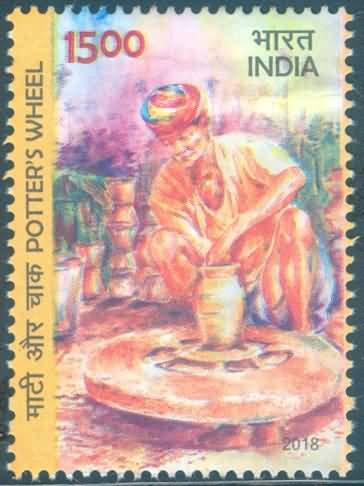
Technical Data
| Date of Issue | January 26, 2018 |
|---|---|
| Denomination | Rs. 15 |
| Quantity | 500,000 |
| Perforation | 13¾ x 13¾ |
| Printer | Security Printing Press, Hyderabad |
| Printing Process | Wet Offset |
| Watermark | No Watermark |
| Colors | Multicolor |
| Credit (Designed By) | Ms. Nenu Gupta |
| Catalog Codes |
Michel IN 3344 Yvert et Tellier IN 3034 Stanley Gibbons IN 3471 |
| Themes | Crafts |
Stamp Design Competition by Department of Posts
Every year on the occasions of Republic Day, Independence Day and Children’s Day, the Department of Posts has been conducting an All India Level Stamp Design Competition since 2015. Selected entries are awarded cash prizes, and the winning designs are used for creating postage stamps and other philatelic items.
This year, the competition was held on the theme “Potter’s Wheel”. With the active support of 23 Circle Offices across the country, the competition received an overwhelming response from participants nationwide.
Pottery: An Ancient Art Form
Pottery, the art of making vessels from burnt clay, is among the oldest human crafts. Pottery remains are an inevitable part of archaeological excavations worldwide. The earliest evidence of pottery dates back to around 10,000 BC in Japan.
The development of clay vessels coincided with the transition of human societies from nomadic lifestyles to agrarian settlements, creating a need for stable and durable containers.
Early Techniques of Pottery Making
In its early stages, ceramic ware was hand-built using the coiling technique, where clay was rolled into long threads, pinched and beaten together to form vessels. These pots were often placed on mats or large leaves, enabling easier rotation during construction. Evidence of this method can still be seen in mat and leaf impressions found on the bases of ancient pottery.
Evolution of the Potter’s Wheel
The Slow Wheel (Tournette)
The earliest potter’s wheels, known as tournettes or slow wheels, emerged around 4500 BC in the Near East. These wheels were turned slowly by hand or foot and were used to make a limited range of vessels, indicating use by a small group of potters. The slow wheel significantly improved the efficiency of pottery production.
The Fast Wheel
By the mid to late 3rd millennium BC, the fast wheel was developed. Operating on the flywheel principle, it stored energy in a heavy stone wheel that was powered by kicking or pushing. This innovation led to the technique of throwing, where clay placed at the center of the rotating wheel was shaped into thinner and more varied forms.
This advancement allowed potters to produce many more vessels per hour, marking an early step toward industrialization. Wheel-thrown pottery is easily identifiable by the rings formed inside the vessel during shaping.
Selected Designs and Prize Winners
Entries on the theme “Potter’s Wheel” were received from all corners of the country. After careful evaluation, eight entries were selected as prize-winning designs by:
- Mr. Abin Bhanu
- Mr. Gokul Raghavan
- Ms. Sonal Kewalramani
- Mr. Vysakh K. S.
- Mr. M. Vaibhav Shenoy
- Mr. Sanskar Verma
- Mr. Abhishek P
- Mr. Sumit Namdev Mandre
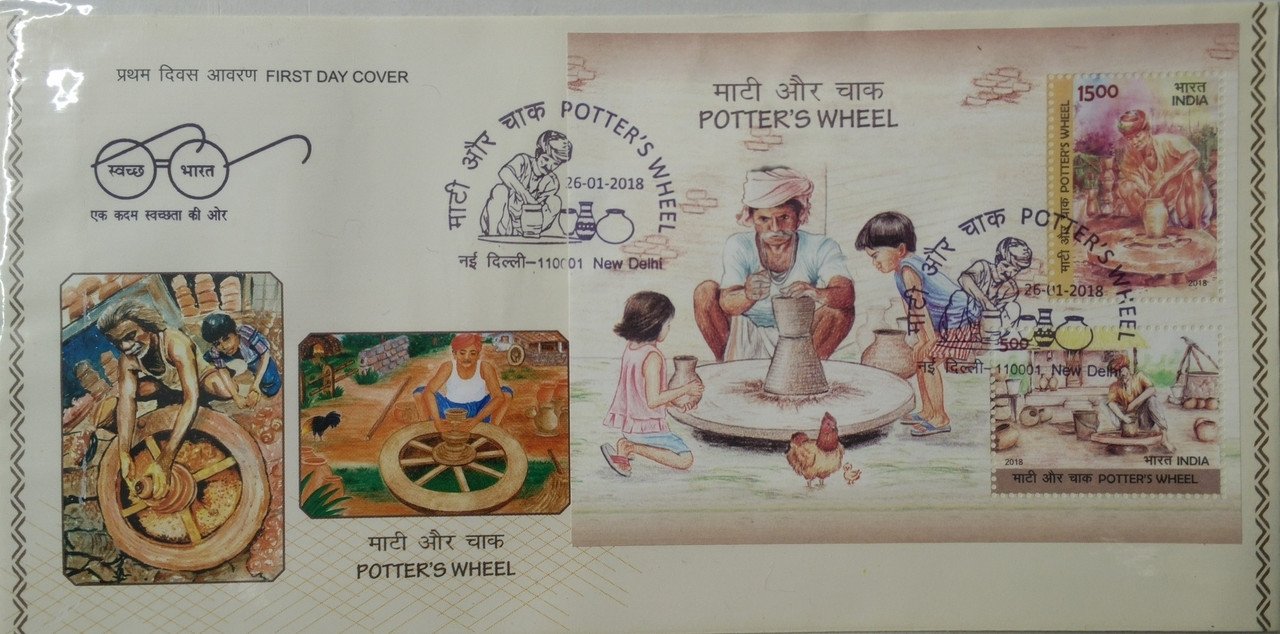
Based on these selected entries, two postage stamps, a miniature sheet, a First Day Cover (FDC) and a brochure have been designed.
Additionally, five entries by Ms. Bharati Manjari Naik, Mr. Jayasooryan S, Ms. Kumud Krishnakumar Kedia, Mr. Bandana Kumar and Ms. Malavika Sunil were also selected, and five maxim cards have been released based on their designs.
Commemorative Philatelic Issue
The Department of Posts is pleased to issue a set of two Commemorative Postage Stamps, along with a Miniature Sheet, First Day Cover, Brochure and five Maxim Cards on the theme “Potter’s Wheel”, celebrating the timeless craft of pottery and the creativity of artists from across India.
First Day Cover
Leave a Comment
You must be logged in to post a comment.