
125th Anniversary of Goan Tiatr

Technical Data
| Date of Issue | April 17, 2018 |
|---|---|
| Denomination | Rs. 5 |
| Quantity | 600,700 |
| Perforation | 13¾ x 13¼ |
| Printer | Security Printing Press, Hyderabad |
| Printing Process | Wet Offset |
| Watermark | No Watermark |
| Colors | Multicolor |
| Credit (Designed By) | Ms. Gulistaan Smt. Alka Sharma |
| Catalog Codes |
Michel IN 3379A Yvert et Tellier IN 3068 Stanley Gibbons IN 3492 |
| Themes | Anniversaries and Jubilees | Musical Instruments | Theatre |
Introduction
Tiatr is a distinctive and vibrant dramatic form of Goa, immensely popular not only within the state but also among Goan communities across India and abroad. Combining drama, music and social commentary, Tiatr has evolved into a powerful medium of cultural expression and entertainment.
Origin and Birth of Tiatr
Goan Tiatr was born nearly 125 years ago in 1892, not in Goa but in Bombay (now Mumbai). A young Goan from Sokolwaddo, Assagao in Bardez Taluka, Lucazinho Ribeiro, is regarded as the innovator of Tiatr. Along with Joao Agostinho Fernandes and others, he staged the first Tiatr performance on Easter Sunday, 17 April 1892.
The first Tiatr was titled “Italian Bhurgo”, and it was based on an English opera, marking the beginning of a new dramatic tradition.
Meaning and Structure of Tiatr
The word ‘Tiatr’ is derived from the Portuguese word “Teatro”, meaning theatre. Tiatr is a unique dramatic form that incorporates music and singing, yet it is not a musical drama in the conventional sense.
A Tiatr is generally divided into six or seven parts, known as “Pordhes”. Between these Pordhes are songs called “Kantaram”. Usually, two to three Kantaram are sung between each Pordho, resulting in 12 to 14 Kantaram in a full Tiatr.
The uniqueness of Tiatr lies in its narrative technique:
- The story of the Tiatr revolves around one central theme, often social or moral in nature.
- Each Kantar, however, addresses a different subject, commenting on contemporary social, political or cultural issues.
Contribution of Eminent Scriptwriters
During the mid-20th century, Tiatr was enriched by the contributions of many talented scriptwriters and playwrights. Notable among them were Alexinho de Candolim, Minguel Rod, C. Alvares, M. Boyer, Prem Kumar, J. P. Souzalin, Nelson’s Afonso, Aristedes Dias, Remy Colaso and John Claro. Their powerful scripts helped Tiatr flourish as a meaningful and engaging theatrical form.
Popularity and Cultural Significance
Tiatr is undoubtedly the most popular dramatic form in Goa. From its inception in 1892 to 2017, spanning nearly 125 years, Tiatr has continued to grow in popularity, captivating audiences generation after generation. It has played a vital role in reflecting social realities, preserving the Konkani language, and strengthening Goan cultural identity.
Commemorative Postage Stamp
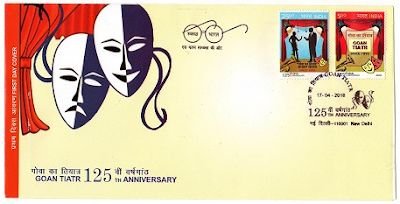
In recognition of the enduring legacy and cultural significance of this unique theatrical tradition, the Department of Posts is pleased to issue Commemorative Postage Stamp on the occasion of the 125th Anniversary of Goan Tiatr, celebrating its contribution to Indian performing arts and Goan heritage.
First Day Cover
Leave a Comment
You must be logged in to post a comment.