
Prithviraj Chauhan

Technical Data
| Date of Issue | April 28, 2018 |
|---|---|
| Denomination | Rs. 15 |
| Quantity | 500,000 |
| Perforation | 13¾ x 13¾ |
| Printer | Security Printing Press, Hyderabad |
| Printing Process | Wet Offset |
| Watermark | No Watermark |
| Colors | Multicolor |
| Credit (Designed By) | Smt. Alka Sharma |
| Catalog Codes |
Michel IN 3386 |
| Themes | Commemoration | Famous people | Kings | Men |
Early Life and Accession
Prithviraj III (reign 1178–1192 CE), popularly known as Prithviraj Chauhan or Rai Pithora, was a distinguished ruler of the Chahamana (Chauhan) dynasty. He ruled Sapadalaksha, the traditional Chahamana territory in present-day north-western India. His kingdom extended over much of Rajasthan, Haryana and Delhi, and parts of Madhya Pradesh and Uttar Pradesh. His capital was Ajayameru (modern Ajmer), though medieval legends often portray him as the ruler of Delhi, the political centre of India.
Prithviraj was born to King Someshvara and Queen Karpuradevi. After Someshvara’s death in 1177 CE, Prithviraj ascended the throne at around 11 years of age. During his minority, his mother served as regent, supported by a council that managed the administration and ensured stability in the kingdom.
Rise of External Threats
In the late 12th century, north-western India faced growing threats from Muhammad of Ghori. In 1175 CE, Ghori crossed the Indus and captured Multan, and by 1178 CE he invaded Gujarat. Over the next few years, he consolidated power in regions west of the Chahamanas, conquering Peshawar, Sindh and Punjab, and shifting his base from Ghazni to Punjab. His eastward expansion inevitably brought him into conflict with Prithviraj Chauhan.
First Battle of Tarain (1191 CE)
In 1190–1191 CE, Muhammad of Ghori invaded Chahamana territory and captured Tabarhindah (identified with modern Bhatinda or Sirhind). On learning of this, Prithviraj marched against him with his feudatories, including Govindaraja of Delhi. The two armies met at Tarain.
In the ensuing battle, Prithviraj Chauhan’s forces decisively defeated Muhammad of Ghori, who was injured and forced to retreat. Despite pressure to pursue and destroy the retreating enemy, Prithviraj refused, adhering to the Rajput code of honour and fair warfare, which forbade attacking a fleeing foe.
Second Battle of Tarain (1192 CE)
Determined to avenge his defeat, Muhammad of Ghori returned to Ghazni and assembled a formidable force of around 120,000 Afghan, Tajik and Turkic horsemen. Marching through Multan and Lahore, with support from Vijayaraja of Jammu, he reached Tarain again.
Ghori employed a strategic ruse, dividing his army into four units of archers to launch surprise attacks and feign retreat, while keeping a large reserve force. At dawn, these divisions attacked the Chahamana camp while Prithviraj was still resting. Misled by the feigned retreat, the Chahamana army pursued the attackers and became exhausted by afternoon. At this critical moment, Ghori unleashed his reserve force, leading to a decisive defeat of the Chahamanas.
Prithviraj Chauhan fought with great bravery but was captured near the Sarasvati fort (modern Sirsa). He died in 1192 CE, marking the end of an era defined by courage, patriotism and unwavering principles.
Legacy
Prithviraj Chauhan remains an enduring symbol of Rajput valour, honour and resistance. His life and battles occupy a prominent place in Indian history, folklore and literature, representing the spirit of sacrifice and adherence to dharma even in the face of overwhelming odds.
A Timeless Legacy Honored in Philately
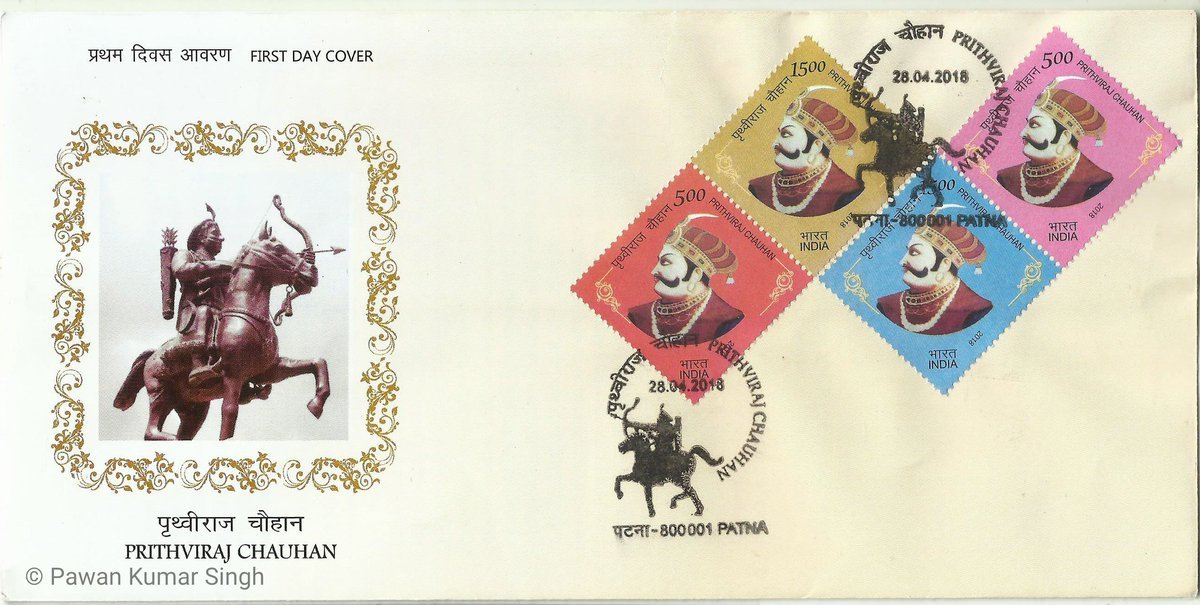
The Commemorative Postage Stamp on Prithviraj Chauhan celebrates the life of a monarch whose bravery and leadership remain an integral part of India’s historical and cultural memory. Through this stamp, the Department of Posts pays tribute to the last Hindu ruler of Delhi, whose story is not merely a tale of battle and loss, but of honor, resilience, and patriotism.
The image of Prithviraj Chauhan on the stamp evokes an age when kings fought not for conquest, but for principle and pride — a legacy that continues to inspire every Indian.
First Day Cover
Leave a Comment
You must be logged in to post a comment.