
Mukesh
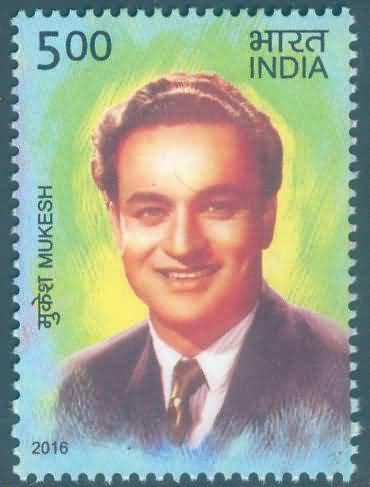
Technical Data
| Date of Issue | December 30, 2016 |
|---|---|
| Denomination | Rs. 5 |
| Quantity | 300,000 |
| Perforation | 13¾ |
| Printer | Security Printing Press, Hyderabad |
| Printing Process | Wet Offset |
| Watermark | No Watermark |
| Colors | Multicolor |
| Credit (Designed By) | Sh. Sankha Samanta Smt. Alka Sharma |
| Catalog Codes |
Michel IN 3054A Yvert et Tellier IN 2758 Stanley Gibbons IN 3224 |
| Themes | Famous people | Men | Singers |
The Soulful Voice of Hindi Cinema
Early Life and Introduction to Music
Mukesh Chand Mathur (22 July 1923 – 27 August 1976), lovingly known to the world simply as Mukesh, remains one of the most celebrated playback singers in the history of Indian cinema. Born in Delhi, Mukesh displayed a passion for music from an early age. Though he came from a modest background, his fascination with melodies and his innate musical talent soon set him on a path that would make him a household name across India.
It was his unique, emotive voice — filled with innocence, sincerity, and pathos — that caught the attention of early filmmakers and music directors. His style was distinctive and deeply personal, resonating with the common man and capturing the emotional essence of the songs he rendered.
Musical Journey and Breakthrough
Mukesh’s debut as a playback singer came with the film Nirdosh (1941), but it was the song “Dil Jalta Hai To Jalne De” from Pehli Nazar (1945) that truly brought him into the limelight. His voice bore an uncanny resemblance to that of legendary actor K.L. Saigal — his early idol — but Mukesh soon evolved his own identity and unmistakable sound.
Through the 1950s, 1960s, and 1970s, Mukesh became the voice of emotion in Hindi cinema. His renditions often carried a quiet intensity, perfectly reflecting the inner worlds of the characters portrayed on screen. His collaboration with Raj Kapoor, starting with Aag (1948), became one of the most iconic actor-singer partnerships in film history. Songs like “Awara Hoon”, “Mera Joota Hai Japani”, and “Jeena Yahan Marna Yahan” remain eternal classics that define an era of Indian film music.
Distinctive Style and Emotional Depth
Mukesh’s singing was characterised by its raw simplicity and deep emotional resonance. Unlike many of his contemporaries who showcased technical brilliance, Mukesh relied on natural expression — a heartfelt sincerity that connected instantly with listeners. His songs often carried undertones of melancholy and introspection, making him the ideal voice for poignant, soul-stirring compositions.
His ability to capture the subtleties of human emotion made every song memorable, whether it was the romantic “Kabhi Kabhi Mere Dil Mein”, the reflective “Kahin Door Jab Din Dhal Jaye”, or the optimistic “Main Pal Do Pal Ka Shayar Hoon.” Each note carried authenticity, humility, and an emotional purity that continues to touch audiences even today.
Awards and Recognition
Mukesh’s artistic brilliance earned him several accolades. He received the National Film Award for Best Male Playback Singer and multiple Filmfare Awards, including for iconic songs such as “Sab Kuch Seekha Humne” (Anari), “Jai Bolo Beimaan Ki” (Beimaan), “Kabhi Kabhie Mere Dil Mein” (Kabhi Kabhie), and “Sabse Bada Naadan” (Pehchaan).
His voice became synonymous with sincerity and emotional truth in film music, earning him a devoted fan following across generations. Mukesh’s music was not merely heard — it was felt, deeply and personally, by millions.
Legacy and Enduring Influence
Mukesh’s untimely passing in 1976 left a void in the world of Indian music, but his legacy endures through the countless songs that continue to move listeners to this day. His voice remains immortal — a symbol of purity, honesty, and heartfelt expression in an age of glamour and grandeur.
New generations of music lovers continue to discover Mukesh’s timeless melodies, finding in them the same simplicity and emotional warmth that defined the golden era of Hindi cinema.
A Philatelic Tribute
The Department of Posts is proud to issue a Commemorative Postage Stamp in honour of Mukesh, the immortal voice whose songs gave life to countless cinematic emotions and defined the soul of Hindi film music.
Through this philatelic homage, India Post celebrates the life and legacy of a singer who touched the hearts of millions and whose music continues to echo across time — a true Voice of the Common Man, and a timeless legend of India’s musical heritage.
First Day Cover

Leave a Comment
You must be logged in to post a comment.