
150th Anniversary of the Allahabad High Court
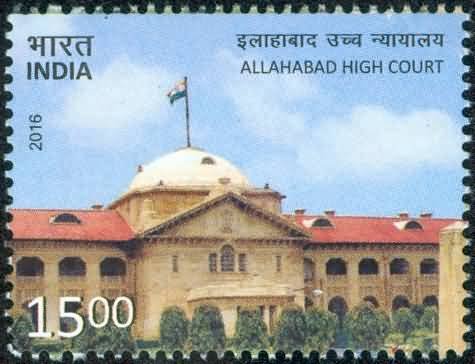
Technical Data
| Date of Issue | March 13, 2016 |
|---|---|
| Denomination | Rs. 15 |
| Quantity | 400,000 |
| Perforation | 13¾ |
| Printer | Security Printing Press, Hyderabad |
| Printing Process | Wet Offset |
| Watermark | No Watermark |
| Colors | Multicolor |
| Credit (Designed By) | Ms. Nenu Gupta |
| Catalog Codes |
Michel IN 2949 Yvert et Tellier IN 2666 Stanley Gibbons IN 3130 |
| Themes | Anniversaries and Jubilees | Buildings | Flags |
A Legacy of Law, Integrity, and Service to the Nation
Establishment and Early Years
The High Court of Allahabad, originally known as the High Court of Judicature for the North-Western Provinces, was established by a Royal Charter on 17th March 1866. It held its first sitting on 18th June 1866 at Agra, under the stewardship of Sir Walter Morgan, the first Chief Justice, along with five distinguished judges — Alexander Ross, William Edwards, William Roberts, Francis Boyle Parson, and Charles Arthur Turner.
In 1869, the Court was shifted from Agra to Allahabad, finding its home in a building on Queen’s Road (now Sarojini Naidu Road).
Architectural Grandeur and Legacy
The magnificent present-day building of the High Court at Allahabad was designed by the renowned architect Frank Lishman. Its foundation stone was laid by Sir John Stanley, K.C., then Chief Justice, on 18th March 1911, and the completed structure was inaugurated by Lord Chelmsford, Viceroy and Governor-General of India, on 27th November 1916.
The edifice, with its graceful dome, pedimented centre, elegant arches, balustrades, and arcaded wings, stands as a perfect blend of Western and Eastern architectural traditions, symbolizing the dignity and strength of the Indian judiciary.
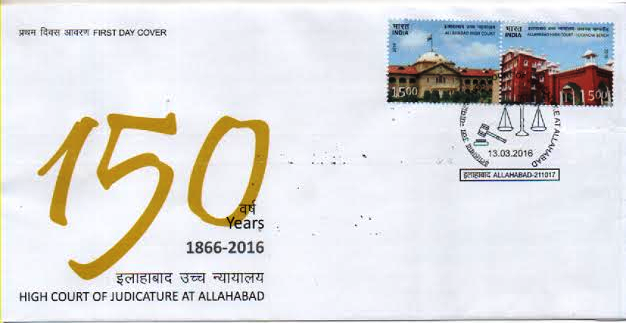
The Lucknow Bench of the High Court occupies another architectural marvel, designed by Mr. W.G. Wood, and constructed in 1900 during the tenure of Sir A.P. Macdonnell, then Lieutenant Governor of the United Provinces. The building beautifully integrates Rajasthani and Mughal architectural styles with majestic domes and pillars.
Evolution and Growth
On 11th March 1919, through a supplementary Letters Patent, the Court received its new name — “High Court of Judicature at Allahabad.”
The Chief Court of Oudh was merged with the Allahabad High Court on 26th July 1948 under the United Provinces High Court (Amalgamation) Order, 1948, creating a unified judicial institution serving the people of Uttar Pradesh.
From its modest beginning with six judges, the Court now celebrates its 150th anniversary with a sanctioned strength of 160 judges (90 permanent and 70 additional), making it the largest High Court in India.
Pioneers and Eminent Jurists
Beginning with Sir Walter Morgan, the first Chief Justice, the Allahabad High Court has witnessed 45 Chief Justices to date.
Notably, it has given India five Chief Justices of India:
- Justice K.N. Wanchoo
- Justice Mirza Hameedullah Beg
- Justice R.S. Pathak
- Justice Kamal Narain Singh
- Justice V.N. Khare
Among its illustrious Indian Chief Justices, Justice Shah Mohammad Suleman stands as the first Indian Chief Justice, while Justice Bidhu Bhushan Malik was the first to assume office after India’s Independence.
The Bar and Its Eminent Advocates
At its inception in 1866, the Allahabad High Court Bar comprised only six advocates. Today, it has grown to a membership of around 15,000 advocates, registered across the High Court Bar Association, the Advocates’ Association, and the Oudh Bar Association at Lucknow.
Among the earliest Indian advocates were Pandit Sundar Lal, Pandit Motilal Nehru, Mr. Ram Prasad, and Mr. J.N. Chaudhary, who were admitted as advocates in 1896.
The Court made history by enrolling Miss Cornelia Sorabji as the first Indian woman Vakil on 24th August 1921, long before other High Courts allowed women to practice law. In 1995, the Cornelia Sorabji Hall was inaugurated to honor her legacy.
Knowledge, Preservation, and Digitization
The High Court houses rich Judges’ and Chief Justice’s Libraries at both Allahabad and Lucknow benches, containing over 1,75,000 books, 1,20,000 bound journals, and 5,000 volumes of government gazettes, making it one of the most comprehensive legal libraries in the country.
To preserve its glorious past, the Allahabad High Court Museum at both locations showcases historic charters, landmark judgments, official robes, photographs, and the original Royal Charter of 1866, issued by Queen Victoria.
Modernization and E-Governance
In step with the digital age, the High Court has undertaken complete computerization and digitization of case records. Since 2009, all judgments and orders have been uploaded online immediately after their pronouncement.
The Court is also transitioning towards a paperless ecosystem through E-filing and E-courts, ensuring faster, transparent, and accessible justice delivery.
A Mediation and Reconciliation Centre at both benches provides litigants the opportunity to resolve disputes amicably through dialogue and mutual consent.
Commemorations and Milestones
- Centenary Celebrations: 1966
- Post-Centenary Silver Jubilee: 1991
- 150th Anniversary: 2016
Each milestone marks the High Court’s unwavering commitment to justice, equality, and the rule of law.
Conclusion
The High Court of Allahabad stands as a pillar of India’s judicial heritage, embodying 150 years of legal excellence, social justice, and public service. From its inception during colonial India to its transformation into a modern institution, the Court continues to uphold its guiding ideals — fairness, integrity, and independence of the judiciary.
The Department of Posts proudly commemorates this historic occasion with a special postage stamp, celebrating the 150 Years of the High Court of Allahabad — a true testament to the enduring spirit of India’s judicial legacy.
First Day Cover
Leave a Comment
You must be logged in to post a comment.