
Western Hoolock Gibbon
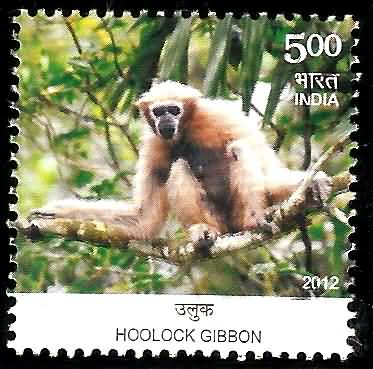
Technical Data
| Date of Issue | October 16, 2012 |
|---|---|
| Denomination | Rs. 5 |
| Quantity | 400,000 |
| Perforation | 13¾ |
| Printer | Security Printing Press, Hyderabad |
| Printing Process | Wet Offset |
| Watermark | No Watermark |
| Colors | Multicolor |
| Credit (Designed By) | Smt. Alka Sharma |
| Catalog Codes |
Michel IN 2671 Stamp Number IN 2595 Stanley Gibbons IN 2893 WADP Numbering System - WNS IN033.2012 |
| Themes | Animals (Fauna) | Apes | Mammals |
The Western Hoolock Gibbon (Hoolock hoolock) holds a unique place in India’s natural heritage as the only ape species found in the country. Graceful, agile, and highly vocal, this arboreal primate symbolizes the rich biodiversity of India’s northeastern forests and the delicate balance of forest ecosystems.
Habitat and Distribution
The Western Hoolock Gibbon is a forest-dwelling species, inhabiting dense tropical and subtropical forests of North-East India, particularly in Assam and adjoining regions. Preferring continuous forest canopies, the gibbon spends most of its life in trees, rarely descending to the ground.
Behaviour and Diet
An important seed disperser, the Western Hoolock Gibbon plays a vital role in forest regeneration. Its diet consists mainly of ripe fruits, supplemented with flowers, leaves, and tender shoots. Through its feeding habits, the gibbon contributes directly to maintaining plant diversity and forest health.
Conservation Status and Threats
The species faces increasing threats in the wild due to habitat encroachment, forest clearance for cultivation, and degradation of forest cover. Fragmentation of forests disrupts canopy continuity, which is essential for the gibbon’s movement, breeding, and survival. These pressures have placed the Western Hoolock Gibbon under serious conservation concern.
Ecological Significance
As a keystone species of forest ecosystems, the Western Hoolock Gibbon helps sustain biodiversity by aiding natural seed dispersal and maintaining ecological balance. Its presence is often an indicator of a healthy and intact forest environment.
Philatelic Tribute to an Endemic Species
To commemorate the Eleventh Conference of the Parties (CoP-11) to the Convention on Biological Diversity, hosted by India in Hyderabad in 2012, the Department of Posts issued a Commemorative Postage Stamp featuring the Western Hoolock Gibbon. The stamp highlights India’s commitment to conserving its endemic wildlife and fragile ecosystems.
Stamps as Voices for Conservation
Through philately, the story of the Western Hoolock Gibbon reaches a wider audience, transforming a postage stamp into a powerful messenger for biodiversity conservation and environmental awareness.
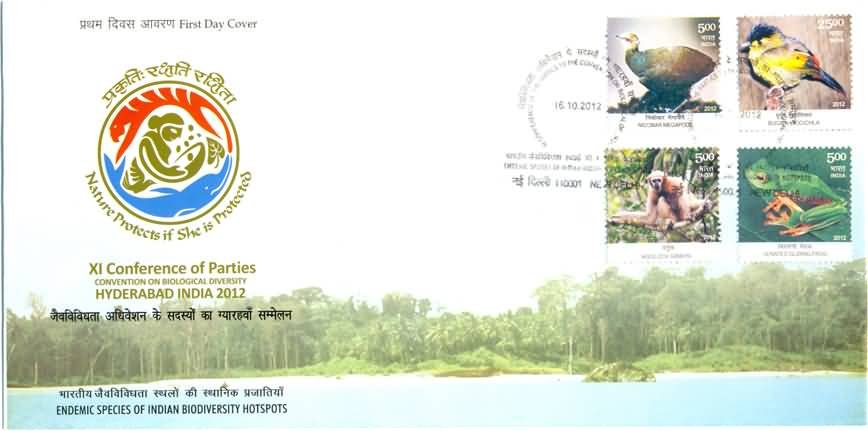
First Day Cover
Leave a Comment
You must be logged in to post a comment.