
Husain Ahmad Madani
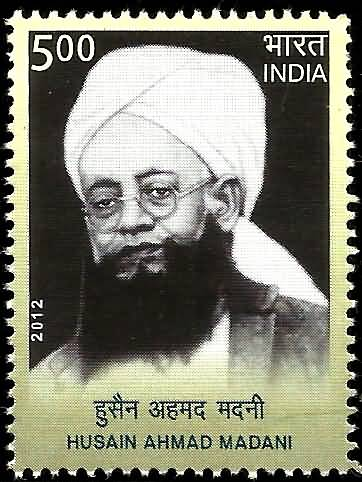
Technical Data
| Date of Issue | August 29, 2012 |
|---|---|
| Denomination | Rs.5 |
| Quantity | 400,000 |
| Perforation | 13¼ |
| Printer | India Security Press, Nashik |
| Printing Process | Wet Offset |
| Watermark | No Watermark |
| Colors | Multicolor |
| Credit (Designed By) | Ms. Nenu Gupta |
| Catalog Codes |
Michel IN 2665 Stamp Number IN 2589 Yvert et Tellier IN 2427 Stanley Gibbons IN 2887 WADP Numbering System - WNS IN028.2012 |
| Themes | Commemoration | Famous people | Freedom Fighters | Headgear | Men | Optical Instruments | Politicians |
Scholar, Freedom Fighter and Champion of Unity
Early Life and Education
Maulana Husain Ahmad Madani, who later earned the revered title of Shaikh-ul-Islam, was born in 1879 at Bangarmau in Uttar Pradesh. His father, Syed Habibullah, was a headmaster and placed great emphasis on sound education rooted in classical Islamic learning. Husain Ahmad was the third among five sons.
At the young age of twelve, in 1891, he was sent to study at the renowned Darul Uloom, Deoband. The curriculum at Deoband was comprehensive, encompassing Arabic grammar and literature, logic, philosophy, Islamic law and jurisprudence, Hadith, Qur’an and theology, which laid the foundation for his lifelong scholarship.
Years in Medina and Scholarly Recognition
In 1898, his family migrated to Medina, where Husain Ahmad spent several formative years, with only occasional visits to India. During this period, his deep scholarship earned him the title “Maulana”, acknowledging his stature as an Islamic scholar.
In Medina, he came to be known as “Maulana Hindi”, while in India he was fondly called “Madani”, reflecting his close association with the holy city. From the 1920s onwards, he was widely recognised as “Shaikh-ul-Islam”, a mark of the highest scholarly authority.
Association with Sheikh-ul-Hind and Imprisonment
While in Medina, Maulana Madani developed a close association with Sheikh-ul-Hind, Maulana Mahmood-ul-Hasan, becoming his trusted confidant. In December 1916, both were arrested in Mecca by the British authorities on charges of sedition and conspiracy against colonial rule in India. They were subsequently interned in Malta.
Their release and return to Bombay in 1920 marked a significant turning point in India’s freedom struggle.
Role in the Freedom Movement
After his return to India, Maulana Madani emerged as a prominent nationalist leader. At the Khilafat Conference held at Allahabad in June 1920, he strongly supported non-cooperation with the British. He firmly believed that the struggle against colonial rule required the collective efforts of Hindus and Muslims, and his commitment to secular nationalism earned widespread respect.
He actively participated in major movements such as the Civil Disobedience Movement (1932) and the Quit India Movement (1942), facing imprisonment on several occasions for his unwavering opposition to British rule.
Leadership and Academic Contributions
In 1940, Maulana Husain Ahmad Madani was elected President of Jamiat Ulama-i-Hind at its Jaunpur session, a position he held until his death in 1957. Under his leadership, the organisation remained committed to India’s freedom, unity and secular ethos.
He later served as Dean of Studies and Head of the Department of Hadith at Darul Uloom, Deoband, where he continued to shape generations of scholars.
Legacy
Maulana Husain Ahmad Madani is remembered as a great Islamic scholar, fearless freedom fighter and a powerful advocate of Hindu-Muslim unity. His life symbolised the harmony between faith and nationalism, scholarship and activism.
Commemorative Postage Stamp
In recognition of his invaluable contribution to India’s freedom struggle, scholarship and national unity, the Department of Posts is pleased to honour Maulana Husain Ahmad Madani by issuing a Commemorative Postage Stamp, paying tribute to one of the most respected leaders of modern India.
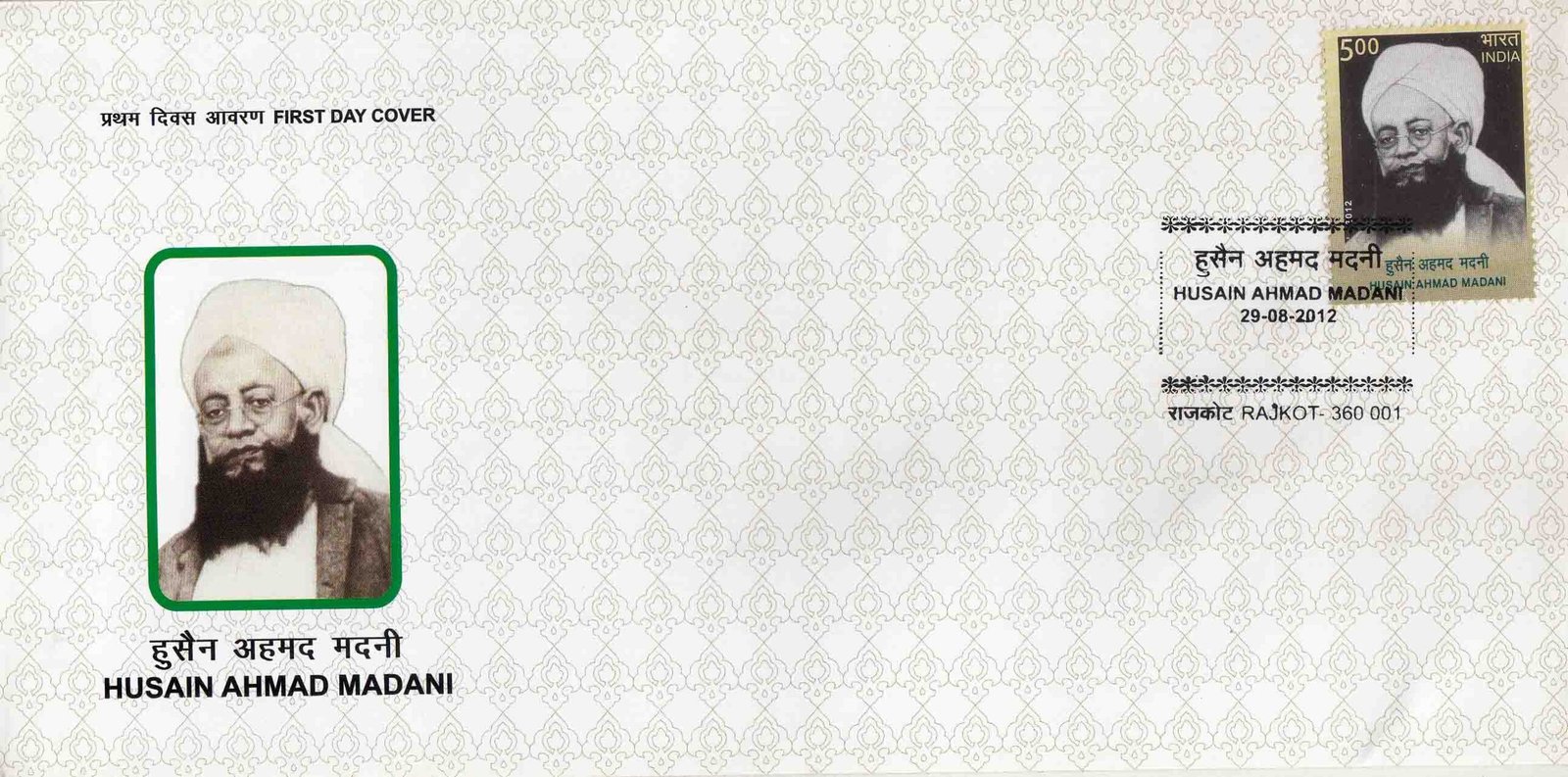
First Day Cover
Leave a Comment
You must be logged in to post a comment.