
India-Israel Joint issue
Technical Data
| Date of Issue | November 5, 2012 |
|---|---|
| Denomination | Rs. 10 |
| Perforation | 13¾ |
| Printer | Security Printing Press, Hyderabad |
| Printing Process | Wet Offset |
| Watermark | No Watermark |
| Colors | Multicolor |
| Credit (Designed By) | Ronen Goldberg Smt. Alka Sharma |
| Catalog Codes |
Michel IN 2678-2679 Stamp Number IN 2602-2603 Stanley Gibbons IN 2897a |
| Themes | Diplomacy | Festivals | Joint Issues |
Stamps in this Se-Tenant

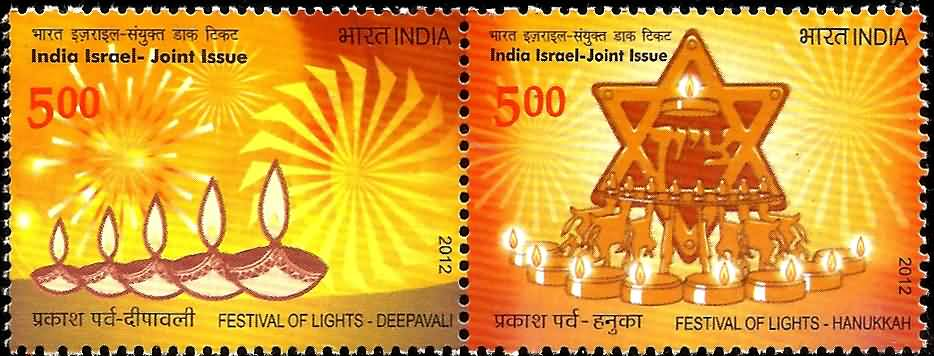
Diplomatic relations between India and Israel were established in 1992. To mark the completion of twenty years of diplomatic ties, both countries have jointly issued a set of two commemorative postage stamps. These stamps highlight the shared cultural symbolism of light through the depiction of two festivals of lights — Deepavali and Hanukkah.
Deepavali – Festival of Lights
Deepavali, popularly known as the Festival of Lights, is celebrated on the new moon day in the month of Kartik according to the Indian lunar calendar, usually falling in late October or early November. It is one of the most important Hindu festivals and symbolizes the victory of righteousness over evil.
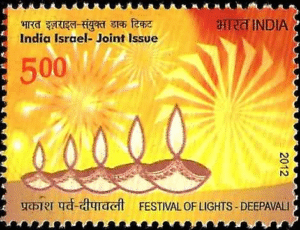
The word Deepavali literally means “rows of lamps.” The festival commemorates the return of Lord Rama, along with his wife Sita and younger brother Lakshmana, to Ayodhya after a fourteen-year exile, following the defeat of the demon king Ravana. Tradition holds that the people illuminated the entire kingdom with earthen lamps (diyas) to celebrate the return of their beloved king.
Deepavali continues to be celebrated with great joy across India through cleaning, decorating and illuminating homes, shops and marketplaces, exchanging greetings and sweets, and bursting firecrackers.
Hanukkah – Jewish Festival of Lights
Hanukkah, also known as the Festival of Lights, is an eight-day Jewish festival commemorating the rededication of the Holy Temple in Jerusalem during the Maccabean Revolt of the 2nd century BC.
According to the Babylonian Talmud (Tractate Shabbat 21b), when the Temple was reclaimed, the Maccabees found only a small quantity of pure oil—sufficient to light the Temple menorah for a single day. Miraculously, this oil lasted for eight days, until more oil could be prepared.
Hanukkah is observed for eight nights and days, beginning on the 25th day of Kislev as per the Hebrew calendar. It is customary to light candles each night in a nine-branched candelabrum, known as the Menorah or Hanukiah, with one additional candle lit on each successive night until all eight are illuminated on the final day.
Shared Symbolism of Light
Like the diyas of Deepavali, the candles of Hanukkah symbolize the triumph of good over evil and the victory of justice over injustice. The menorah depicted on the Hanukkah stamp is inspired by the wooden menorah traditionally used by the Jewish community in Mumbai, reflecting the cultural links between the two nations.
India–Israel Joint Stamp Issue
To mark 20 years of diplomatic relations between India and Israel, a complete set of two commemorative postage stamps was issued by India Post and Israel Post.
First Day Cover

Leave a Comment
You must be logged in to post a comment.