
Rashtrapati Bhavan and Gardens
Technical Data
| Date of Issue | August 5, 2011 |
|---|---|
| Denomination | Rs. 5 |
| Quantity | 400,000 |
| Perforation | 13 |
| Printer | India Security Press, Nashik |
| Printing Process | Wet Offset |
| Watermark | No Watermark |
| Colors | Multicolor |
| Credit (Designed By) | Sh. Sankha Samanta |
| Catalog Codes |
Michel IN 2611 Stanley Gibbons IN 2827 WADP Numbering System - WNS IN032.2011 |
| Themes | Architecture | Gardens | Government Buildings |
From Imperial Edifice to Democratic Symbol
The Rashtrapati Bhavan, formerly known as the Viceregal Lodge or Viceroy’s House, was conceptualized in 1911 following the Delhi Durbar, under Lord Hardinge, the then Viceroy and Governor General of India. The architectural responsibility was entrusted to Sir Edwin Landseer Lutyens, an architect of exceptional originality, ably assisted by Herbert Baker.
Construction commenced in 1913 and was completed in 1929. The building was commissioned in 1931, when Lord Irwin became its first occupant. Originally built to project the power and authority of the British Empire, Rashtrapati Bhavan has since evolved into the office-cum-residence of the President of India. Today, it stands as a living heritage monument and a powerful symbol of the Republic of India, the world’s largest democracy.
Architectural Grandeur and Design Elements
The entrance to Rashtrapati Bhavan is marked by an intricately designed wrought iron grille, supported by stone piers crowned with pairs of sandstone elephants and stone lanterns. Stone aedicules provide shade to the guards, reflecting a thoughtful blend of functionality and ornamentation.
The Processional Way leading to the majestic forecourt features the Jaipur Column, rising 145 feet from its base to the tip of its six-pointed glass star. The column derives its name from the Maharaja of Jaipur, who bore the cost of its construction. Inscribed on its base are Lutyens’ inspiring words:
“Endow your thoughts with faith, your deeds with courage, your life with sacrifice so all men may know the greatness of India.”
The Central Portico, forming the main façade, consists of twenty stately columns approached by thirty-one imposing steps. In front of the Durbar Hall stands the historic Rampurva Bull Capital from the Asokan period, reinforcing the continuity of India’s ancient heritage within a modern architectural framework.
Interiors and Ceremonial Spaces
Entering through the massive teak doors, one encounters the magnificently illuminated Durbar Hall, built beneath the grand dome and adorned with a suspended chandelier. At its centre stands a statue of Gautam Buddha from the Gupta age. This hall witnessed the historic swearing-in ceremonies of Shri C. Rajagopalachari as Governor General and Pandit Jawaharlal Nehru as independent India’s first Prime Minister.
The building contains North and South Courts at the upper ground level. The South Court is distinguished by polished bronze cobras spouting water from atop tapering octagonal red sandstone pillars, their chevron patterns evoking the texture of snake skin.
Among the four inner stairways, the Grand Open Staircase of sandstone is regarded as “one of the triumphs of Lutyens’ imagination.” Though it appears to be indoors, its blue ceiling is in fact the open sky. During ceremonial occasions, the President’s Bodyguard lines these steps, enhancing the grandeur of state functions.
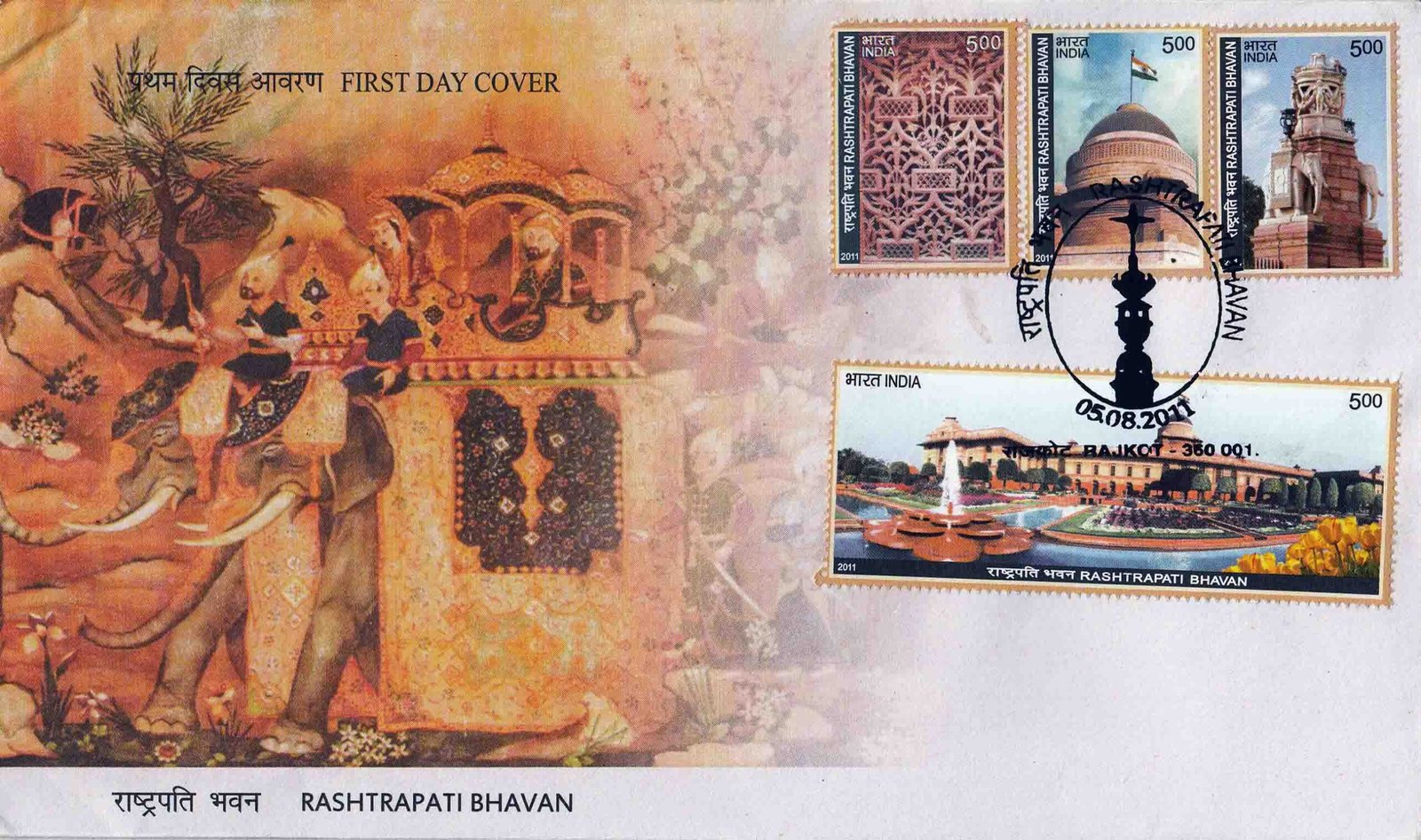
The Ashoka Hall, originally the State Ballroom, now hosts significant national ceremonies. Its ceiling, painted by T. Colonello, and the surrounding panels depicting royal processions of animals and carriages exemplify artistic excellence. A portion of this artwork is also featured on the First Day Cover.
The Dome and Indian Architectural Motifs
Dominating the skyline is the large Neo-Buddhist Dome, inspired by the Stupa of Sanchi. Measuring 22.8 metres in diameter and clad in copper, the dome has acquired a dark patina over time. It is encircled by a Buddhist railing of Sanchi provenance and flanked by four octagonal kiosks that break the contours of the dome.
Lutyens extensively incorporated Mughal stone jalis, floral relief designs, and motifs inspired by Delhi’s Red Fort, blending them seamlessly into his architectural vocabulary. Indian animal motifs, particularly carved sandstone elephants, appear prominently along approach roads and atop the entrance piers, reinforcing the building’s Indian identity.
The Mughal Gardens: A Living Landscape Heritage
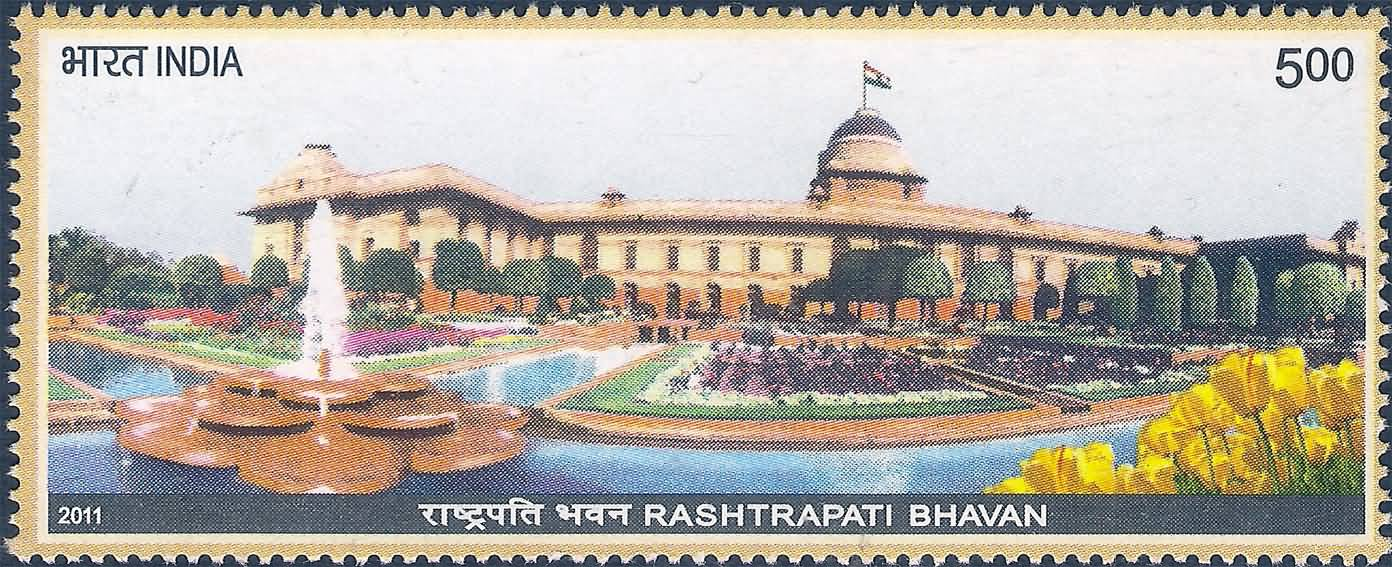
The Mughal Gardens of Rashtrapati Bhavan are a tribute to geometrical precision, symmetry, and the Mughal love for water channels and fountains. The East Lawn and Central Lawn, each measuring approximately 125 feet by 100 feet, are laid out with intersecting water channels running north–south and east–west, dividing the garden into a grid of squares.
At the intersections of these channels are six lotus-shaped fountains, while rectangular lawns with flower beds and canopied trees line the pathways. Beyond the main lawns lies the Circular Garden, centred around a round pool and bordered by concentric rings of flowers. The gardens reach their peak beauty during February and March, when they are opened to the public.
Commemorative Stamp Issue
As New Delhi celebrated its centenary and Rashtrapati Bhavan completed eighty years of its existence, the Department of Posts commemorated this milestone with the issuance of a set of four commemorative postage stamps. These stamps celebrate the architectural magnificence, historical importance, and enduring national symbolism of Rashtrapati Bhavan and its gardens.
First Day Cover
Leave a Comment
You must be logged in to post a comment.