
Centenary of The Corps of Signals of the Indian Army
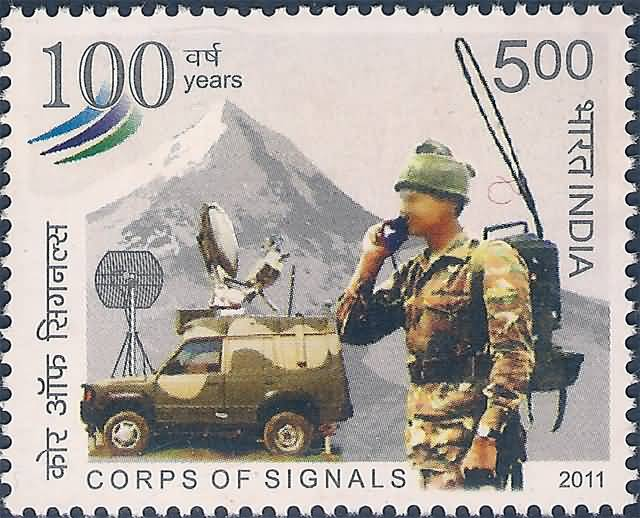
Technical Data
| Date of Issue | February 4, 2011 |
|---|---|
| Denomination | Rs. 5 |
| Quantity | 300,000 |
| Perforation | 13 |
| Printer | Security Printing Press, Hyderabad |
| Printing Process | Wet Offset |
| Watermark | No Watermark |
| Colors | Multicolor |
| Credit (Designed By) | Sh. Sankha Samanta |
| Catalog Codes |
Michel IN 2551 Stamp Number IN 2488 Yvert et Tellier IN 2314 Stanley Gibbons IN 2793 WADP Numbering System - WNS IN005.2011 |
| Themes | Anniversaries and Jubilees | Army | Cars | Military Forces | Vehicles |
The Communication Arm of the Indian Army
Role of Communications in Warfare
Communications have always played a vital role in warfare, forming the nervous system of armies across the world. From early methods such as smoke signals, human runners and carrier pigeons to telegraphy, wireless communication, and today’s information-age networks, the evolution of military communications has been dramatic and revolutionary.
Evolution of the Corps of Signals
The Corps of Signals of the Indian Army, with its dedicated band of officers and men, has continuously assimilated emerging technologies over the years. This has enabled the Corps to develop into a highly efficient networking force, comparable with the best communication arms in the world.
Founder and Identity
The Corps traces its origin to Lt. Col. S. H. Powell of the Royal Engineers, who became the founder and first head of the Indian Signal Service, later redesignated as the Indian Signal Corps.
The motto of the Corps is “Teevra Chaukas”, meaning “Swift and Secure”. Its emblem depicts Mercury (Hermes), the Roman messenger of the gods, symbolising speed and communication. This emblem is also common to many armies of the Commonwealth nations, highlighting shared military heritage.
Operational Role and Technological Advancement
The primary role of the Corps of Signals is to provide secure, reliable and responsive strategic, operational and tactical communications to the Indian Army. The Corps spearheads the information technology revolution within the Army.
From early line and carrier systems, the Corps has progressed to state-of-the-art communication networks, employing advanced technologies such as:
- Fibre optic communication
- High-capacity switching systems
- Satellite and cellular communications
- Modern radio equipment
- Software Defined Radios (SDR)
This evolution reflects the Corps’ vision, determination and commitment to excellence.
Major Communication Networks
The personnel of the Corps, proudly known as “Information Warriors”, have successfully implemented several prestigious projects, including:
- Army Static Switched Communication Network (ASCON) – commissioned in 1995
- Army Wide Area Network (AWAN) – commissioned in 2006
These networks form the backbone of secure military communications across the nation.
Service Beyond the Battlefield
In addition to combat operations, signallers play a crucial role in out-of-area contingencies, disaster and flood relief operations, and other missions as aid to civil authorities. The Corps also contributes significantly to United Nations Peacekeeping Missions abroad, ensuring reliable communication in challenging environments.
Excellence in Sports
The Corps of Signals has an outstanding record in sports and athletics. It has produced numerous national and international level sportspersons, including Olympians, who have represented India in hockey, boxing, athletics, and other disciplines.
Centenary Celebrations
On 15 February 2011, the Corps of Signals proudly completed 100 years of distinguished service to the Armed Forces of India, marking a century of excellence in military communications.
Commemorative Postage Stamp
To honour its remarkable contribution to national defence and technological advancement, India Post is pleased to issue a commemorative postage stamp on the Corps of Signals.
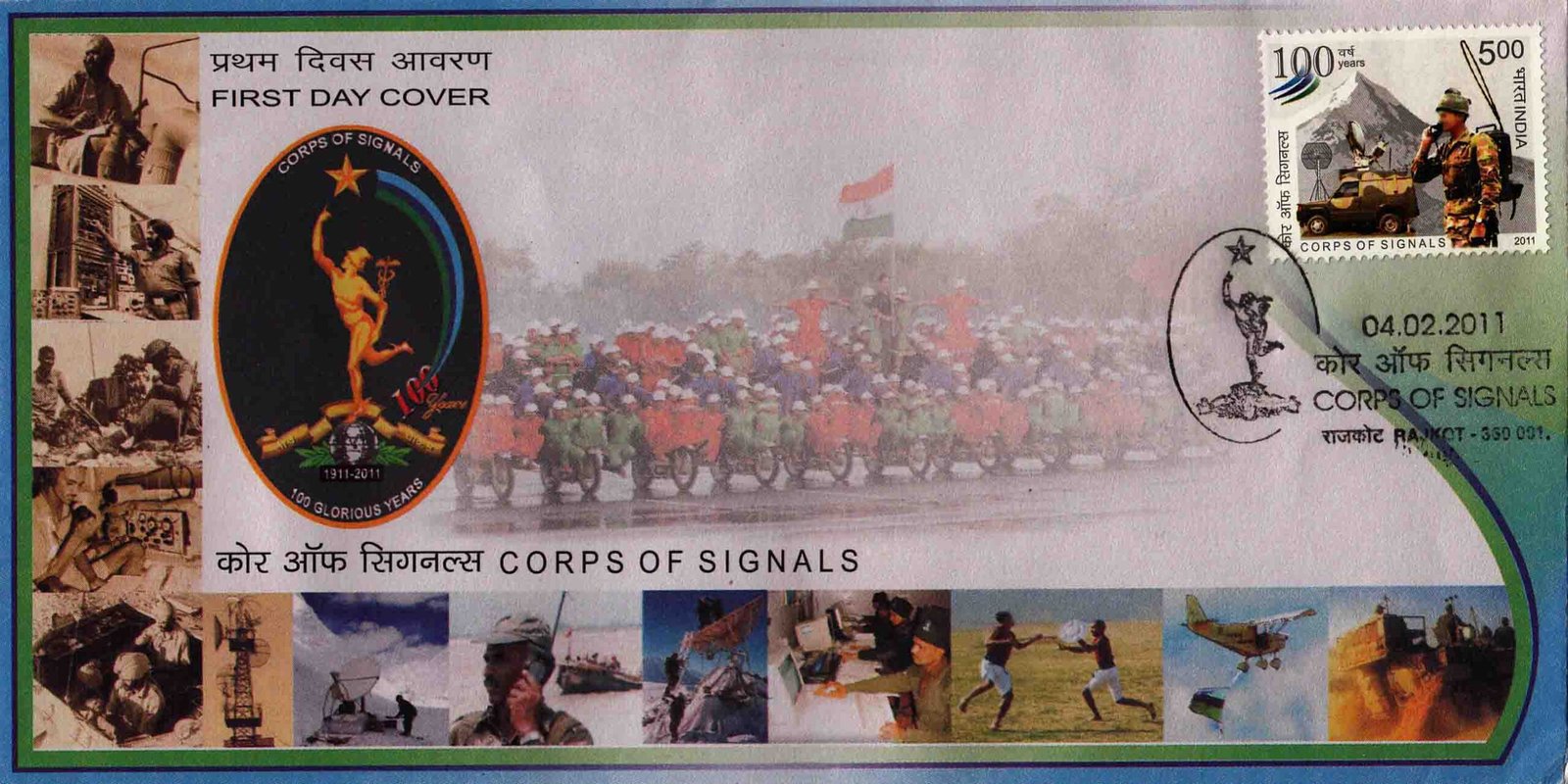
First Day Cover
Leave a Comment
You must be logged in to post a comment.