
Subhadra Joshi
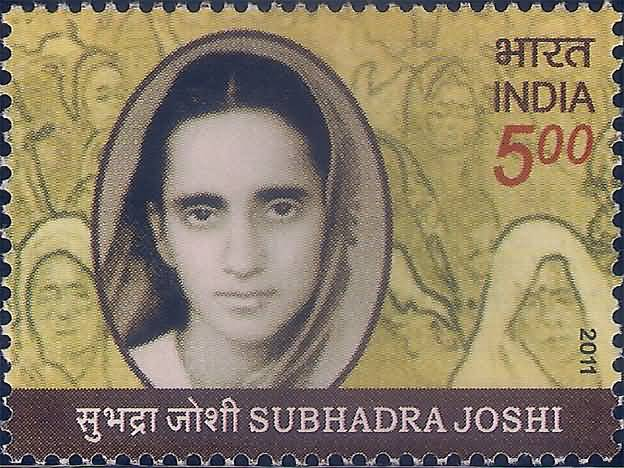
Technical Data
| Date of Issue | March 23, 2011 |
|---|---|
| Denomination | Rs. 5 |
| Perforation | 13 |
| Printer | India Security Press, Nashik |
| Printing Process | Offset Lithography |
| Watermark | No Watermark |
| Colors | Multicolor |
| Credit (Designed By) | Smt. Alka Sharma |
| Catalog Codes |
Michel IN 2596 Stanley Gibbons IN 2810 WADP Numbering System - WNS IN020.2011 |
| Themes | Anniversaries and Jubilees | Commemoration | Famous people | Politicians | Reformers | Women |
Freedom Fighter, Parliamentarian and Champion of Communal Harmony
Early Life
Subhadra Joshi was born on 23 March 1919 in a well-known family of Sialkot (now in Pakistan). From an early age, she was deeply influenced by ideals of nationalism, social justice and human equality, which later shaped her lifelong commitment to public service.
Participation in the Freedom Struggle
Inspired by Mahatma Gandhi, Subhadra Joshi visited his Wardha Ashram while she was a student in Lahore. She actively participated in the Quit India Movement of 1942, went underground, and edited the journal “Hamara Sangram”, which disseminated revolutionary ideas.
She was arrested and imprisoned in Lahore Central Jail. During this period, she also opened evening schools for Dalit children in Delhi, reflecting her commitment to social equality even amidst political turmoil.
Social Work and Communal Harmony
After her release, Subhadra Joshi worked among industrial labourers in Delhi. Her efforts to restore peace during the communal disturbances of 1946 in Delhi brought her to the attention of Mahatma Gandhi and Jawaharlal Nehru. Gandhiji sought daily situation reports from her, while Nehru openly admired her dedication and courage.
She organised a volunteer force called ‘Shanti Dal’, which went door-to-door spreading Gandhian ideals of peace, tolerance and brotherhood. She also played a significant role in the rehabilitation of evacuees from Pakistan after Partition.
Parliamentary Career and Legislative Contributions
Elected to Parliament for four consecutive terms, Subhadra Joshi made notable contributions to landmark legislations such as the Special Marriage Act, Nationalisation of Banks, Abolition of Privy Purses, and the Aligarh University Amendment Act.
Her most pioneering legislative effort was the amendment to the Criminal Procedure Code, which made organised propaganda that spreads fear or hatred among communities a cognizable offence—a decisive step in safeguarding communal harmony.
Upliftment of the Marginalised
Subhadra Joshi launched several welfare initiatives aimed at empowering the weaker sections of society. These included cooperative societies for food-grain distribution at controlled prices, rickshaw pullers, coffee workers, and organisations for the deaf and dumb. She also founded the Delhi Mahila Samaj Trust to support destitute women.
She was the Founder President of the All India Newspaper Employees Federation, advocating for the rights and welfare of media professionals.
Crusade for Secularism and National Integration
Her most enduring contribution was in the field of national integration and communal harmony. She consistently stood above religious and caste divisions, striving for peaceful coexistence. During communal riots in Jabalpur, Hyderabad, Ahmedabad, and during the disturbances of 1984, she personally visited affected areas to help restore peace and confidence.
In 1962, she established the All India Sampradayik Virodhi Committee to counter communal and divisive forces. She also launched the monthly journal “Secular Democracy” and later headed the Qaumi Ekta Trust as its Chairperson. Through publications, seminars, cultural programmes and workshops, she inspired youth to actively defend secular values.
A memorial building, Ganesh Shankar Vidyarthi Bhawan, named after the first martyr for communal harmony, was constructed as a nodal centre for these activities.
Legacy
Subhadra Joshi was admired across political lines. Indira Gandhi described her as “one of the few women in Delhi for whom I have immense admiration and respect.” She passed away on 29 October 2003, leaving behind a legacy of courage, compassion and unwavering commitment to secularism.
Commemoration
In recognition of her invaluable contribution to India’s freedom struggle, social justice, and communal harmony, India Post is pleased to issue a Commemorative Postage Stamp on Subhadra Joshi.
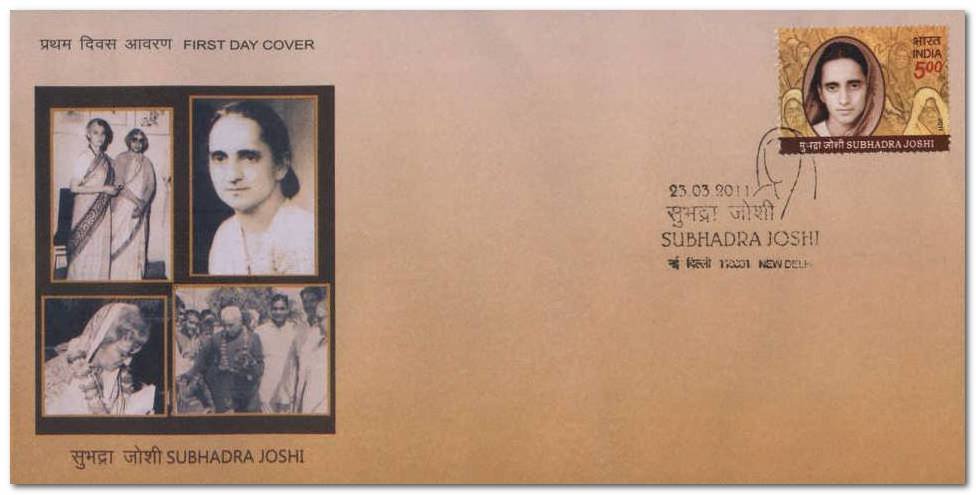
First Day Cover
Leave a Comment
You must be logged in to post a comment.