
Dr. Daulat Singh Kothari
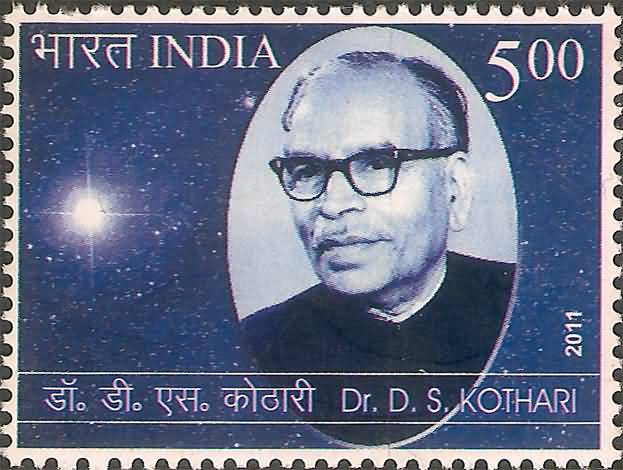
Technical Data
| Date of Issue | July 6, 2011 |
|---|---|
| Denomination | Rs. 5 |
| Quantity | 300,000 |
| Perforation | 13½ |
| Printer | Security Printing Press, Hyderabad |
| Printing Process | Wet Offset |
| Watermark | No Watermark |
| Colors | Multicolor |
| Credit (Designed By) | Ms. Nenu Gupta |
| Catalog Codes |
Michel IN 2603 Yvert et Tellier IN 2336 Stanley Gibbons IN 2819 WADP Numbering System - WNS IN027.2011 |
| Themes | Anniversaries and Jubilees | Commemoration | Famous people | Men | Optical Instruments | Scientists | Teachers |
Eminent Scientist, Educationist and Visionary Reformer
Early Life and Education
Daulat Singh Kothari was born on 6 July 1906 at Udaipur to Shri Fateh Lal Kothari, a school teacher. After his father’s untimely death in 1918, he was brought up by his mother, a devout and generous lady who played a pivotal role in shaping his character.
After completing his early education in Udaipur, he went to Indore for his matriculation and later returned to Udaipur for further studies. In recognition of his outstanding performance in the Intermediate Examination in 1924, the Maharana of Mewar awarded him a monthly scholarship of Rs. 50. He completed his B.Sc. from Allahabad University in 1926 with distinction under the guidance of the eminent physicist Prof. Meghnad Saha, and went on to obtain his M.Sc. in 1928, specialising in Wireless (Electronics).
Academic Career and Research
Owing to his brilliant academic record, Dr. Kothari was appointed as a Demonstrator in the Department of Physics at Allahabad University. After two years, he proceeded to England for higher studies on a scholarship from the United Province and an interest-free loan from the Mewar State Government. He completed his Ph.D. under the supervision of Lord Ernest Rutherford at the Cavendish Laboratory, Cambridge.
In May 1934, Dr. Kothari joined Delhi University as Reader and Head of the Department of Physics, at a time when the University was still in its formative years. He introduced modern experiments, improved laboratory facilities, strengthened the library, invited eminent physicists for lectures and established an active research group. He also played a key role in starting the M.Sc. Physics programme at Delhi University.
Dr. Kothari published numerous research papers in physics and astrophysics, and his pioneering work on pressure ionisation received international acclaim and found wide-ranging applications.
Service to Defence Science
In 1948, Dr. Kothari was appointed Scientific Adviser to the Ministry of Defence, Government of India. During his tenure, he was instrumental in establishing several laboratories under the Defence Science Organisation, laying the foundation for indigenous defence research. He served in this crucial position until 1961.
Architect of Educational Reforms
In 1961, Dr. Kothari became Chairman of the University Grants Commission (UGC) and made significant contributions to strengthening higher education in the country. In 1964, the Government of India appointed him Chairman of the Indian Education Commission. The Commission’s report (1964–66), widely known as the Kothari Commission Report, provided a comprehensive blueprint for the future development of education in India.
He was closely associated with the National Council of Educational Research and Training (NCERT) and redefined its role and functions. His vision also led to the formulation of improved examination and selection processes for central services, and the launch of the National Talent Search Programme.
National and International Contributions
Dr. Kothari served in several prestigious positions, including Chairman of the UNESCO Institute of Education, Hamburg, President of the Jawaharlal Nehru Memorial Fund, President of the Indian National Science Academy, and General President of the Indian Science Congress (1963). In 1974, he was appointed Chairman of the UPSC Committee on Recruitment Policy and Selection Methods.
Honours and Legacy
In recognition of his outstanding contributions to science and education, Dr. Kothari was awarded the Padma Bhushan in 1962 and the Padma Vibhushan in 1973.
Dr. Daulat Singh Kothari passed away on 4 February 1993, leaving behind a legacy as one of India’s most influential scientists and education reformers.
Commemoration
In honour of his remarkable service to the nation in the fields of science, defence research and education, the Department of Posts is pleased to issue a Commemorative Postage Stamp on Dr. Daulat Singh Kothari.
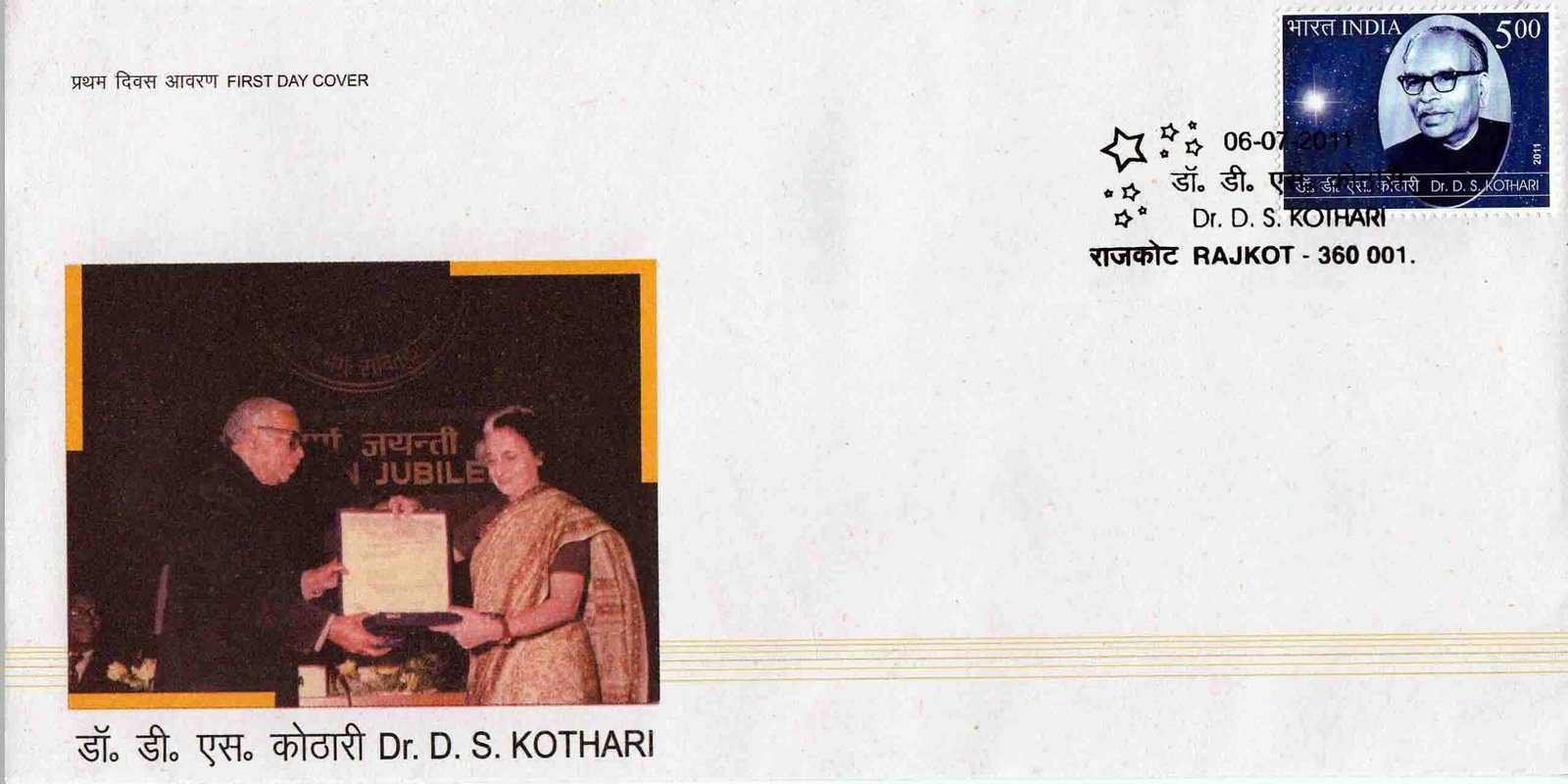
First Day Cover
Leave a Comment
You must be logged in to post a comment.