
Pandit K. Santanam
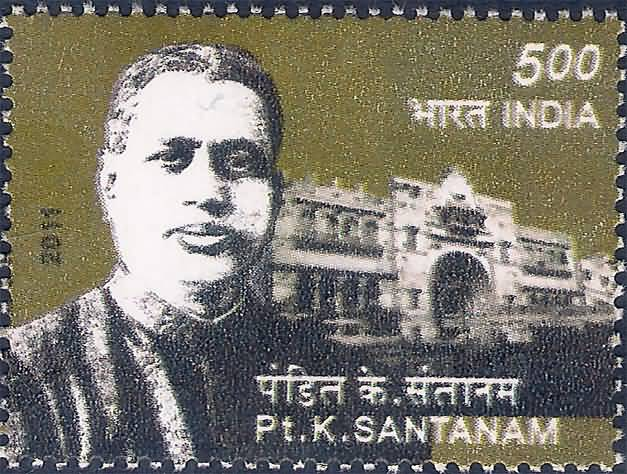
Technical Data
| Date of Issue | August 25, 2011 |
|---|---|
| Denomination | Rs. 5 |
| Quantity | 300,000 |
| Perforation | 13 |
| Printer | India Security Press, Nashik |
| Printing Process | Offset Lithography |
| Watermark | No Watermark |
| Colors | Multicolor |
| Credit (Designed By) | Smt. Alka Sharma Smt. Madhu Chawdhary |
| Catalog Codes |
Michel IN 2612 Stanley Gibbons IN 2829 WADP Numbering System - WNS IN032.2011 |
| Themes | Buildings | Businessman | Famous people | Men | Politicians |
Freedom Fighter, Jurist and Visionary Nationalist
Early Life and Education
Pandit K. Santanam was born on 25 August 1885 to A. Krishnamachari Iyengar, the then Dewan of Mysore. Orphaned at a young age, he was sent to live with relatives in Kumbakonam, Tamil Nadu, where he completed his schooling and collegiate education.
An exceptionally bright student, Santanam pursued post-graduation in Economics at Madras Presidency College, graduating with distinction and earning a Gold Medal. Awarded a scholarship, he travelled to England to study law at King’s College, Cambridge, and qualified as a Barrister in 1910.
Legal Career in Lahore
On returning to India, Pt. K. Santanam chose to practice law at the Lahore High Court, where he quickly gained recognition for his legal acumen. His career as a lawyer coincided with a turbulent phase in India’s freedom struggle, during which he demonstrated exceptional courage and commitment to justice.
Role after the Jallianwala Bagh Massacre
Following the Jallianwala Bagh massacre of 1919, Santanam undertook a bold and dangerous mission. Despite strict Martial Law prohibiting movement outside Amritsar, he managed to slip out and personally brought details of the atrocities committed in Punjab to the attention of the Viceroy’s Executive Council. He also assisted Mahatma Gandhi in drafting the inquiry report into the massacre, contributing significantly to exposing colonial brutality.
Participation in the Freedom Movement
After nearly a decade of legal practice, Pt. Santanam made a historic decision to abandon his profession in response to Gandhiji’s call to boycott law courts and British institutions. He became an active participant in the Non-Cooperation Movement and was arrested on 2 December 1921, alongside Lala Lajpat Rai.
Following his release, he taught at the National College, an institution founded by Lalaji to promote nationalist education. Santanam went on to hold several responsible positions within the Indian National Congress and actively participated in the Salt Satyagraha Movement, reinforcing his commitment to India’s freedom.
Entrepreneurial Vision: Lakshmi Insurance Company
In 1924, inspired by Lala Lajpat Rai, Pt. K. Santanam founded the Lakshmi Insurance Company, with its headquarters in Lahore. The company emerged as one of the most successful indigenous insurance enterprises of its time and became Punjab’s second-largest life insurance company, as recorded in “Life Insurance in India – Its History, Law, Practice and Problems” by R. M. Ray. Several buildings associated with the company still stand in present-day Pakistan, bearing testimony to this pioneering venture.
Progressive Thinker and Social Reformer
Pt. K. Santanam was known for his progressive outlook and reformist beliefs. He rejected the rigid caste system, opposed regressive rituals, and championed rational thought and equality. His life reflected a rare synthesis of legal brilliance, nationalist zeal, social reform, and entrepreneurial foresight.
Legacy and Remembrance
Pandit K. Santanam passed away on 30 August 1949, leaving behind a legacy of service to the nation that spanned law, freedom struggle, education, and enterprise.
Commemorative Postage Stamp
In recognition of his invaluable contributions to India’s freedom movement and nation-building, the Department of Posts proudly issues a Commemorative Postage Stamp on Pandit K. Santanam, honouring a life dedicated to courage, conscience, and country.
First Day Cover

Leave a Comment
You must be logged in to post a comment.