
Dev Narayan
Technical Data
| Date of Issue | September 7, 2011 |
|---|---|
| Denomination | Rs. 5 |
| Quantity | 300,000 |
| Perforation | 13½ |
| Printer | Security Printing Press, Hyderabad |
| Printing Process | Wet Offset |
| Watermark | No Watermark |
| Colors | Multicolor |
| Credit (Designed By) | Smt. Alka Sharma |
| Catalog Codes |
Michel IN 2615 Stanley Gibbons IN 2832 WADP Numbering System - WNS IN039.2011 |
| Themes | Animals (Fauna) | Folklore | Gods and goddesses | Horses | Mammals |
The Revered Folk-Deity of Rajasthan and Malwa
Folk Traditions of Devotion
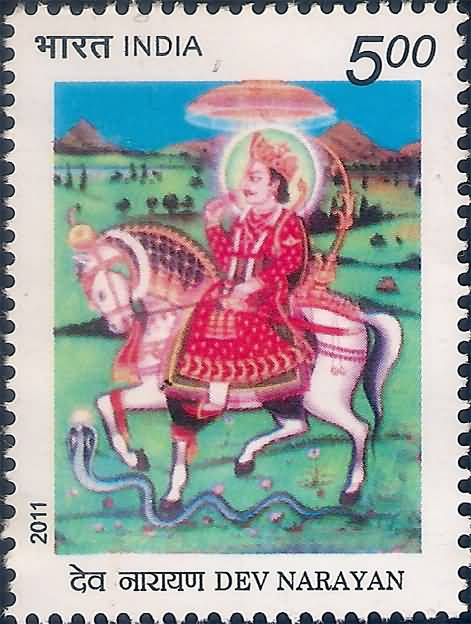
Dev Narayan is a widely revered folk-deity of Rajasthan and north-west Madhya Pradesh, worshipped particularly by pastoral and agrarian communities. His life and deeds, rooted in valour, justice, and divine intervention, form an important part of the region’s rich oral and visual folk traditions.
Birth and Historical Context
According to popular belief, Dev Narayan was born in 911 AD to Shri Savai Bhoj, a Bagaravat chieftain, and Sadu Mata Gurjari. Some historians, however, place his lifetime between 1200 and 1400 AD. Despite variations in chronology, Dev Narayan’s legend remains deeply embedded in the collective memory of the people.
Death of Savai Bhoj and Sadu Mata’s Penance
Shri Savai Bhoj was killed in a fierce battle by the Rana, the King of Ran city. Grief-stricken, Sadu Mata performed intense penance for eleven days on a hill near the battlefield. As a result of this devotion, she gave birth to Dev Narayan. Fearing further danger, she fled to her maternal home in Malwa, where Dev Narayan spent his childhood, unaware of his lineage and destiny.
Awakening to His Destiny
Years later, Chochu Bhat, the bard and genealogist of the 24 Bagaravat clans, traced Dev Narayan and narrated the tragic tale of the Bagaravats and the death of his father. Deeply moved, Dev Narayan resolved to avenge the injustice, despite his mother’s reluctance.
Battle with the Rana and Divine Mercy
Dev Narayan reunited with his cousins, and together they waged war against the Rana. In the battle, the Rana was defeated and beheaded by Dev Narayan’s bow string. However, one of Dev Narayan’s cousins, who had been adopted by the Rana, mourned his foster father. Moved by compassion, Dev Narayan revived the Rana and instructed him to establish the city of Udaipur, demonstrating both justice and mercy.
Family Life and Ascension
Dev Narayan later married Queen Pipalde, who bore him a son and a daughter. Initially, his son failed to recognise Dev Narayan’s divine stature, but later realised his father’s greatness. He accepted the responsibility of tending to the first temple of Dev Narayan after Dev Narayan departed for his heavenly abode.
Dev Narayan Katha and the Phad Tradition
The life and exploits of Dev Narayan are preserved through the Dev Narayan Katha, sung by Bhopas, the traditional priest-singers. These performances take place at night, from November to July, across villages of Rajasthan and Malwa.
The narration is accompanied by a Phad, a large painted cloth scroll—often 30 feet long—depicting scenes from Dev Narayan’s life in vibrant colours. The epic is divided into two main parts:
- Bagaravat Bharata
- Dev Narayan Katha
Commemorative Postage Stamp
Honouring the enduring cultural, spiritual, and artistic legacy of this revered folk deity, the Department of Posts is pleased to issue a Commemorative Postage Stamp on Dev Narayan, celebrating a tradition that continues to inspire devotion and preserve Rajasthan’s vibrant folk heritage.
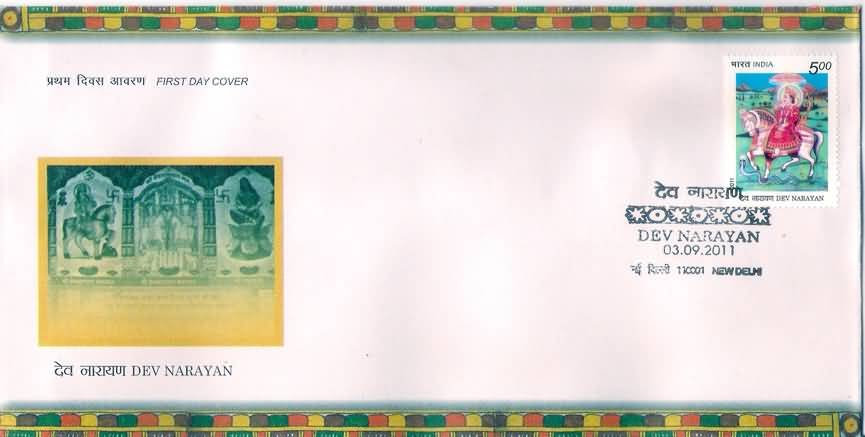
First Day Cover
Leave a Comment
You must be logged in to post a comment.