
Tejaji Maharaj
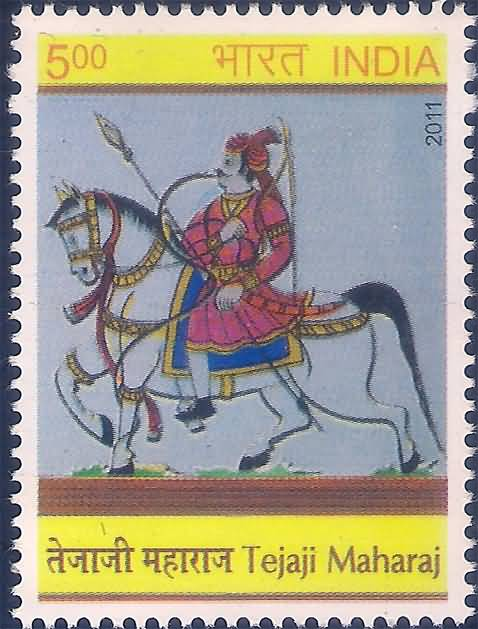
Technical Data
| Date of Issue | September 7, 2011 |
|---|---|
| Denomination | Rs. 5 |
| Quantity | 300,000 |
| Perforation | 13 |
| Printer | Security Printing Press, Hyderabad |
| Printing Process | Wet Offset |
| Watermark | No Watermark |
| Colors | Multicolor |
| Credit (Designed By) | Ms. Nenu Gupta |
| Catalog Codes |
Michel IN 2616 Stanley Gibbons IN 2833 WADP Numbering System - WNS IN040.2011 |
| Themes | Animals (Fauna) | Folklore | Gods and goddesses | Horses | Mammals |
The Folk-Deity and Warrior Hero of Rajasthan
Rajasthan’s Tradition of Folk Heroes
Rajasthan is a land rich in folk legends and heroic sagas, shaped during an era when small clans ruled under local chieftains. Frequent conflicts demanded courage, loyalty, and an unflinching sense of honour from these leaders. Many such warriors became symbols of bravery and self-sacrifice, revered by the people and eventually worshipped as folk-deities.
Among these legendary figures, Veer Teja, popularly known as Tejaji Maharaj, occupies a special place in the cultural and spiritual life of Rajasthan and parts of Madhya Pradesh.
Birth and Early Life of Tejaji
According to legend, Tejaji was born on 29 January 1074 at Khinal village in the Nagaur district of Rajasthan. He was the son of Chaudhary Tahar and Smt. Sugna. From an early age, Tejaji displayed courage, integrity, and a deep sense of duty towards his people.
The Ploughing Ritual and Turning Point
It was customary for clan chieftains to ceremonially initiate the first ploughing of fields after the monsoon rains. In the absence of his father and elder brother, Tejaji’s mother entrusted him with this honour. While engaged in ploughing, a delay in bringing his meal by his sister-in-law led to a sharp exchange, during which she advised him to bring his wife from her maternal home at Paner.
The Fateful Journey to Paner
The very next day, Tejaji set out for Paner, overcoming numerous hardships along the way. He reached the village by evening, unknowingly disturbing his mother-in-law while she was milking her cows. Unaware of his identity, she uttered a curse in irritation. Offended, Tejaji turned back without revealing himself.
However, Laccha Gurjari, a messenger sent by his wife, persuaded him to stay and assist in recovering cattle stolen by dacoits.
Martyrdom and Legend
Tejaji confronted the dacoits with exceptional bravery. One legend narrates that he was killed in the fierce battle that followed. Another version says that after successfully retrieving the cattle, Tejaji succumbed to a snake bite, believed to be the result of his mother-in-law’s curse.
Regardless of the version, his valour, righteousness, and self-sacrifice left an indelible mark on the collective memory of the people.
Worship and Cultural Legacy
Tejaji’s heroic life transformed him into a folk-deity, worshipped for protection, courage, and justice. Numerous Tejaji temples dot the landscape of Rajasthan, and a grand annual fair is held in his honour, drawing thousands of devotees who celebrate his legacy through rituals, songs, and storytelling.
Commemorative Postage Stamp
Recognising the enduring cultural and spiritual significance of this legendary warrior, India Post is pleased to issue a Commemorative Postage Stamp on Tejaji Maharaj, honouring a folk hero whose courage and sacrifice continue to inspire generations.
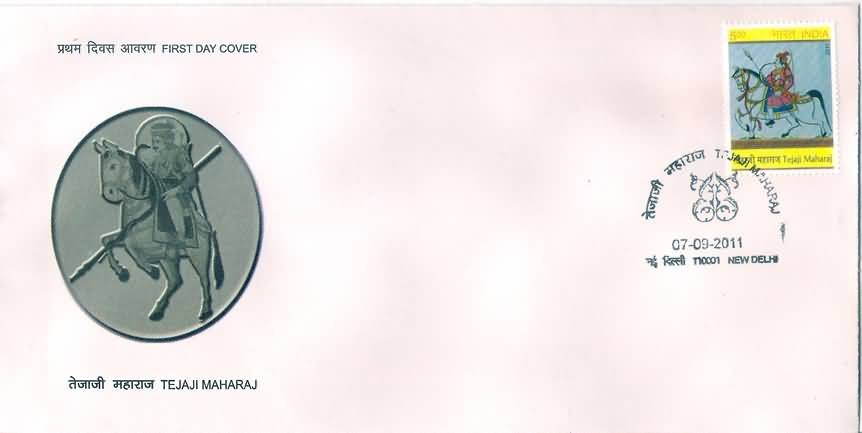
First Day Cover
Leave a Comment
You must be logged in to post a comment.