
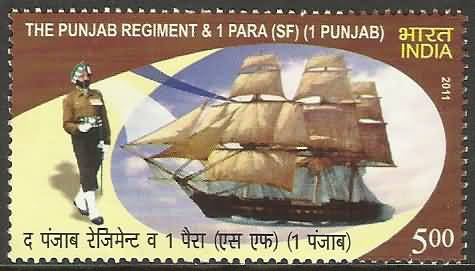
250th Anniversary of the Punjab Regiment and 1 Para
Technical Data
| Date of Issue | October 12, 2011 |
|---|---|
| Denomination | Rs. 5 |
| Quantity | 400,000 |
| Perforation | 13 |
| Printer | Security Printing Press, Hyderabad |
| Printing Process | Wet Offset |
| Watermark | No Watermark |
| Colors | Multicolor |
| Credit (Designed By) | Sh. Brahm Prakash Smt. Alka Sharma |
| Catalog Codes |
Michel IN 2621 Stanley Gibbons IN 2838 WADP Numbering System - WNS IN045.2011 |
| Themes | Anniversaries and Jubilees | Army | Military Forces | Sailing Ships | Ships |
Legacy of Valor and Excellence
Origins and Early History
The Punjab Regiment is one of the oldest and most distinguished infantry regiments of the Indian Army. Its lineage traces back to the Coastal Sepoys, later known as the Carnatic Battalions and subsequently the Madras Battalions. The first battalions were raised between 1761 and 1798, forming the foundation of what would become a regiment of exceptional repute.
Over the years, these units underwent several reorganizations and redesignations. In 1903, they emerged as the 67th, 69th, 72nd, 74th and 87th Punjab. These battalions later came to be known collectively as the 2nd Punjab Regiment, with recruitment confined to the Punjab region.
Formation of 1 PARA (Special Forces)
The illustrious 1 PARA (Special Forces) traces its origin to 1761, when it was raised at Trichinopoly as the 8th Battalion Coast Sepoys. It underwent numerous redesignations, including 7th Carnatic, 7th Madras Native Infantry, 67th Punjab, 1/2nd Punjab Regiment, and 1st Battalion, Punjab Regiment.
In 1952, the battalion was converted to 1 PARA (Punjab) and later redesignated as 1 PARA (Commando) in 1978. In 1996, it achieved the unique distinction of being converted into a Special Forces unit, earning its present designation as 1 PARA (Special Forces)—a symbol of elite combat capability and unmatched professionalism.
Reorganization and Expansion
Following the reorganization of 1922, the battalions were renumbered as 1/2nd, 2/2nd, 3/2nd, 4/2nd, 5/2nd and 10/2nd Punjab, all forming part of the 2nd Punjab Regiment. A Training Battalion was also raised to support regimental growth.
During World War II, the Regiment expanded significantly with the raising of additional battalions numbered 6, 7, 8, 25, 26 and 27 Punjab. To meet the growing demand, the Training Battalion was expanded and became the 1st Regimental Centre. In 1940, it was redesignated as the 2nd Punjab Regiment Centre, and after Independence, it became the Punjab Regiment Centre.
Post-Independence Developments
In 1953, the forces of the erstwhile PEPSU (Patiala & East Punjab Union)—including Jind, Nabha Akal and Patiala Battalions—were merged into the Punjab Regiment. The Regiment also holds the unique honour of contributing:
- 1st Battalion to the Parachute Regiment,
- 2nd Battalion to the Brigade of Guards, and
- 7th Battalion to the Mechanised Infantry.
Battle Honours and Decorations
The Punjab Regiment is among the most decorated regiments of the Indian Army, having earned:
- 35 pre-Independence and 41 post-Independence battle honours,
- 8 COAS Unit Citations and 13 Army Commander Unit Citations.
Individual gallantry awards include 747 pre-Independence and 1,388 post-Independence decorations, featuring 6 PVSM, 18 MVC, 11 KC, 2 UYSM, 9 AVSM, 58 VrC, and 55 SC.
Regimental Insignia and Centre
The Regiment’s insignia is a Galley, an ancient Greek or Roman warship. Remarkably, it is perhaps the only infantry regiment in the world with a naval vessel as its emblem, symbolizing strength, endurance, and heritage.
The Punjab Regiment Centre is located at Ramgarh Cantonment, Jharkhand.
Commemorative Postage Stamp
In recognition of their extraordinary service, historic legacy, and unparalleled contribution to the nation’s defence, India Post is proud to issue a Commemorative Postage Stamp on The Punjab Regiment & 1 PARA (Special Forces) (1 Punjab).
First Day Cover

Leave a Comment
You must be logged in to post a comment.