
150th Birth Anniversary of Madan Mohan Malaviya
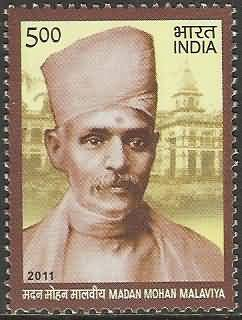
Technical Data
| Date of Issue | December 27, 2011 |
|---|---|
| Denomination | Rs. 5 |
| Quantity | 300,000 |
| Perforation | 13 |
| Printer | India Security Press, Nashik |
| Printing Process | Wet Offset |
| Watermark | No Watermark |
| Colors | Multicolor |
| Credit (Designed By) | Sh. Sankha Samanta |
| Catalog Codes |
Michel IN 2637 Stanley Gibbons IN 2856 WADP Numbering System - WNS IN061.2011 |
| Themes | Commemoration | Education | Famous people | Headgear | Men |
Early Life and Education
Madan Mohan Malaviya was born on 25 December 1861 in Allahabad into a family renowned for its scholarship and learning. A diligent and gifted student, Malaviya excelled during his school and university education. His early exposure to classical learning and national concerns shaped his lifelong commitment to public service and nation-building.
Entry into Public Life and Journalism
Malaviya first gained national attention as a young patriot when he delivered a powerful speech at the Indian National Congress session in Calcutta in 1886. Returning to Allahabad, he began his career in journalism, serving as the editor of the Hindi weekly Hindustan and later Indian Union. He firmly believed in the power of the press as a tool for public education and national awakening.
Role in the Indian National Congress
From 1886 onwards, Malaviya participated regularly in the annual Congress sessions and gradually emerged as a respected leader and opinion maker. His growing stature in public life led to his election to the Provincial Legislative Council in 1902 and the Imperial Legislative Council in 1909. He articulated Indian concerns on vital issues such as free and compulsory primary education, abolition of indentured labour, and nationalization of railways, earning recognition as one of the most influential members of the Council.
Malaviya’s integrity and leadership led to his election as President of the Indian National Congress four times—in 1909, 1918, 1932 and 1933.
Hindu Mahasabha and National Unity
In 1906, Malaviya founded the Hindu Mahasabha, not as a sectarian organization but as a platform to counter the British policy of “divide and rule”. Despite this initiative, he remained a strong supporter of the Congress and was widely respected for his commitment to national unity.
Founder of Benaras Hindu University
One of Malaviya’s most enduring contributions was the establishment of the Benaras Hindu University (BHU) at Varanasi in 1916. The university reflected his vision of holistic education, combining science and technology with moral and spiritual values. Today, BHU stands as one of the largest residential universities in the world, with nearly 20,000 students, including 2,500 research scholars and 650 foreign students from 34 countries.
Social Reformer and Advocate of Equality
Malaviya was deeply committed to social reform. He spoke strongly against injustice towards the depressed classes and supported efforts to improve the status of women in society. His reformist outlook was rooted in compassion, moral conviction, and national progress.
Champion of Indian Journalism
An early advocate of Indian-language journalism, Malaviya founded several influential journals, including Abhyudaya and Maryada in Hindi, and The Leader in English. He served as Chairman of the Board of Directors of the Hindustan Times from 1924 to 1946, guiding one of India’s leading newspapers during a crucial period of the freedom struggle.
Legislative Career and Freedom Struggle
Between 1924 and 1930, Malaviya played an active role as a Member of the Central Legislative Assembly. He was imprisoned twice by the British during the Civil Disobedience Movement (1930–1932). In 1931, he participated as a delegate in the Second Round Table Conference in London, but returned dissatisfied with the British government’s approach to Indian aspirations.
Though gentle and humble by nature, Malaviya was firm in matters of principle. He openly differed with Mahatma Gandhi on issues such as the boycott of educational institutions and resigned from the Congress Parliamentary Board in 1934 over the Communal Award.
Legacy and Commemoration
Jawaharlal Nehru aptly described Madan Mohan Malaviya as “a giant among men and one of the foundation-layers of Indian nationalism.” His contributions to education, journalism, social reform, and the freedom movement remain deeply embedded in India’s national life.
Commemorative Postage Stamp
In grateful remembrance of this great son of India, the Department of Posts has issued a Commemorative Postage Stamp to mark the 150th birth anniversary of Madan Mohan Malaviya, honouring his enduring legacy and invaluable service to the nation.
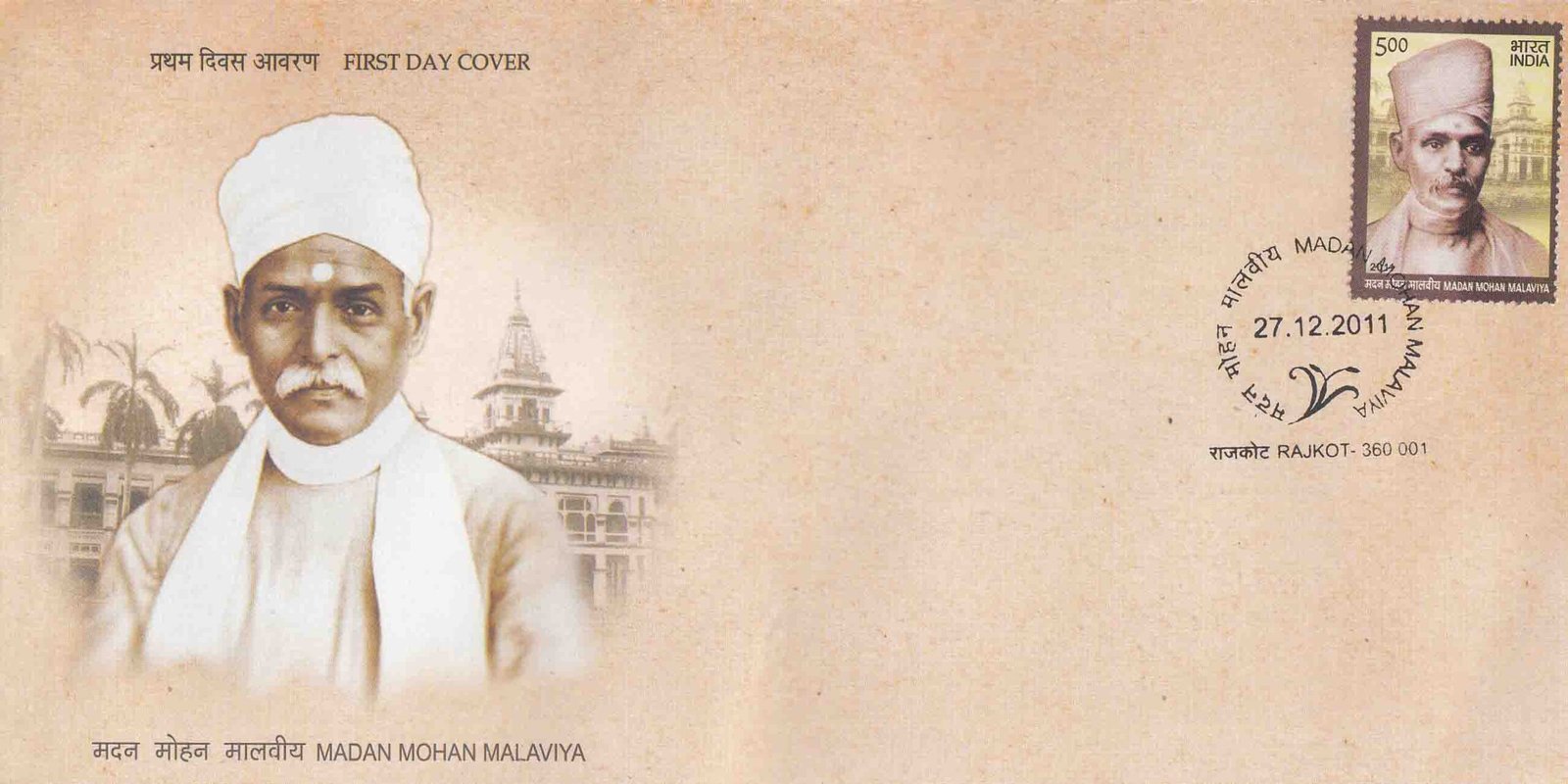
First Day Cover
Leave a Comment
You must be logged in to post a comment.