
Civil Aviation Centenary
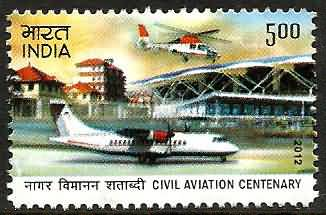
Technical Data
| Date of Issue | March 14, 2012 |
|---|---|
| Denomination | Rs. 5 |
| Quantity | 400,000 |
| Perforation | 13 |
| Printer | India Security Press, Nashik |
| Printing Process | Wet Offset |
| Watermark | No Watermark |
| Colors | Multicolor |
| Credit (Designed By) | Shri Kamleshwar Singh |
| Catalog Codes |
Michel IN 2645 Stamp Number IN 2569 Stanley Gibbons IN 2864 WADP Numbering System - WNS IN010.2012 |
| Themes | Aircraft | Anniversaries and Jubilees | Aviation | Helicopters |
Beginnings of Civil Aviation
Civil Aviation in India began on 18th February, 1911, when a French pilot, Monseigneur Piguet, undertook the first commercial flight in the country. This historic flight covered a distance of about 10 kilometres from Allahabad to Naini and was undertaken for carrying mail. This modest beginning marked the foundation of a sector that would later become a vital component of India’s infrastructure and economic growth.
Early Expansion and First Air Routes
The growth of civil aviation gathered pace with the opening of the first domestic air route between Karachi and Delhi in December 1912. This service was operated by the Indian State Air Services in collaboration with the UK-based Imperial Airways, laying the groundwork for organized air transport in the subcontinent.
Role of J.R.D. Tata and Nationalisation
A major milestone was achieved in 1932, when J.R.D. Tata founded Tata Airlines, which later evolved into Air India, the national carrier of independent India. To further strengthen the aviation sector, the Government of India established Air India International as a joint sector company in early 1948.
Subsequently, under the Air Corporations Act, 1953, nine existing airline companies were nationalised, giving structured shape to civil aviation in the country.
Liberalisation and Open Sky Policy
With the onset of economic liberalisation in the 1990s, the Government adopted the Open Sky Policy. This policy was extended in 1994, ending the monopoly of Indian Airlines and Air India. The Air Corporations Act, 1994 allowed private operators to enter the sector, bringing competition, efficiency and wider choice for passengers.
Aviation as a Catalyst for Development
Aviation is a critical component of national infrastructure. In India, it has played a significant role in promoting tourism, trade and business, opening up remote and inaccessible regions, and stimulating overall economic growth. While air travel was once perceived as a luxury for the elite, it is now widely recognized as an essential mode of connectivity within the country and with the rest of the world.
Modern Growth and Transformation
Today, the Indian aviation industry is among the fastest growing in the world. Over the past two decades, it has witnessed remarkable transformation with:
- Modernised, world-class airport terminals
- Sophisticated aircraft and advanced equipment
- Multiple airline options offering affordable air travel
This growth has made air travel accessible to a much larger section of society.
Commemorative Postage Stamp
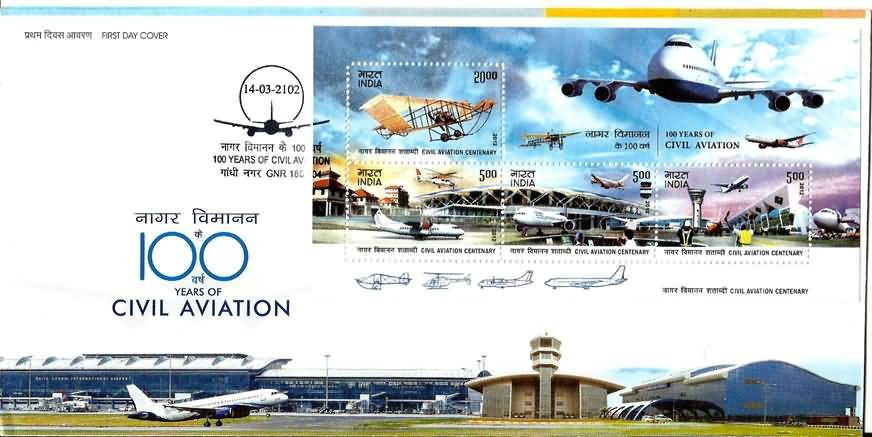
The Department of Posts commemorates 100 years of Civil Aviation in India by issuing a Commemorative Postage Stamp. The design depicts the remarkable journey of Indian civil aviation from the first commercial flight in 1911 to its present-day ubiquitous presence across the country, marked by world-class airports and modern aviation facilities.
First Day Cover
Leave a Comment
You must be logged in to post a comment.