
100 Years of Mahatma Gandhi’s Return
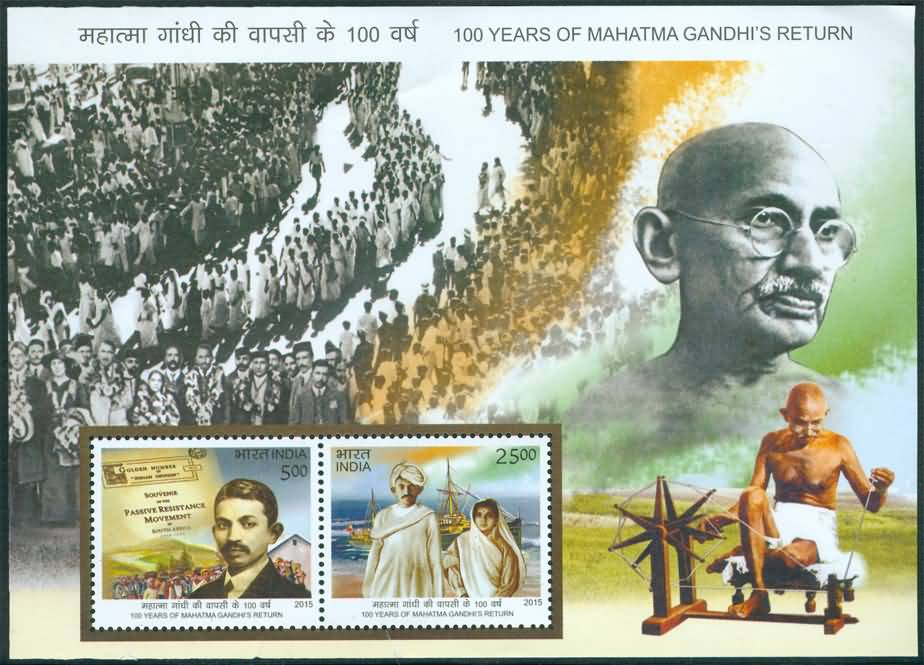
Technical Data
| Date of Issue | January 8, 2015 |
|---|---|
| Denomination | Rs. 30 |
| Quantity | 500,000 |
| Perforation | 13 |
| Printer | Security Printing Press, Hyderabad |
| Printing Process | Wet Offset |
| Watermark | No Watermark |
| Colors | Multicolor |
| Credit (Designed By) | Sh. Sankha Samanta Smt. Alka Sharma |
| Catalog Codes |
Michel IN BL126 Stamp Number IN 2714a Yvert et Tellier IN BF114 Stanley Gibbons IN MS3034 |
| Themes | Anniversaries and Jubilees | Famous people | Freedom Fighters | Men | Optical Instruments | Teachers | Women |
Stamps in this Miniature Sheet
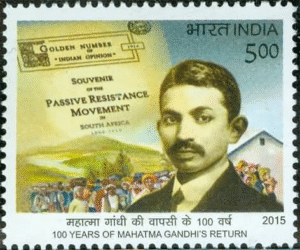
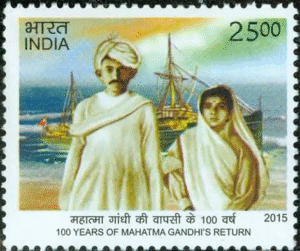
Mahatma Gandhi: The Visionary Leader of Non-Violence
A Man of Extraordinary Courage and Vision
Mahatma Gandhi stands as one of the greatest leaders in world history—a visionary whose moral strength, simplicity, and unwavering courage transformed the course of nations. His political activism laid the foundation for his return to India, where he emerged as the guiding force behind the struggle for freedom from British rule. As the architect of modern civil disobedience, Gandhi’s influence extended far beyond India, shaping global movements for justice and equality.
Early Years in South Africa: The Making of the Mahatma
In 1893, Gandhi arrived in South Africa as a young lawyer on a temporary assignment to represent an Indian merchant in a commercial dispute. What began as a brief professional engagement evolved into a 21-year mission that transformed him into the “Mahatma,” or “Great Soul.”
During his stay, Gandhi worked tirelessly to defend the rights of the Indian community. He:
- Drafted petitions and memoranda
- Led delegations
- Wrote extensively to the press
- Built public support in South Africa, India, and Britain
His legal practice gradually became devoted to securing justice for Indians facing discrimination under oppressive laws.
Birth of Satyagraha: A New Philosophy of Resistance
South Africa was the crucible in which Gandhi developed one of the world’s most powerful tools for social change—Satyagraha (truth-force). Rooted in non-violence and civil disobedience, Satyagraha encouraged peaceful marches, acceptance of arrest, and fearless defiance of unjust laws.
This groundbreaking method of resistance:
- Originated in South Africa
- Came to define India’s freedom struggle
- Inspired numerous global movements, including those led by Martin Luther King Jr. and Nelson Mandela
Satyagraha profoundly shaped 20th-century political thought, becoming a universal symbol of moral strength and peaceful protest.
A Crucial Phase in Gandhi’s Evolution
Gandhi’s years in South Africa played a decisive role in shaping his worldview. It was here that he refined his ethical beliefs, political principles, and leadership style. The experiences he gained became the foundation for his future role as the moral and political leader of India’s independence movement.
Return to India: Leadership Rooted in Non-Violence
On 9 January 1915, Gandhi returned to India and soon became a central figure in the national movement. He supported the Home Rule Movement and later took leadership of the Indian National Congress.
He promoted:
- Non-violent non-cooperation
- Boycott of unjust systems
- Mass participation in peaceful protest
His mission focused especially on the plight of farmers, laborers, and the poor, aiming to free them from oppressive taxation and discrimination. Through his unique leadership, he united millions across regions, castes, and communities in the quest for Swaraj—self-rule.
A Legacy of Truth and Non-Violence
Mahatma Gandhi’s life, shaped significantly by his experiences in South Africa, remains a beacon of moral courage and transformative leadership. His philosophy of non-violence continues to inspire movements for justice worldwide, reinforcing his status as one of the most influential figures of the modern age.
Leave a Comment
You must be logged in to post a comment.