
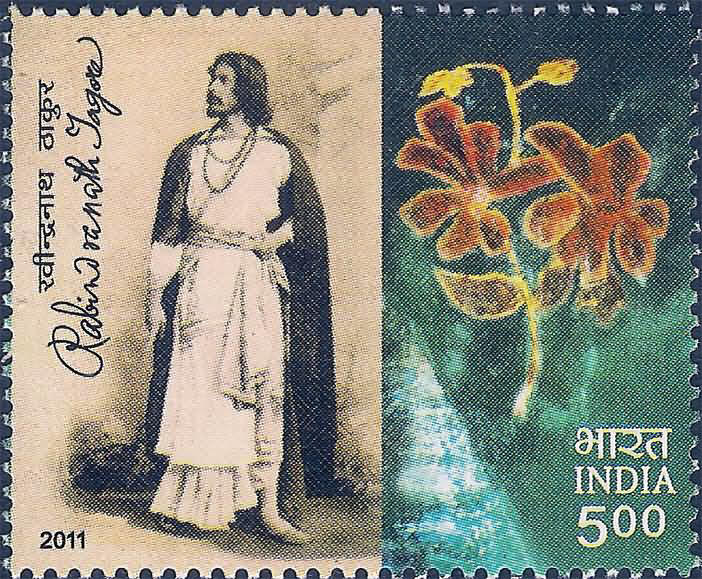
150 Years of Rabindranath Tagore
Technical Data
| Date of Issue | May 7, 2011 |
|---|---|
| Denomination | Rs. 5 |
| Quantity | 600,000 |
| Perforation | comb13 |
| Printer | India Security Press, Nashik |
| Printing Process | Wet Offset |
| Watermark | No Watermark |
| Colors | Multicolor |
| Credit (Designed By) | Sh. Sankha Samanta |
| Catalog Codes |
Michel IN 2600 Yvert et Tellier IN 2333 Stanley Gibbons IN 2814 WADP Numbering System - WNS IN024.2011 |
| Themes | Anniversaries and Jubilees | Authors | Famous people | Literary People (Poets and Writers) | Literature | Men | Nobel Laureates | Paintings |
Poet, Philosopher and Universal Humanist
Birth and Family Background
Rabindranath Tagore, the fourteenth child of Maharshi Debendranath Tagore and Sarada Devi, was born on 7 May 1861 at Jorasanko, Kolkata. From an early age, he displayed extraordinary creative abilities that would later place him among the greatest cultural figures of the modern world.
Education and Vision for Learning
Dropping out of formal education, Tagore developed his own philosophy of learning rooted in freedom, creativity and harmony with nature. He founded two unique schools—Patha Bhavan and Siksha Satra—and later established the international university Visva-Bharati at Santiniketan, which became a global centre for art, culture and humanistic learning.
Early Literary Career
Tagore wrote his first drama ‘Prithvirajer Parajey’ in 1873, though no copy survives today. In 1874, his poem ‘Abhilasha’ was published in Tattwabodhini Patrika. A year later, he made his first public appearance by reciting his patriotic poem ‘Hindumela Upohar’. His study of Law at University College London remained incomplete, and he returned to India in 1880.
Prolific Creativity and Social Engagement
His literary output—spanning poetry, prose, drama and music—was vast and continuous despite the personal joys and tragedies of his life, including his marriage to Mrinalini Devi and the upbringing of five children. His first book, ‘Sandhya Sangit’, was published in 1880, followed by his first musical drama ‘Valmiki Pratibha’ in 1881.
Tagore strongly advocated education in the mother tongue and criticised the prevailing English education system. He actively promoted Swadeshi ideals, establishing a Swadeshi store in Kolkata and a jute pressing factory in Kushtia to encourage indigenous industry and employment. In 1898, he reacted to the arrest of Bal Gangadhar Tilak through his paper ‘Kantharodh’.
Santiniketan and Cultural Leadership
After moving to Santiniketan, Tagore revived Bankim Chandra Chattopadhyaya’s journal Bangadarshan. Though the nucleus of Santiniketan began in 1901, its foundation stone was laid in 1918. He supported constructive non-cooperation against British rule through his writings but later withdrew from the Swadeshi movement, disillusioned by its exploitation of communal divisions.
Gitanjali and the Nobel Prize
Tagore’s magnum opus ‘Gitanjali’ was first published in Bengali in 1910. His association with British painter William Rothenstein led to its English publication by the India Society of London, with an introduction by W.B. Yeats. The work was later published by Macmillan, London, along with The Gardener, Crescent Moon and Chitra. In 1913, Tagore became the first Asian recipient of the Nobel Prize for Literature.
International Influence and National Conscience
Knighted in 1915, Tagore met Mahatma Gandhi the same year at Santiniketan. He later renounced his knighthood in protest against the Jallianwala Bagh Massacre. From 1916 onwards, he travelled extensively across Asia, Europe, Africa, South America and the USA, delivering lectures on nationalism, education and culture, while raising funds for Visva-Bharati University.
Artist, Thinker and Final Years
Tagore’s creative expression expanded further when his doodles evolved into a distinctive style of painting from 1924 onwards. His later years were marked by performances in his plays, exhibitions of his artwork, lectures, publications, institutional development at Santiniketan and leadership in civil protests.
In 1940, Oxford University conferred upon him an Honorary Doctorate. His last lecture was read out on the occasion of his 80th birthday. Rabindranath Tagore passed away on 7 August 1941.
Philatelic Tribute
India Post is proud to commemorate the 150th Birth Anniversary of Rabindranath Tagore by issuing a set of commemorative postage stamps, honouring his unparalleled contribution to literature, education, culture and the universal ideals of humanism.
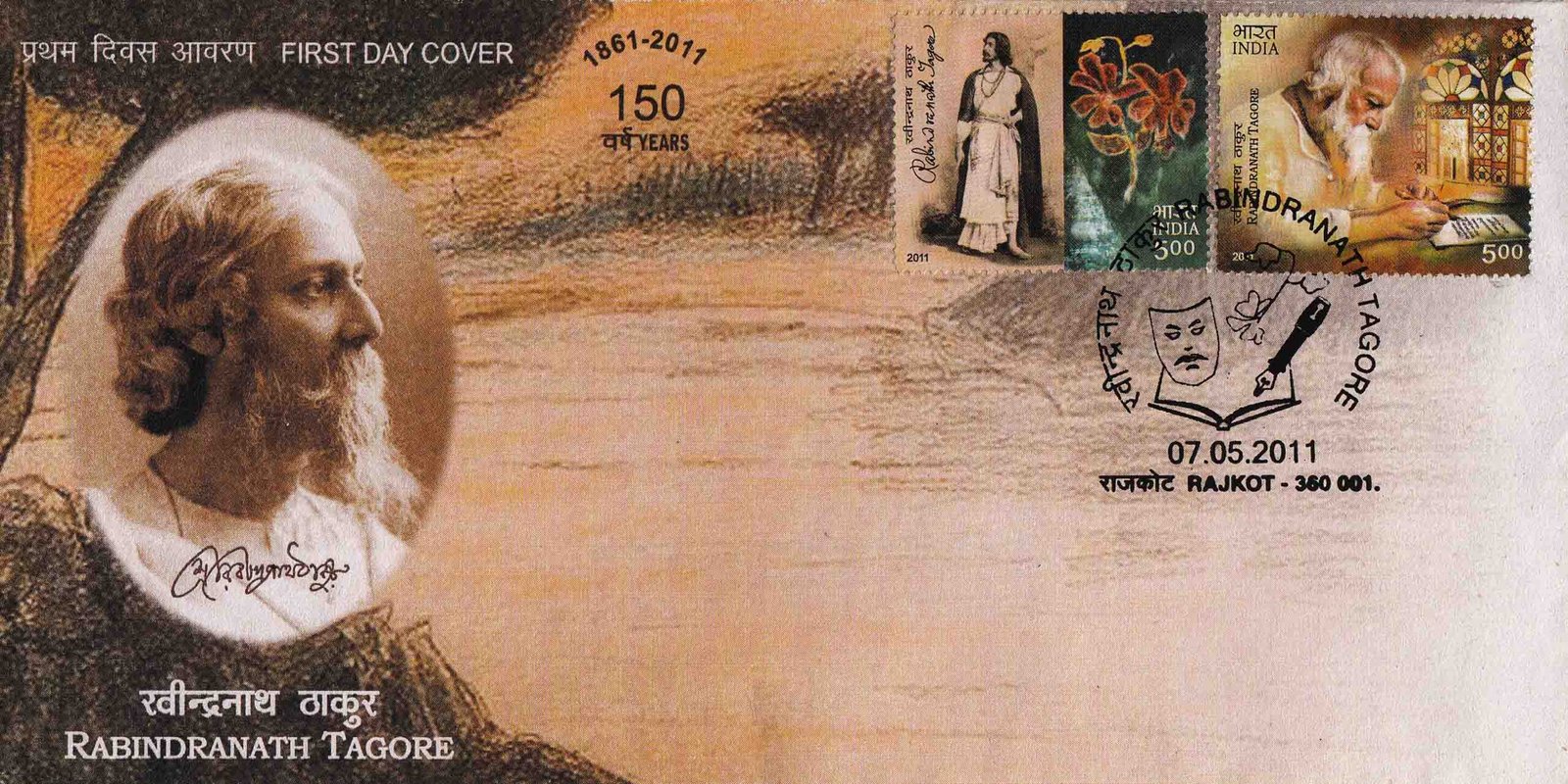
First Day Cover
Leave a Comment
You must be logged in to post a comment.