150 Years of Railways in India

Technical Data
| Date of Issue | April 16, 2002 |
|---|---|
| Denomination | Rs. 15 |
| Quantity | 100,000 |
| Perforation | comb13¼ x 13 |
| Printer | Calcutta Security Printers Ltd |
| Printing Process | Offset Lithography |
| Watermark | No Watermark |
| Colors | Multicolor |
| Credit (Designed By) | Sh. Sankha Samanta |
| Catalog Codes |
Michel IN BL12, Stamp Number IN 1952a Yvert et Tellier IN BF11 Stanley Gibbons IN MS2065 |
| Themes | Anniversaries and Jubilees | Locomotives | Railways | Transport |
The Lifeline of the Nation and Its Historic First Journey
Indian Railways has been a powerful force in uniting India for over a century. Since independence in 1947, it has played a crucial role in strengthening the country’s economy, supporting industrial and agricultural growth, and connecting people across vast distances.
Beginning of Railways in India
The history of railways in India dates back to First Train in India on April 16, 1853. On this historic day, the first train ran from Bori Bunder to Thane, covering a distance of 34 kilometers.
This modest beginning marked the start of a transportation revolution that would transform the nation.
Growth and Expansion
From a single route, Indian Railways has grown into one of the largest railway networks in the world:
- Around 7,000 stations across the country
- Route length of nearly 63,000 kilometers
- Workforce of over 1.6 million employees
It operates multiple track systems, including broad gauge, meter gauge, and narrow gauge, and serves as the primary mode of transport for both passengers and freight.
Role in Nation Building
Indian Railways has significantly contributed to:
- Economic integration and trade
- Industrial and agricultural development
- Social and cultural connectivity
- Tourism, education, and pilgrimage travel
Every day, thousands of trains carry millions of passengers, linking even the most remote regions of India.
Philatelic Tribute
To celebrate the 150th anniversary of India’s first train journey in 2003, India Post issued a A Miniature sheet consisting of one commemorative postage stamp
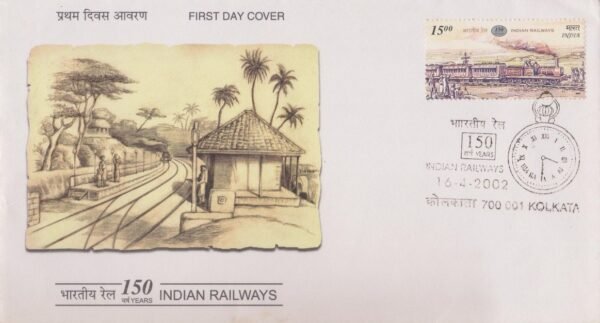
The stamp design beautifully recreates the historic scene of 1853, showing the first train traveling from Bombay to Thane. The First Day Cover features an artistic impression of Byculla Railway Station, one of the early railway stations on this route.
Additionally, the cancellation design includes a station master’s watch, symbolizing the exact moment when the historic journey began.
Conclusion
Indian Railways stands as the lifeline of the nation, connecting people, cultures, and economies. From its humble beginning in 1853 to becoming one of the largest railway systems in the world, it continues to drive India’s progress. The commemorative stamp honoring the first train journey captures this remarkable legacy and celebrates a milestone that changed the course of India’s history.
First Day Cover