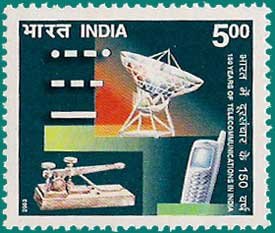
150th Anniversary of Telecommunications
Technical Data
| Date of Issue | November 1, 2003 |
|---|---|
| Denomination | Rs. 5 |
| Quantity | 800,000 |
| Perforation | comb 13½ x 13 |
| Printer | Eagle Press Ltd. |
| Printing Process | Offset Lithography |
| Watermark | No Watermark |
| Colors | Multicolor |
| Credit (Designed By) | Sh. Sankha Samanta |
| Catalog Codes |
Michel IN 1990 Stamp Number IN 2030 Yvert et Tellier IN 1755 Stanley Gibbons IN 2164 WADP Numbering System - WNS IN047.03 |
| Themes | Anniversaries and Jubilees | Satellite Dishes | Telecommunication | Telegraphy | Telephones | Telephony |
Introduction
Telecommunications in India has evolved from a small experimental telegraph line into a vast network connecting millions of people across the country and the world. To celebrate the remarkable progress made over a century and a half, India Post issued a commemorative postage stamp marking 150 Years of Indian Telecommunications.
Early Beginnings
The story of telecommunications in India began in 1850 with an experimental electric telegraph line established between Kolkata and Diamond Harbour.
This pioneering initiative was led by William Brooke O’Shaughnessy, who later became the first Superintendent of Electric Telegraphs in India and eventually the first Director General of Telegraphs.
Expansion of Telegraph Services
In November 1853, formal telegraph services were launched connecting major cities such as Kolkata, Peshawar, Mumbai, Chennai, Ooty, and Bengaluru.
These early connections laid the foundation for India’s modern telecommunications infrastructure.
Introduction of Telephone Services
India witnessed its first private telephone line in 1875 in Mumbai. Later, in 1881, the Oriental Telephone and Electric Company Limited received a license to establish telephone exchanges in Mumbai, Kolkata, and Chennai.
The Indo-European Telegraph Department, which handled overseas communication, merged with the Indian Telegraph Department in 1888, strengthening the country’s communication system.
Formation of the Post and Telegraph Department
A major milestone came in 1914 when the Indian Post and Telegraph Department was formed as a unified entity. In the same year, the first automatic telephone exchange in India was commissioned at Shimla.
Technological Developments
During the early twentieth century, telecommunications expanded with the introduction of several new technologies:
- Radio Telegraphy in 1927
- Radio Telephone services in 1933
- Use of trunk lines for broadcasting programmes in 1937
In 1950, many isolated telephone exchanges and those belonging to princely states were integrated into the national telecom network.
Modernisation and Growth
Further development occurred in the 1960s with the introduction of Subscriber Trunk Dialling (STD) services between Kanpur and Lucknow, allowing customers to dial long-distance calls directly.
In 1985, the Posts and Telecommunications Department was divided into separate departments. Administrative control of telecommunications was later entrusted to the Telecom Commission in 1989.
Telecom Reforms and New Organisations
With reforms and reorganisation, several specialised telecom organisations emerged:
- Mahanagar Telephone Nigam Limited for metropolitan telephone services.
- Videsh Sanchar Nigam Limited for overseas communication.
- Telecom Regulatory Authority of India, established in 1995 to regulate the telecom sector.
- Bharat Sanchar Nigam Limited, created in 2000 when the operational wing of the telecom department was corporatized.
Era of Cellular Communication
The introduction of cellular mobile services in 1995 marked the beginning of a new era in Indian telecommunications. From a modest network of telegraph lines, the telecom system expanded to millions of telephone lines and connections, transforming communication across the country.
Conclusion
The journey of Indian telecommunications from a single telegraph experiment in 1850 to a vast and sophisticated communication network reflects technological innovation and national progress. The commemorative postage stamp issued by India Post celebrates 150 years of this remarkable evolution, acknowledging the role telecommunications has played in connecting people and strengthening the nation.
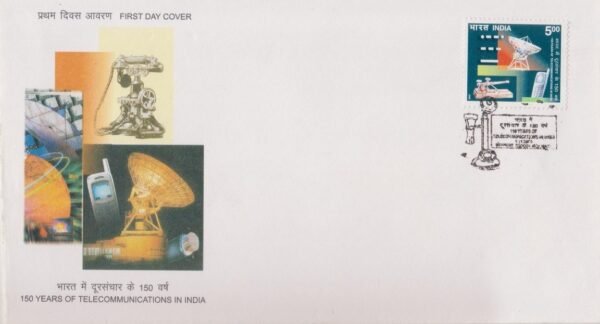
First Day Cover