1857 First War of Independence

Technical Data
| Date of Issue | August 9, 2007 |
|---|---|
| Denomination | Rs. 20 |
| Quantity | 400,000 |
| Perforation | 13¼ x 13 |
| Printer | India Security Press, Nasik |
| Printing Process | Photogravure |
| Watermark | No Watermark |
| Colors | Multicolor |
| Credit (Designed By) | Sh. Sankha Samanta |
| Catalog Codes |
Michel IN BL44 Stamp Number IN 2200c Stanley Gibbons IN MS2411 WADP Numbering System - WNS IN031MS.2007 |
| Themes | Animals (Fauna) | Battle | Horses | Mammals | Uprising |
Stamps in this Miniature Sheet
The Dawn of Indian Nationalism
The year 1857 marked a defining moment in India’s freedom struggle with the outbreak of the First War of Independence. Regarded as the earliest large-scale uprising against British rule, the revolt fundamentally altered the course of Indian history and ignited the spirit of nationalism across the subcontinent.
Causes of the Uprising
Historians attribute the revolt of 1857 to a combination of political, economic, social, and military causes. One immediate trigger was the widespread resentment among Indian soldiers of the East India Company’s army over the use of greased cartridges, which offended religious sentiments.
However, deeper causes lay in the growing dissatisfaction of the people due to oppressive land revenue policies, the annexation of princely states, and the systematic erosion of traditional political structures. Above all, there was an intense and widespread desire to free India from foreign domination.
Beginning and Spread of the Revolt
One of the earliest acts of defiance by Indian soldiers occurred at Barrackpur near Kolkata. Soon after, in May 1857, Indian soldiers—referred to by the British as “native sepoys”—rose in open revolt. On 10 May, they marched to Delhi and proclaimed Bahadur Shah II, the Mughal ruler, as the Emperor of India.
The uprising rapidly spread across the Gangetic heartland, engulfing major centres such as Kanpur, Lucknow, Jhansi, and Bareilly. The rebellion was led by towering figures of courage and resistance, including Nana Saheb, Diwan Azimullah, Tantia Tope, Kunwar Singh, and Rani Laxmi Bai. The fiercest battles were fought in the region between the Narmada and the Ganga, though the echoes of resistance were felt as far as South India, Gujarat, Rajasthan, and even the North-East, including the Khasi-Jaintia Hills and Cuchar.
National Character and Historical Significance
What made the uprising of 1857 truly historic was its all-India character. Unlike earlier revolts, rebellions erupted simultaneously in multiple regions, covering nearly half of the country. The scale, intensity, and popular participation made it unprecedented and deeply impactful on the Indian psyche.
Equally remarkable was the unity displayed among different communities during the revolt. Allegiance to the Mughal Emperor provided a symbolic political unity, bringing together diverse leaders and regions under a common banner against British rule. This sense of collective struggle sowed the seeds of Indian nationalism and inspired future generations in the long march towards independence.
Philatelic Tribute: 150 Years of the First War of Independence
To commemorate 150 years of the First War of Independence (1857–2007), the Department of Posts issued a Miniature Sheet consisting of special set of postage stamps and philatelic materials.
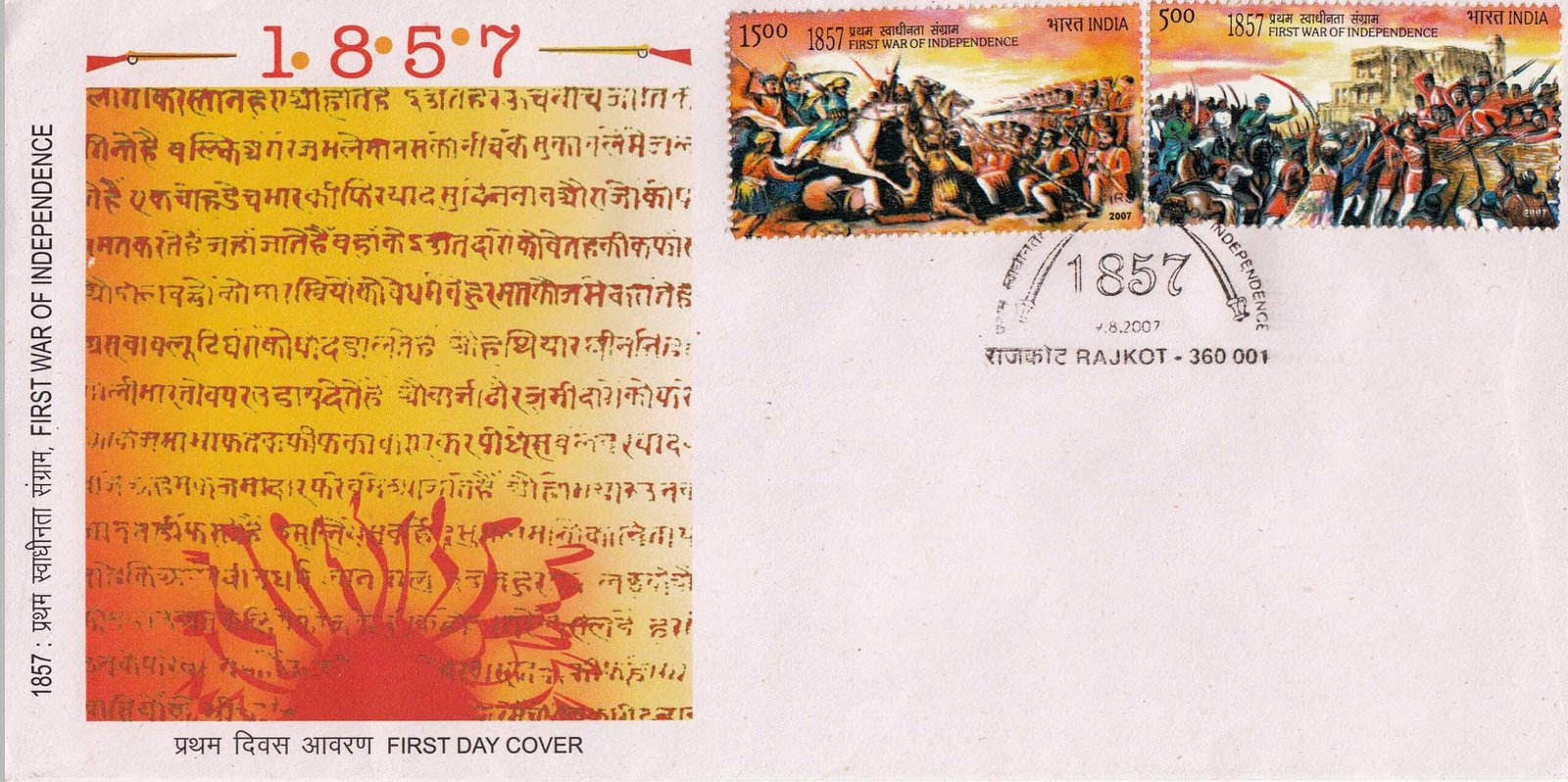
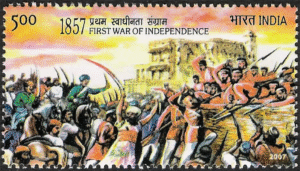
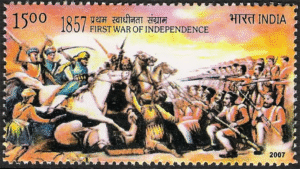
- The stamps and miniature sheet artistically depict the pitched battles at Kanpur and Lucknow, focusing on the valor of unknown soldiers.
- The First Day Cover (FDC) symbolizes the dawn of Indian nationalism through a rising sun motif, alongside imagery of the rifles whose greased cartridges triggered the revolt. It also features part of a constitution drafted by the sepoys.
- The Maxim Cards portray dramatic war scenes inspired by murals and tribal paintings from Madhya Pradesh.
The Department of Posts is honored to release this commemorative set, paying tribute to the heroes of 1857 and celebrating the enduring legacy of India’s First War of Independence.
First Day Cover