
225th Anniversary of President’s Bodyguard
Technical Data
| Date of Issue | November 16, 1998 |
|---|---|
| Denomination | Rs. 3 |
| Quantity | 700,000 |
| Perforation | comb 13 x 13½ |
| Printer | Security Printing Press, Nashik |
| Printing Process | Photogravure |
| Watermark | No Watermark |
| Colors | Multicolor |
| Credit (Designed By) | |
| Catalog Codes |
Michel IN 1654 Stamp Number IN 1721 Yvert et Tellier IN 1419 Stanley Gibbons IN 1817 |
| Themes | Animals (Fauna) | Anniversaries and Jubilees | Horses | Mammals | National Guards |
History, Heritage, and Elite Military Tradition
The President’s Bodyguard is the oldest surviving regiment of the Indian Army and holds precedence over all other units. Renowned for its ceremonial splendor and operational excellence, the President’s Bodyguard has a proud history spanning more than two centuries.
The regiment celebrated its bicentenary on 30 September 1973, marking 200 years of distinguished service to the nation.
Formation of President’s Bodyguard
The President’s Bodyguard was originally raised in 1773 by Warren Hastings at Varanasi (then Banaras).
It was established with a dual role:
- Operational military service
- Ceremonial escort duties
For the next eighty years, the regiment participated in many major military campaigns while the Governor-General often took the field as Commander-in-Chief.
Evolution of the Regiment’s Name
The unit has undergone several name changes through history:
- 1773 – The Governor’s Troops of Moguls
- 1784 – The Governor-General’s Body Guard
- 1950 onwards – The President’s Bodyguard
Following India becoming a republic in 1950, the regiment assumed its current prestigious title.
Operational Roles Beyond Cavalry
Although the President’s Bodyguard was raised as a cavalry regiment when the Bengal military establishment had no other cavalry force, it has served in multiple combat roles throughout history.
These roles include:
- Artillery in Egypt (1801–1802)
- Marines in 1809
- Dismounted Cavalry in Indonesia (1811)
- Mechanised Troops during World War II (1943)
- Paratroopers with the 44 Airborne Division (1944–46)
This adaptability highlights the regiment’s professionalism and versatility.
Strength of the Regiment
When first raised, the President’s Bodyguard had:
- 2 Officers
- 112 Other Ranks
This is close to its modern strength.
However, during wartime the unit expanded significantly. In 1845, its numbers reached nearly 2,000 personnel, the highest in its history.
Ceremonial Uniform and Mounted Tradition
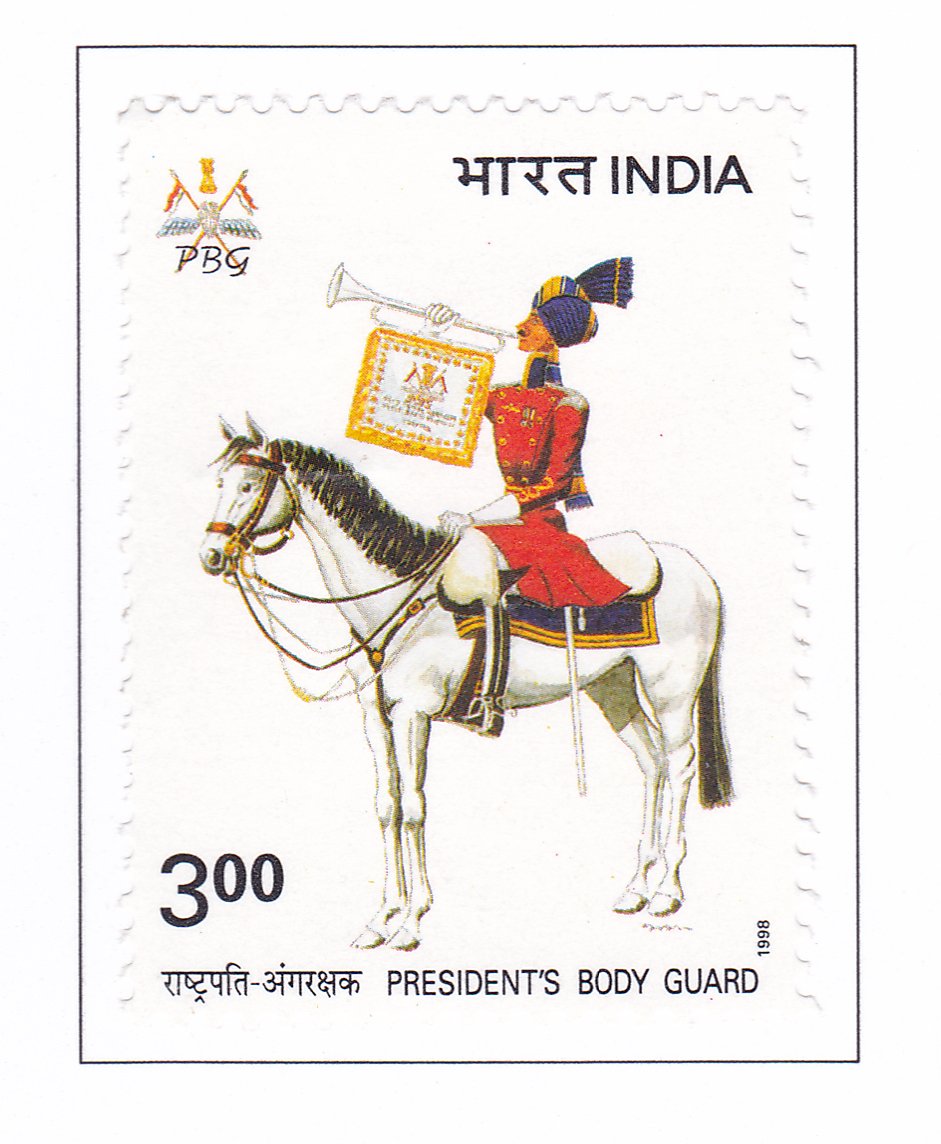
The President’s Bodyguard is widely admired for its striking ceremonial appearance.
Winter Ceremonial Uniform
The uniform includes:
- Blue turban with gold embroidery
- Scarlet frock coat with brass regimental buttons
- Raised collar and gold-embroidered sleeves
- White pantaloons
- Napoleonic boots with spurs
Mounted Tradition
The regiment rides bay-colored horses, equipped with:
- Blue saddle cloth
- Sheepskin rug
- Lance with red and white pennant
The colors of the pennant symbolize:
“Blood Before Surrender.”
Elite Recruitment Standards
The soldiers of the President’s Bodyguard, known as Sowars, are carefully selected.
They are chosen for their ability to become skilled:
- Horsemen
- Tankmen
- Paratroopers
The minimum height requirement for enlistment is six feet, reflecting the regiment’s elite physical standards.
Motto and National Pride
The regiment’s proud motto is:
“Bharat Mata Ki Jai”
This reflects devotion to the nation and the spirit of service.
Commemorative Stamp
To honor the 200th anniversary of this elite regiment, the Posts & Telegraphs Department issued a commemorative postage stamp depicting the President’s Bodyguard along with its emblem.
Conclusion
The President’s Bodyguard is a unique symbol of India’s military heritage, discipline, and ceremonial grandeur. From battlefields across continents to the ceremonial heart of the Republic, the regiment continues to uphold a legacy of honor, courage, and national pride.