300th Anniversary of Nagpur
Technical Data
| Date of Issue | November 11, 2002 |
|---|---|
| Denomination | Rs. 5 |
| Perforation | comb 13 |
| Printer | Security Printing Press, Nashik |
| Printing Process | Photogravure |
| Watermark | No Watermark |
| Colors | Multicolor |
| Credit (Designed By) | Shri Kamleshwar Singh |
| Catalog Codes |
Michel IN 1929 Stamp Number IN 1981 Yvert et Tellier IN 1694 Stanley Gibbons IN 2096 WADP Numbering System - WNS IN040.02 |
| Themes | Anniversaries and Jubilees | Buildings | Government Buildings | Temples |
The Orange City of India
Nagpur is a vibrant urban centre that reflects the long and evolving history of Indian cities. From ancient times, when cities first emerged during the Indus Valley Civilization, urban settlements in India have symbolized organized, civilised life. Over centuries, cities adapted to political and cultural changes, growing into centres of administration, trade and culture.
Foundation and Early Development
Nagpur’s origin is closely associated with Bakht Buland Shah, a Gond king who, inspired by the grandeur of Delhi, laid the foundation of a new capital in 1702 by integrating several small hamlets. His successor, Chand Sultan, expanded the city further.
Later, the rule of the Bhonsle dynasty from 1742 brought significant growth, with emphasis on agriculture, industry, and patronage of cultural and religious activities.
Colonial Transformation
Nagpur’s trajectory changed during British rule in the mid-19th century. It became the capital of the Central Provinces and Berar due to its strategic location. While improved road and rail connectivity integrated it into the global economy, colonial policies altered its natural growth and social fabric, turning it into a centre for trade in agricultural and forest produce.
Post-Independence Growth
After independence, Nagpur became part of Maharashtra and was designated as its second capital. Over the decades, it has grown rapidly into one of India’s major cities, balancing tradition with modernization.
Economic and Environmental Profile
Nagpur today has a diversified industrial base, including:
- Ferromanganese and metal industries
- Cotton processing and ginning
- Paint manufacturing
Located near the geographical centre of India, the city enjoys excellent connectivity by road, rail and air. It is also known as one of the greenest cities in India, maintaining a commendable ecological balance despite rapid urbanization.
Cultural Identity
Nagpur is popularly known as the “Orange City of India” due to its flourishing orange trade. With a cosmopolitan population and a blend of traditional and modern lifestyles, it represents the spirit of contemporary urban India.
Commemorative Stamp
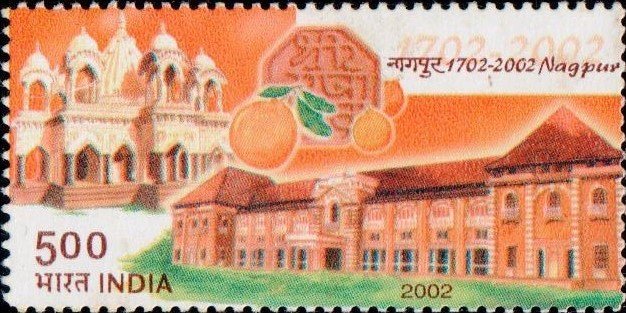
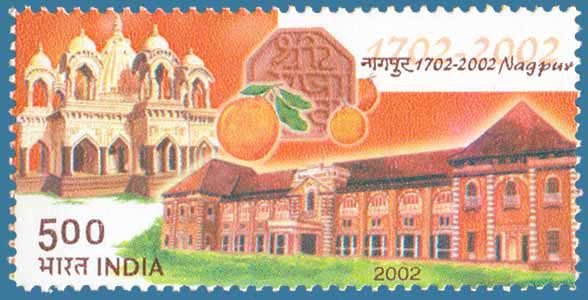
To celebrate the tercentenary of the city, India Post issued a commemorative stamp. The design features prominent landmarks such as the Vidhan Bhavan and the samadhi of Raghuji Bhonsle, along with imagery highlighting the city’s identity as the Orange City. The stamp sheetlet also includes an artistic portrait of Bakht Buland Shah, while the First Day Cover presents a collage of Nagpur’s heritage and development.
Conclusion
From a cluster of small villages to a thriving metropolis, Nagpur’s journey reflects resilience, adaptability and growth. Today, it stands as a key commercial, industrial and cultural hub, embodying the dynamic character of modern India.
First Day Cover