40th Anniversary of DRDO
Technical Data
| Date of Issue | January 26, 1999 |
|---|---|
| Denomination | Rs. 10 |
| Quantity | 700,000 |
| Perforation | comb 13 |
| Printer | Security Printing Press, Nashik |
| Watermark | No Watermark |
| Colors | Multicolor |
| Catalog Codes |
Michel IN 1672 Stamp Number IN 1733 Yvert et Tellier IN 1439 Stanley Gibbons IN 1835 |
| Themes | Aircraft | Anniversaries and Jubilees | Aviation | Organizations | Rockets | Tanks | Weapons |
Advancing India’s Defence Technology and Self-Reliance
The Defence Research and Development Organisation (DRDO) is India’s premier agency for defence research and technology. Established in 1958, DRDO is dedicated to the design, development, and integration of advanced defence systems for the Indian Armed Forces.
To recognize DRDO’s contribution to strengthening India’s defence capabilities and promoting self-reliance, the Department of Posts issued a commemorative postage stamp. The stamp celebrates the organization’s achievements in missiles, aircraft, tanks, radar systems, computing, naval research, and soldier support technologies.
History and Role of DRDO
The Defence Research and Development Organisation was founded in 1958 with the aim of creating indigenous defence technologies for India. Since its establishment, DRDO has grown into a vast network of 51 laboratories working in different areas of science and engineering.
DRDO laboratories cover a wide range of disciplines, including:
- Aeronautics
- Missiles and Armaments
- Armoured Fighting Vehicles
- Electronics and Radar Systems
- Advanced Computing and Software
- Materials Science
- Naval Systems
- Life Sciences
Through these laboratories, DRDO has played a key role in making India more self-reliant in defence production.
DRDO and the ARJUN Main Battle Tank
One of DRDO’s most important achievements is the development of the ARJUN Main Battle Tank. The ARJUN tank was designed with superior firepower, high mobility, strong protection, and a low silhouette to improve its performance on the battlefield.
The organization also developed the Bridge Layer Tank (BLT) and a mechanically launched bridging system. These systems help Indian Army troops move quickly across difficult terrain and obstacles during military operations.
Missile Systems Developed by DRDO
DRDO has made major contributions to India’s missile programme. One of its most successful projects is the PRITHVI surface-to-surface missile.
The PRITHVI missile was developed in different versions:
- PRITHVI for the Indian Army with a range of 150 km
- PRITHVI for the Indian Air Force with a range of 250 km
DRDO also successfully tested AGNI, the re-entry technology demonstrator that later became one of India’s most important missile systems.
These missile programmes strengthened India’s strategic and defence capabilities.
Development of the Light Combat Aircraft and Pilotless Aircraft
Another major achievement of DRDO is the development of the Light Combat Aircraft (LCA). The aircraft was designed using advanced technologies and represented a significant step in India’s indigenous aviation programme.
DRDO also developed:
- Remotely Piloted Vehicles (RPVs)
- Pilotless Target Aircraft (PTA)
The reusable Pilotless Target Aircraft was accepted for induction by all three branches of the Indian Armed Forces.
DRDO Electronics and Radar Systems
DRDO has designed several advanced communication and electronic systems for the armed forces. These include:
- Portable Satellite Communication Terminals
- Very Low Frequency (VLF) Receivers
- Secure Telephone (SECTEL)
- Night Vision Devices
DRDO also developed the INDRA Radar, equipped with pulse compression technology to detect low-flying aerial targets for the Indian Air Force.
DRDO Supercomputer and Naval Research
In the field of computing, DRDO created the ‘Pace Plus’ supercomputer. This high-performance parallel processing computer had a capacity of 1.7 GFLOPs and was used for solving complex computational fluid dynamics problems.
DRDO also developed the marine acoustic research ship SAGARDHWANI. The ship is used to collect important data from the oceans and supports India’s naval research programmes.
DRDO Support for Soldiers and Civilian Technology
DRDO has worked extensively to improve the living conditions of soldiers, especially those serving in difficult environments such as high-altitude regions, deserts, and tropical areas.
The organization developed:
- Extreme Cold Climate Clothing
- NBC Protective Clothing
DRDO has also adapted many of its defence technologies for civilian use. These technologies are now used in healthcare and public welfare.
Important civilian applications developed by DRDO include:
- Eye laser devices
- Cytoscan for early cancer detection
- Cardiac catheters
- Coronary stents
- Cardiac pacemakers
- Coronary stress test systems
DRDO technologies have also been used to provide portable drinking water to villages in Barmer district of Rajasthan and to support the greening of the cold deserts of Leh.
DRDO Commemorative Postage Stamp
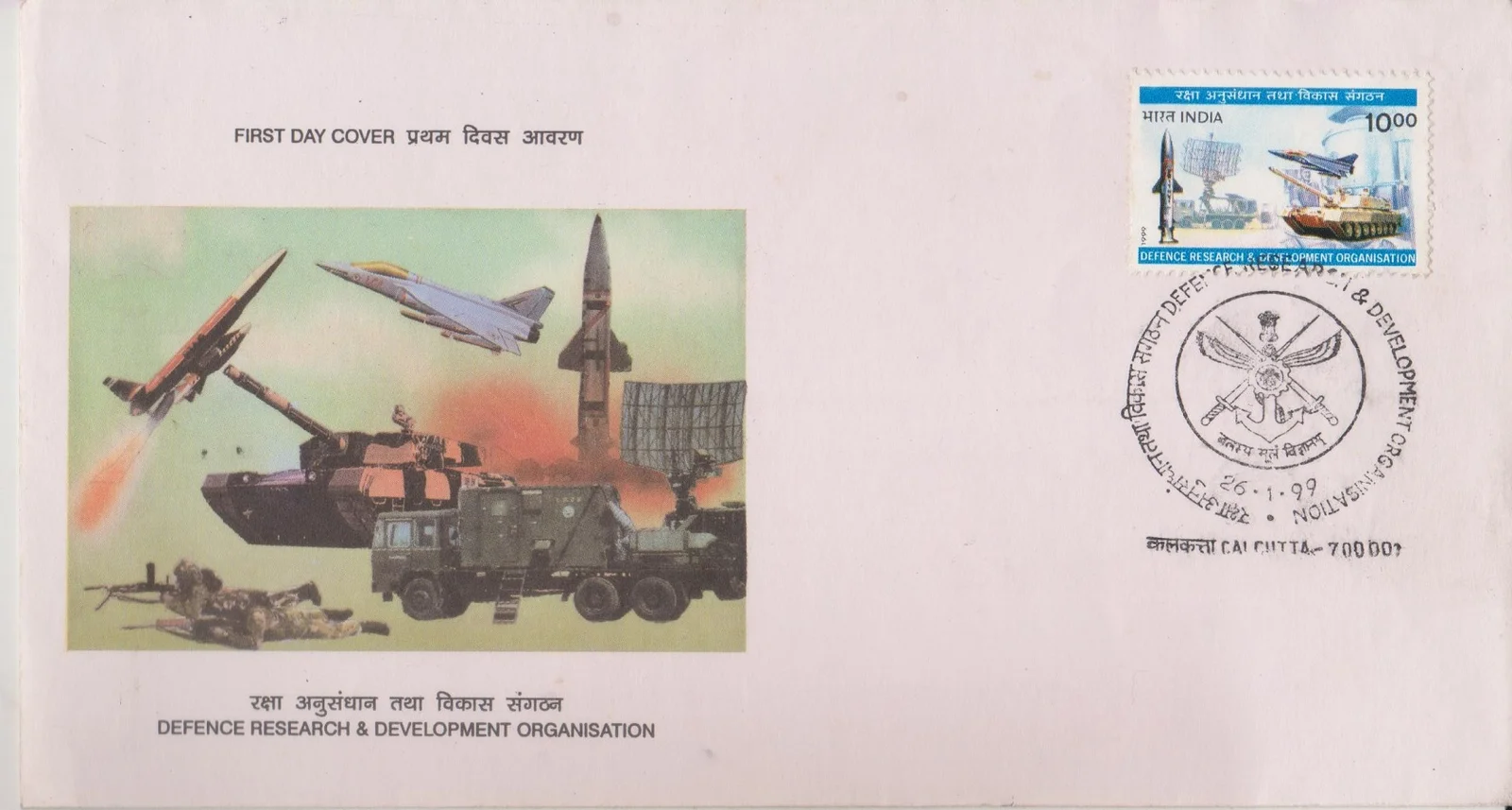
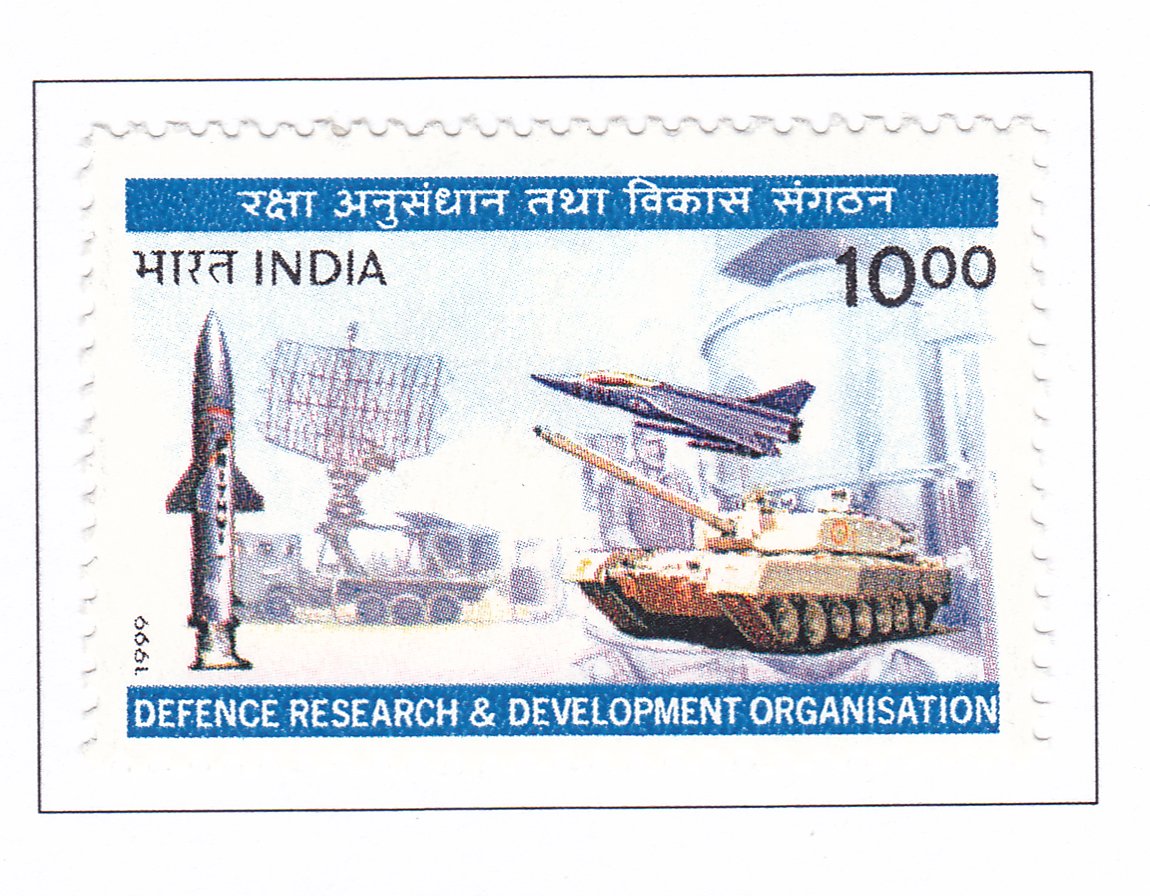
The commemorative postage stamp issued by the Department of Posts highlights some of DRDO’s most important achievements.
The stamp features:
- The Light Combat Aircraft (LCA)
- Pilotless Target Aircraft (PTA)
- PRITHVI missile in flight
- ARJUN Main Battle Tank in the foreground
- INDRA Radar
- An experimental research ship in the background
The stamp is a tribute to DRDO’s successful efforts in building advanced defence technologies and making India self-reliant in national security.
Importance of DRDO
The Defence Research and Development Organisation has transformed India’s defence sector through innovation, research, and indigenous technology. Its contributions have strengthened the armed forces, improved the quality of life for soldiers, and created technologies that benefit ordinary citizens.
Today, DRDO remains one of the most important scientific organizations in India and continues to play a vital role in the country’s defence and technological progress.
First Day Cover