
50th Anniversary of Bandung Conference
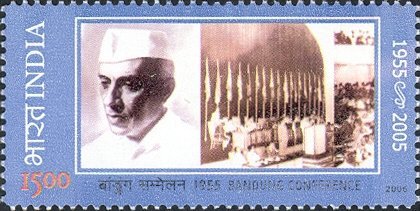
Technical Data
| Date of Issue | April 18, 2005 |
|---|---|
| Denomination | Rs. 15 |
| Quantity | 50,000 |
| Perforation | comb 13½ |
| Printer | Security Printing Press, Nashik |
| Watermark | No Watermark |
| Colors | Multicolor |
| Catalog Codes |
Michel IN 2088 Stamp Number IN 2105 Yvert et Tellier IN 1853 Stanley Gibbons IN 2272 WADP Numbering System - WNS IN019.05 |
| Themes | Anniversaries and Jubilees | Buildings | Conferences | Famous people | Headgear | Men | Politicians |
A Milestone in Afro-Asian Solidarity
The Bandung Conference was a landmark gathering of newly independent nations from Asia and Africa. It marked the first major meeting of these countries and served as a powerful call for the independence of peoples still under colonial rule. The conference symbolized the beginning of South-South cooperation, where developing nations sought to collaborate and assert their collective voice on the global stage.
Background and Organization
The conference was convened at the invitation of the Prime Ministers of Burma, Ceylon, India, Indonesia, and Pakistan. It was attended by representatives of 24 additional nations from Asia and Africa.
The conference took place from 18 to 24 April 1955 in Bandung, located in Central Java. The event brought together many influential leaders who shared a vision of a more equitable global order based on equality among nations, respect for sovereignty, and cooperation for development.
Vision and Objectives
The leaders who gathered at Bandung were deeply concerned about major global issues such as political and economic freedom, human rights, and the future of newly independent nations. Emerging from the shadows of colonialism and the devastation of the Second World War, they faced a world divided by rival ideological blocs.
Rather than aligning themselves with the dominant power blocs of the time, the participating countries chose to pursue an independent path. They envisioned a global order that emphasized peaceful coexistence, mutual respect, and cooperation among nations.
Birth of South-South Cooperation
The Bandung Conference initiated a process through which nations of the Global South could reconnect and collaborate. Colonial rule had disrupted many long-standing economic, cultural, and political relationships between Asian and African societies. Bandung provided an opportunity to renew these ties.
The conference encouraged cooperation in areas such as:
- Exchange of experts and technical knowledge
- Establishment of national and regional technical institutions
- Promotion of joint economic ventures
- Collective action to safeguard shared interests
These initiatives helped lay the groundwork for future partnerships among developing nations.
Economic and Development Ideas
Bandung also introduced several forward-looking economic ideas. The leaders emphasized the importance of diversifying exports, adding value to raw materials, strengthening intra-regional trade, and improving the exchange of commercial information.
These proposals reflected a broader vision of economic independence and sustainable development for newly independent countries.
Commemorative Postage Stamp
Recognizing the historic significance of the Bandung Conference and its role in shaping Afro-Asian solidarity and South-South cooperation, India Post issued a commemorative postage stamp honoring the Bandung Conference of 1955, celebrating its contribution to international cooperation and the quest for a more balanced global order.