
16 Squadron Air Force
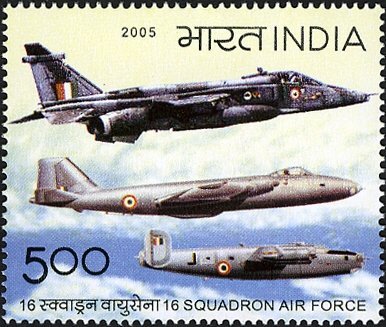
Technical Data
| Date of Issue | December 27, 2005 |
|---|---|
| Denomination | Rs. 5 |
| Quantity | 800,000 |
| Perforation | comb 14 |
| Printer | Security Printing Press, Nashik |
| Watermark | No Watermark |
| Colors | Multicolor |
| Catalog Codes |
Michel IN 2118 Stamp Number IN 2133 Yvert et Tellier IN 1883 Stanley Gibbons IN 2303 WADP Numbering System - WNS IN050.05 |
| Themes | Air Forces | Aircraft | Anniversaries and Jubilees | Aviation |
Introduction
The No. 16 Squadron Indian Air Force has served the nation with distinction for over fifty years. Known as the “Cobras,” the squadron has actively participated in all major post-independence conflicts and continues to remain one of the principal strike squadrons of the Indian Air Force.
Formation and Early Development
The squadron began as a flight operating Supermarine Spitfire aircraft and later Hawker Tempest aircraft. It was formally established on 15 September 1954 with Consolidated B-24 Liberator aircraft. At that stage, its role evolved from a bomber formation to a heavy bomber unit, and the squadron was also entrusted with the responsibility of training bomber aircrew.
On 19 November 1957, the squadron was re-equipped with English Electric Canberra aircraft, and its operational role was redefined as a Light Bomber and Interdictor Squadron.
Operational Deployments
In 1957, the squadron moved to Kalaikunda Air Force Station and became part of the operational forces of the Central Air Command. Towards the end of 1965, it relocated to Gorakhpur Air Force Station. Later, on 10 November 1986, the squadron was equipped with modern aircraft and its role was further defined as Counter Air and Interdiction operations.
Participation in Major Military Operations
Liberation of Goa (1961)
After being equipped with Canberra aircraft, the squadron undertook its first operational assignment during the Annexation of Goa. It carried out bombing attacks on the Dabolim airfield and also flew sorties in support of operations against Diu.
Sino-Indian Conflict (1962)
During the Sino-Indian War, the squadron operated a detachment from Kalaikunda to support national defence operations.
Indo-Pak War (1965)
In the Indo-Pakistani War of 1965, the squadron was deployed in the Eastern Theatre for counter-air operations and executed several successful missions. It also carried out strike operations against strategic targets including Sargodha airfield, Chak Jhumra, and Badin. One of the most notable missions was a daylight strike against a heavily defended radar installation at Badin, which successfully disabled the radar and disrupted enemy air defence systems.
Indo-Pak War (1971)
During the Indo-Pakistani War of 1971, the squadron operated under the command of Wing Commander P. Gautam. It conducted successful bombing missions against heavily defended targets in both East and West Pakistan. Despite challenging operational conditions, the squadron maintained high aircraft serviceability and completed all assigned missions, earning several gallantry awards.
Kargil Conflict and Operation Parakram
The squadron also played an important role during the Kargil War and later during Operation Parakram, serving as a key operational unit of the Indian Air Force in the south-western sector.
Recognition and Awards
In recognition of its distinguished service to the nation, the squadron was presented the President’s Standards by Fakhruddin Ali Ahmed on 13 November 1976. Over the years, the squadron has earned numerous honours including one Bar to the Maha Vir Chakra, four Vir Chakras, six Vayu Sena Medals, five Vishisht Seva Medals, one Mention in Dispatches, and several commendations from the Chief of the Air Staff and Air Officers Commanding-in-Chief.
Commemorative Postage Stamp
To honour the remarkable contributions and proud legacy of the Cobras, the Department of Posts issued a commemorative postage stamp celebrating the service and achievements of the 16 Squadron of the Indian Air Force.
Leave a Comment
You must be logged in to post a comment.