Aga Khan Foundation

Technical Data
| Date of Issue | May 17, 2008 |
|---|---|
| Denomination | Rs. 20 |
| Quantity | 200,000 |
| Perforation | 13 |
| Printer | India Security Press, Nasik |
| Printing Process | Photo Gravure |
| Watermark | No Watermark |
| Colors | Multicolor |
| Credit (Designed By) | Sh. Brahm Prakash Smt. Alka Sharma |
| Catalog Codes |
Michel IN BL54 Stamp Number IN 2241c Stanley Gibbons IN MS2478 WADP Numbering System - WNS IN016MS.2008 |
| Themes | Anniversaries and Jubilees | Buildings | Mosques | Palm-trees |
Stamps in this Miniature Sheet

Spirit of Giving
“It is well to give when asked but it is better to give unasked, through understanding.” – Kahlil Gibran
The true driving force behind charity is an unbounded love for humanity and a deep spirit of compassion. The most profound form of generosity is voluntary giving — inspired not by obligation, but by understanding and empathy. Embodying this noble philosophy is the Aga Khan Foundation (AKF), an institution that has consistently demonstrated visionary commitment toward uplifting underprivileged communities across the world.
Foundation and Global Presence
Founded in 1967 in Geneva, Switzerland, by His Highness the Aga Khan, the Aga Khan Foundation forms part of the broader Aga Khan Development Network (AKDN) — a group of nine institutions working in health, education, culture, rural development, and economic advancement.
Established in India in 1978, AKF today operates in 18 countries across Central and South Asia, the Middle East, Sub-Saharan Africa, Europe, and North America. Its mission is to seek sustainable solutions to long-term challenges such as poverty, hunger, illiteracy, and ill-health, with particular emphasis on rural and resource-poor communities in mountainous and coastal regions.
Community-Based and Participatory Approach
The success of the Aga Khan Foundation lies in its integrated, community-based, and participatory approach. By respecting local cultures and empowering communities to take ownership of their development, AKF fosters long-term, self-sustaining progress.
Its four central objectives are:
- Enabling poor communities to improve income, health, environment, and education.
- Providing knowledge that empowers informed decision-making.
- Building confidence and competence among beneficiaries to participate in programmes affecting their lives.
- Establishing sound management and financial systems to ensure sustainability within a defined timeframe.
This philosophy aligns with the belief that teaching individuals to grow independently is the greatest service one can render.
Development Initiatives in India
The Foundation’s initiatives in India offer sterling examples of its grassroots impact:
- Empowerment of Siddi Women in Gujarat: Women from the Siddi community were trained in producing organic compost, enabling them to achieve financial independence.
- Rural Development Programmes: Since the early 1980s, AKF has supported rural development across India.
- Earthquake-Resistant Construction in Jammu & Kashmir (2006): Over 25 masons were trained in earthquake-resistant construction techniques, strengthening local capacity and safety standards.
- Community Health Management: Through a “social franchise agreement,” local communities were engaged in the management and delivery of healthcare services.
- Agricultural Tool Libraries in South Gujarat: Small and marginal farmers were supported through the establishment of agricultural tool “libraries,” allowing them to rent equipment at nominal rates and reduce exploitative costs.
Through these interventions, AKF has helped communities move from dependency toward self-reliance.
Philatelic Tribute
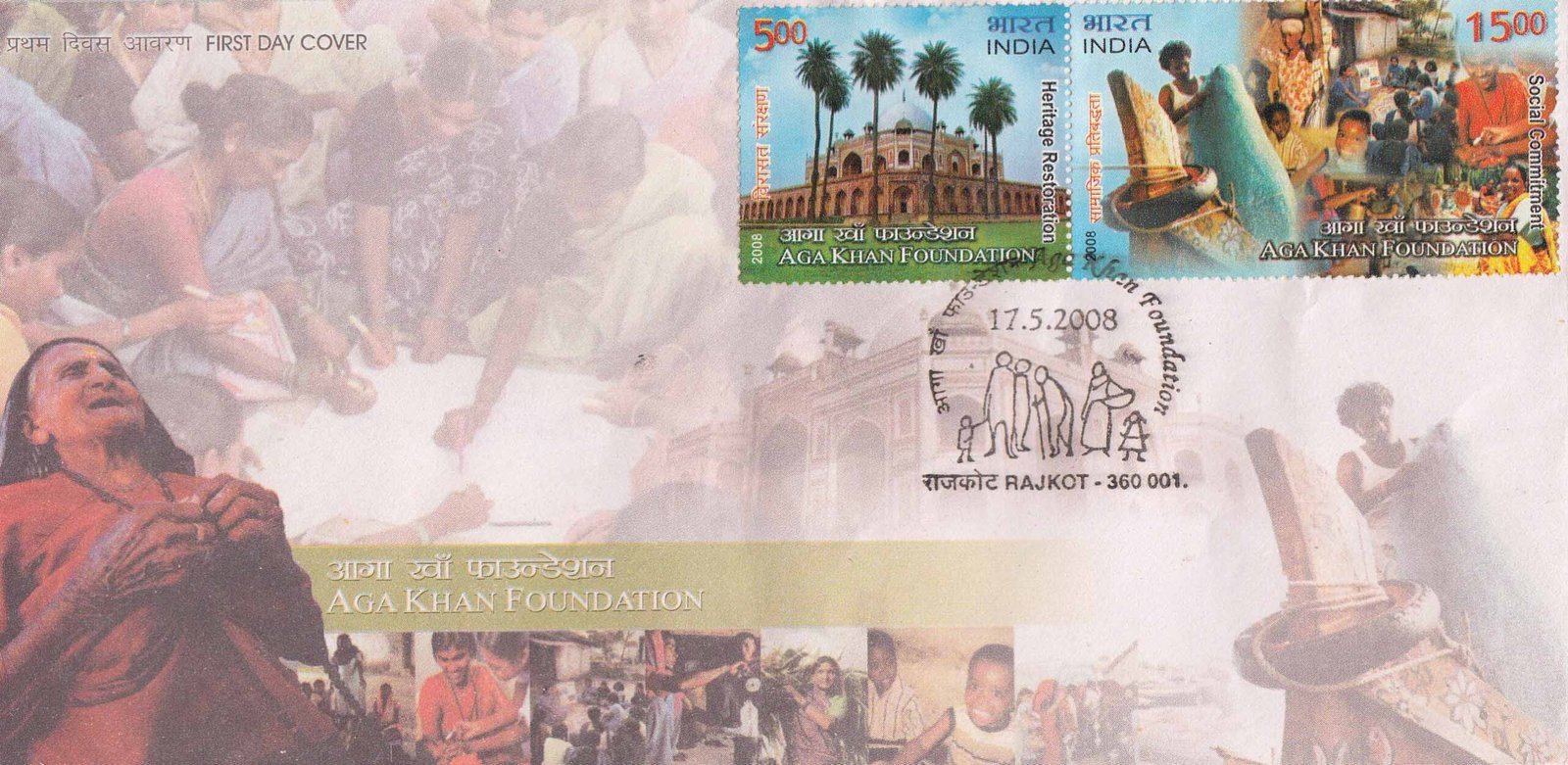
Marking 30 years of purposeful and philanthropic work in India, the Department of Posts honoured the Aga Khan Foundation with a Miniature Sheet consisting of set of two commemorative postage stamps. These stamps highlight key facets of the Aga Khan Development Network — its social commitment and its contribution to the restoration of heritage and culture.
The commemorative issue stands as a tribute to the Foundation’s indomitable spirit and its enduring dedication to human dignity, sustainable development, and cultural preservation.
First Day Cover