
Airborne Warning and Control System
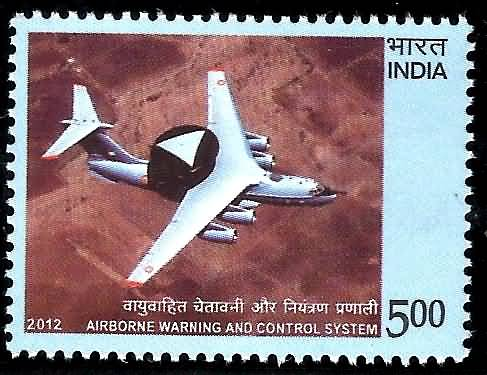
Technical Data
| Date of Issue | October 8, 2012 |
|---|---|
| Denomination | Rs. 5 |
| Quantity | 300,000 |
| Perforation | 13¼ |
| Printer | India Security Press, Nashik |
| Printing Process | Wet Offset |
| Watermark | No Watermark |
| Colors | Multicolor |
| Credit (Designed By) | Mr. Suresh Kumar Smt. Alka Sharma |
| Catalog Codes |
Michel IN 2668 Stamp Number IN 2592 Stanley Gibbons IN 2890 WADP Numbering System - WNS IN031.2012 |
| Themes | Aircraft | Aviation |
A Landmark for the Indian Air Force
The long-cherished dream of the Indian Air Force (IAF) to have a radar system in the sky became a reality with the induction of the first Airborne Warning and Control System (AWACS) aircraft on 28th May, 2009. This achievement was the result of a tripartite agreement between India, Russia and Israel. With this induction, India joined an elite group of nations possessing advanced airborne radar surveillance capability.
Enhanced Surveillance and Combat Capability
The IL-76 based AWACS has significantly enhanced the electronic reach of the IAF far beyond that of ground-based sensors. It provides all-weather airborne early warning, air battle management, and command and control functions for both tactical and strategic operations. The system greatly strengthens network-centric warfare operations, enabling faster and more coordinated decision-making.
Unique Technological Features
AWACS is unique in several respects. It carries the largest and heaviest dome mounted on any aircraft in the world. The complex radar system is the world’s first 360-degree active phased array antenna system. Compared to ground-based systems, AWACS offers a decisive operational edge by simultaneously monitoring airborne and surface targets over vast distances.
Strategic Advantage
Equipped with highly effective on-board signal intelligence gathering systems, AWACS helps build an accurate and composite picture of the battlefield. It assists in planning future operational and tactical strategies and represents a paradigm shift in air operations over Indian airspace and beyond. The system seamlessly bridges airborne platforms and ground entities, enabling rapid, decisive and coordinated operations. Its air-to-air refuelling capability allows it to remain airborne for extended durations.
The Squadron Behind the System
The personnel of No. 50 Squadron of the Indian Air Force, aptly named ‘Adwitiya’ meaning Second to None or Unique, are the skilled professionals who operate and maintain this magnificent airborne system.
Commemorative Postage Stamp
To mark this significant milestone in India’s defence capabilities, the Department of Posts released a Commemorative Postage Stamp on the Airborne Warning and Control System (AWACS). The stamp honours the technological excellence, strategic importance, and the dedicated personnel behind this advanced airborne surveillance and control system.
First Day Cover

Leave a Comment
You must be logged in to post a comment.