
Jai Hind -AIRCRAFT
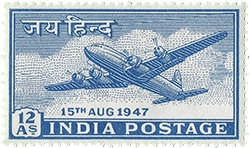
Technical Data
| Stamp Set | Independence |
|---|---|
| Date of Issue | December 15, 1947 |
| Denomination | 12 ANNAS |
| Quantity | 2,400,000 |
| Printer | Nasik Security Press |
From Ancient Couriers to the First Air Mail Service
The India Post has a history that dates back to ancient times, reflecting the deep-rooted tradition of communication in India. The Indian Postal System emerged from the essential need for rulers to stay connected with officials across distant regions and remain informed about developments throughout their empire.
Ancient Origins and Early Communication Network
The early structure of the Indian Postal System is vividly described by the renowned traveler Ibn Battuta, who visited India during the reign of Muhammad bin Tughluq in the 14th century.
He recorded the existence of two types of couriers, known as El Wolam:
- Horse couriers, stationed every four miles
- Foot couriers, placed at one-mile intervals at relay points called El Davah
This structured system ensured that messages were transmitted quickly across long distances. Couriers carried whips fitted with bells to signal their movement, allowing the next courier to be ready for immediate relay. This efficient chain enabled the Sultan to receive timely updates despite the vast size of his empire.
Evolution During the Colonial Period
The modern Indian postal system was formally opened to the public in 1837, with postage charges collected in cash. The standard rate was two annas per hundred miles, and copper tokens of equivalent value were introduced to facilitate payments.
A significant milestone came in 1852 with the introduction of the first postage stamps in Sindh. These stamps were issued in three varieties:
- Embossed on white paper without color
- Blue embossed on white paper
- Embossed on vermilion wafers
This innovation marked the beginning of a more structured and efficient postal system in India.
First Air Mail Flight in India
A major breakthrough in the Indian Postal System occurred on February 18, 1911, with the launch of the first official air mail service.
The historic flight was piloted by Henri Pequet, who carried around 6,500 letters and postcards from the exhibition grounds in Allahabad to Naini.
To mark this milestone, a special souvenir postmark was issued by the Postmaster General of U.P., and the seal was ceremonially destroyed after the flight, making it a unique historical artifact.
Legacy and Significance
The introduction of air mail marked the beginning of a new era in communication, significantly improving speed and efficiency. Over time, the Indian Postal System evolved into one of the largest and most reliable postal networks in the world.
Conclusion
From ancient courier networks to pioneering air mail services, the Indian Postal System showcases a remarkable journey of innovation and growth. It continues to serve as a vital communication backbone, connecting people across India with efficiency and reliability.