
Archaeological Survey of India
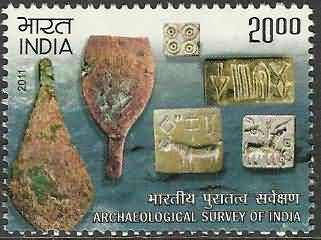
Technical Data
| Date of Issue | December 20, 2011 |
|---|---|
| Denomination | Rs. 20 |
| Quantity | 400,000 |
| Perforation | 13 |
| Printer | Security Printing Press, Hyderabad |
| Printing Process | Wet Offset |
| Watermark | No Watermark |
| Colors | Multicolor |
| Credit (Designed By) | Shri Kamleshwar Singh Smt. Alka Sharma |
| Catalog Codes |
Michel IN 2634 Stanley Gibbons IN 2852 WADP Numbering System - WNS IN058.2011 |
| Themes | Anniversaries and Jubilees | Archaeology | Coins | Rock Art and Cave Paintings |
Archaeology, while deeply engaged with the human past, is a distinctly modern discipline that promotes a meaningful relationship between society and its heritage. In a country like India, often described as a civilization living simultaneously in multiple centuries, understanding the interaction between past societies and their environment has become more relevant than ever. Archaeology helps foster cultural continuity, historical awareness, and harmony between development and preservation.
Archaeological Survey of India: Guardian of National Heritage
The responsibility of protecting India’s vast and diverse cultural heritage rests with the Archaeological Survey of India (ASI), an organisation under the Department of Culture, Ministry of Culture, Government of India. The ASI is entrusted with a wide range of functions, including archaeological research, scientific analysis, excavation of buried remains, conservation and preservation of protected monuments, maintenance of site museums, and regulation of construction activities around heritage sites and monuments of national importance.
Origins and Institutional Growth of Indian Archaeology
The scientific study of India’s past began in the late eighteenth century, inspired by early accounts of travellers such as Yuan Chwang. A major turning point came with the arrival of Sir William Jones and the establishment of the Asiatic Society in 1784, which gave significant impetus to archaeological and historical studies. These early efforts culminated in the formal establishment of the Archaeological Survey of India in 1861, marking the institutionalisation of archaeology in the country.
Visionary archaeologists such as Alexander Cunningham, John Marshall, and Mortimer Wheeler played a pivotal role in shaping the ASI into a leading institution for archaeological research and knowledge generation.
A Vast and Diverse Cultural Landscape
The heritage protected by the ASI is immense in scale and diversity. Today, the ASI safeguards around 3,650 monuments and sites spread across the length and breadth of India. These include palaces, temples, mosques, churches, monasteries, stupas, step-wells, megaliths, pillars, kos-minars, tombs, cemeteries, sarais, rock shelters with prehistoric paintings, and rock-cut caves. Together, they represent prehistoric, proto-historic, historic, medieval, and colonial periods.
Located across varied bio-geographical zones—from the snow-clad Himalayas to the coastal regions of Tamil Nadu—these monuments reflect India’s unity, cultural plurality, and layered historical evolution. They stand as a priceless legacy for future generations.
Challenges of Conservation in a Changing World
Conservation in India presents complex challenges due to varying climatic conditions, geographical diversity, and human interactions with heritage. With the growing recognition of intangible cultural heritage and its interface with tangible monuments, the ASI faces evolving responsibilities that require new knowledge systems and interdisciplinary approaches.
Conservation today extends beyond monuments and archaeological sites to encompass environmental concerns, developmental pressures, land-use issues, and community engagement. Over time, the ASI has built a strong pool of trained professionals and accumulated valuable experience to address these challenges effectively.
150 Years of Service to Heritage and Nation Building
Despite limitations and challenges, the Archaeological Survey of India has served the cause of heritage preservation and nation building with dedication and credibility for 150 years. Its sustained efforts continue to safeguard India’s cultural inheritance while adapting to contemporary needs.
Philatelic Commemoration
To mark the 150th Anniversary of the Archaeological Survey of India, the Department of Posts commemorates this milestone with the issue of a set of two commemorative postage stamps. These stamps honour the ASI’s enduring contribution to archaeological research, conservation, and the preservation of India’s rich cultural heritage.
First Day Cover
