
Bartholomaeus Ziegenbalg

Technical Data
| Date of Issue | December 10, 2006 |
|---|---|
| Denomination | Rs. 5 |
| Quantity | 400,000 |
| Perforation | comb13¼ |
| Printer | India Security Press, Nasik |
| Printing Process | Photogravure |
| Watermark | No Watermark |
| Colors | Multicolor |
| Credit (Designed By) | Mr. Suresh Kumar |
| Catalog Codes |
Michel IN 2179 Stamp Number IN 2177 Yvert et Tellier IN 1940 Stanley Gibbons IN 2369 |
| Themes | Anniversaries and Jubilees | Clergy | Famous people | Men |
Pioneer of Indo-German Cultural Exchange
Bartholomaeus Ziegenbalg was a German theologian, missionary, and scholar who made India his home and played a pioneering role in building bridges between Western and Indian cultures. His contributions to Tamil language, literature, printing, and education marked the beginning of a remarkable chapter in Indo-German relations.
Arrival in India and Cultural Transformation
Ziegenbalg arrived in Tranquebar (present-day Tharangambadi, Tamil Nadu) on 9th July 1706. Initially, his mission was to introduce German Lutheran Pietism among communities influenced by various Bhakti traditions. However, his deep engagement with the people and their way of life transformed his outlook.
Instead of remaining a distant observer, he immersed himself in Indian culture and became a respected scholar of Tamil language and religious heritage.
Contribution to Tamil Language and Literature
Ziegenbalg adopted an innovative approach to learning Tamil and soon became proficient in the language. He translated the New Testament into Tamil, making Christian scriptures accessible to the local population.
His scholarly achievements include translating Tamil grammatical prose into Latin and composing the first Tamil grammar in Europe, Grammatica Damulica, which was published in 1716 in Halle, Germany.
In 1711, he authored Malabarian Gods, a comprehensive treatise that referenced 176 Tamil literary works, including Sivavackiam, Gnanavenba, and Thiruvilayadal Puranam. His second major work, Genealogy of Malabarian Gods, incorporated 145 letters written by Tamil scholars, reflecting his close intellectual association with local thinkers.
Many of his letters, poems, and correspondences remain valuable historical sources, some preserved as palm leaf manuscripts.
Introduction of Printing and Educational Reforms
Ziegenbalg introduced a Tamil printing press in Tranquebar in 1712—an important milestone in the history of printing in India. The publication of Nirubam, a small circular, marked the beginning of Tamil printed literature.
He also contributed to social reform by establishing the first school for girls in 1710, promoting education at a time when such initiatives were rare. His efforts played a role in shaping early educational development in Tamil Nadu.
Legacy and Commemoration
Bartholomaeus Ziegenbalg passed away in India in 1719, but his legacy continues through his scholarly works and cultural contributions. He is remembered as a key figure who fostered mutual understanding between India and Germany.
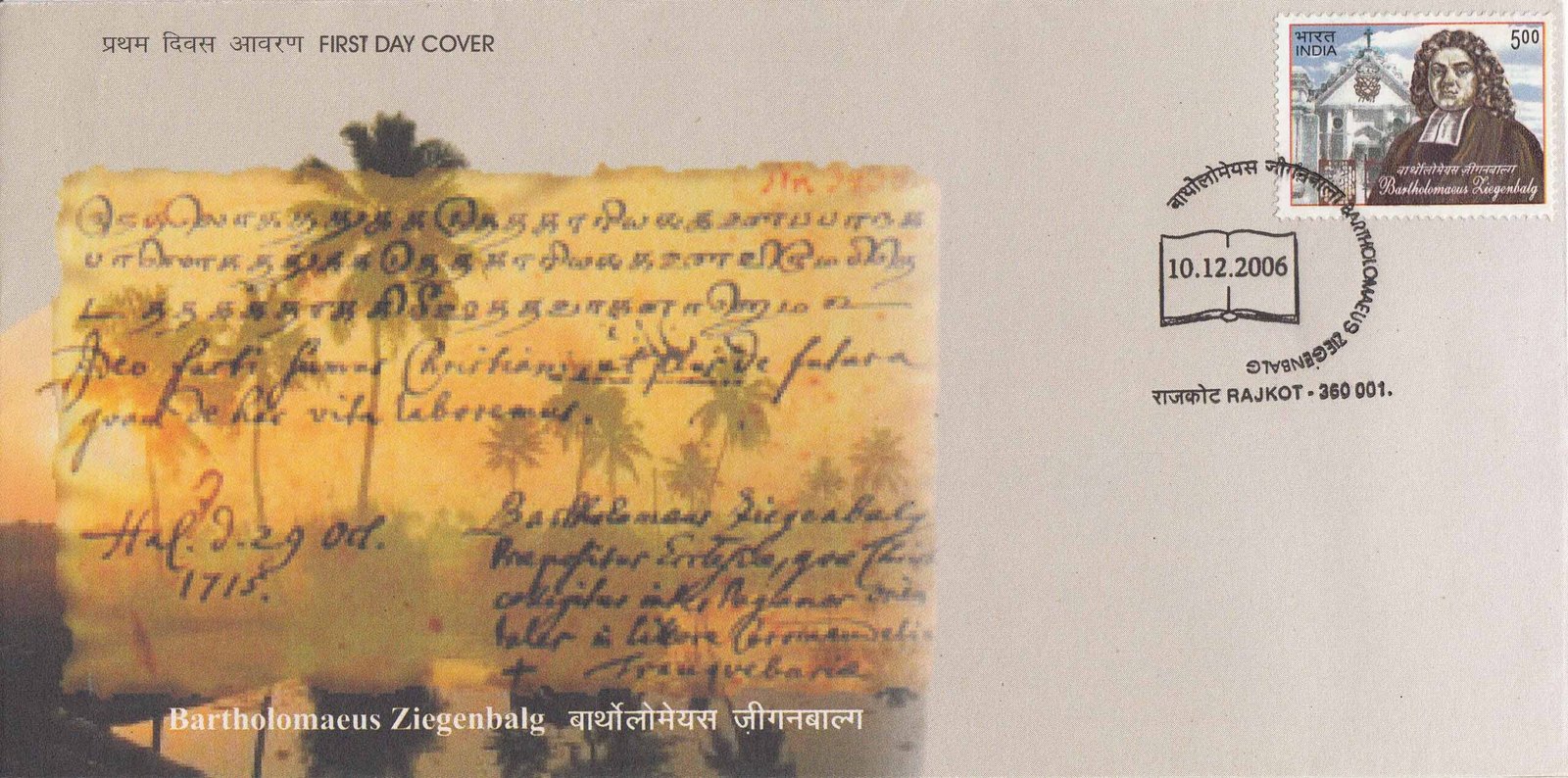
To commemorate the 300th anniversary of his arrival in India, the Department of Posts issued a postage stamp in honor of Bartholomaeus Ziegenbalg, celebrating his enduring contributions to language, literature, education, and Indo-German relations.
First Day Cover
Leave a Comment
You must be logged in to post a comment.