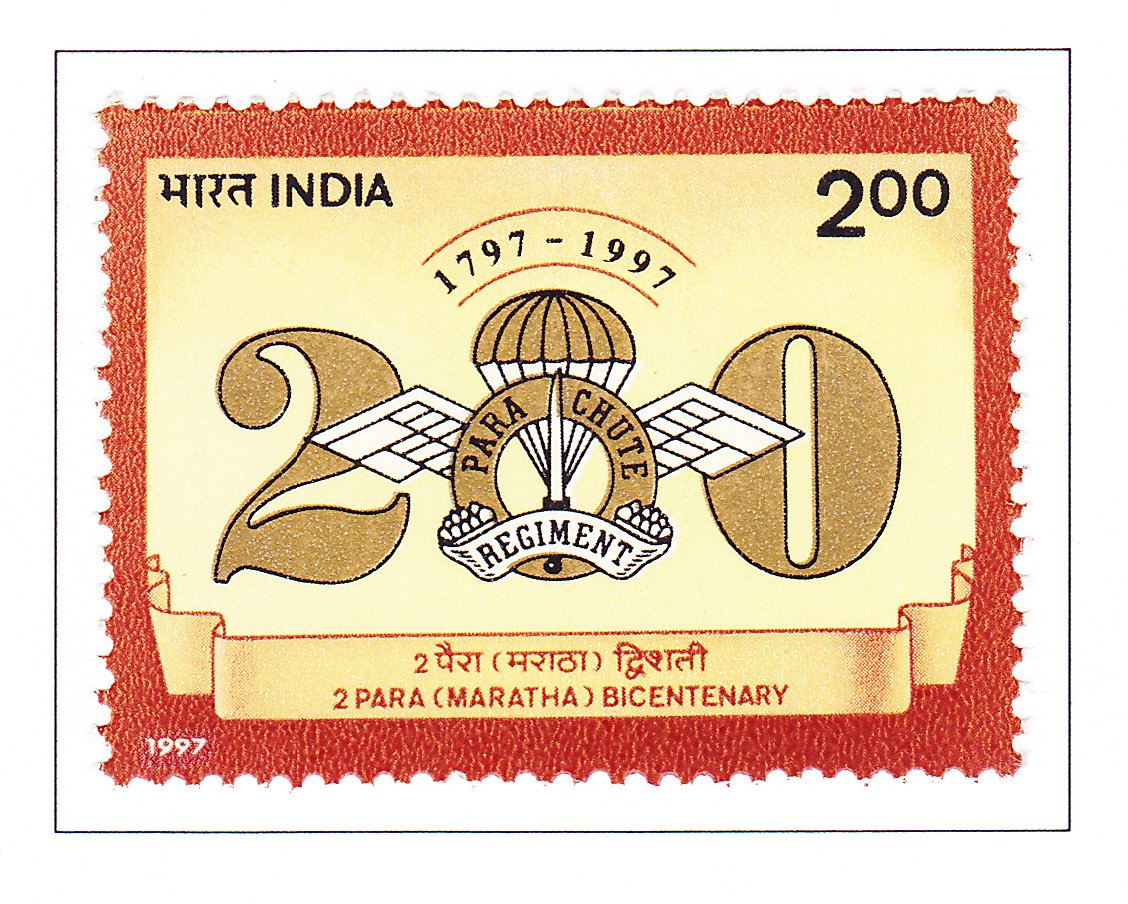
Bicentenary of 2nd (Maratha) Battalion, Parachute Regiment
Technical Data
| Stamp Set | Centenary Series |
|---|---|
| Date of Issue | September 7, 1997 |
| Denomination | Rs. 2 |
| Quantity | 700,000 |
| Perforation | comb 13½ x 13 |
| Printer | Security Printing Press, Nashik |
| Printing Process | Photogravure |
| Watermark | No Watermark |
| Colors | Multicolor |
| Credit (Designed By) | |
| Catalog Codes |
Michel IN 1567 Stamp Number IN 1619 Yvert et Tellier IN 1342 Stanley Gibbons IN 1731 |
| Themes | Anniversaries and Jubilees | Army | Military Forces | Numbers | Seals(Emblems) |
Formation and Early History
The Battalion was raised on 6 September 1797 for the Bombay Presidency under a treaty with the Raja of Travancore. It was originally designated as the 2nd Battalion, 5th Regiment Native Infantry of the Travancore Regiment.
Distinguished Service in the 19th Century
The Battalion displayed exceptional courage during the Abyssinian Campaign (1867–68), especially in the storming of Magdala. For its gallantry, it received the honour of being designated a Light Infantry Regiment. Later, it participated in the Second Afghan War.
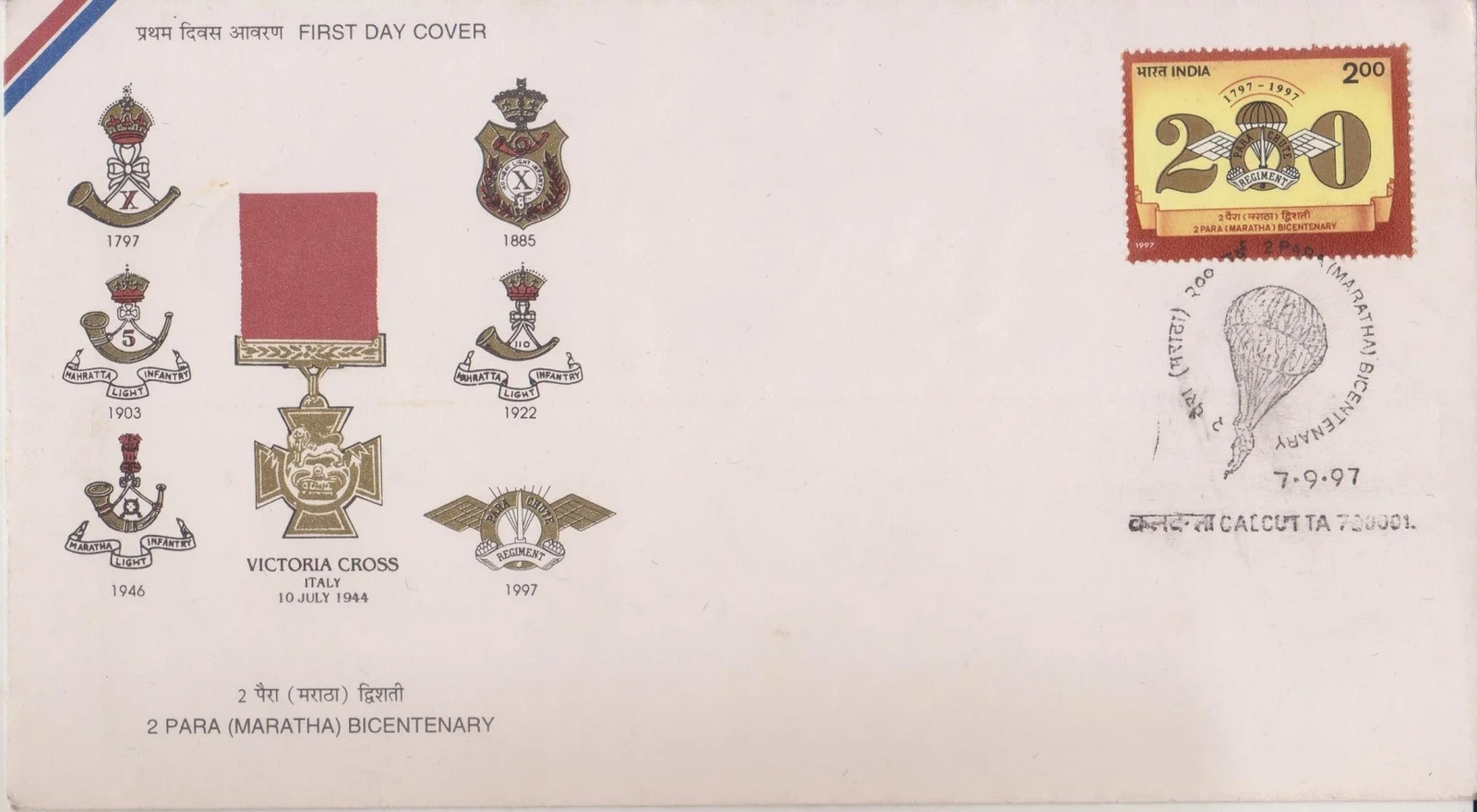
In 1885, it became the 10th Regiment, The Bombay Native Light Infantry, and in 1903 it was redesignated as the 110 Maharatta Light Infantry.
Role in the First World War
During the First World War, the Battalion fought against Turkish forces in Mesopotamia and earned distinction in battles at Shaiba, Kut-el-Amara, and Ctesiphon. It also served as part of the Egyptian Expeditionary Force in Palestine.
Heroism in the Second World War
The Battalion won lasting fame in the assault on the strong Italian fortress of Keren. It also fought against Field Marshal Rommel’s forces in North Africa. In Italy, Naik Yeshwant Ghadge was posthumously awarded the Victoria Cross for supreme bravery at Citta-de-Castello.
Transition to Airborne Forces
In 1946, the Battalion was selected for parachute duties under the 2nd Indian Airborne Division and redesignated as the 3rd Parachute Battalion, The Maharatta Light Infantry.
Service After Independence
In 1948, the Battalion was sent to Jammu and Kashmir, where it fought notable battles at Naushera and Jhangar. On 15 April 1952, it became part of the Parachute Regiment and was redesignated as the Second Battalion, The Parachute Regiment.
It later served with the Indian Custodian Forces in Korea and took part in the liberation of Goa in 1961.
Wars of 1965 and 1971
During the Indo-Pak War, the Battalion saw action in the Rann of Kutch and Lahore sectors. In 1971, it achieved distinction by carrying out the first airborne assault of the Indian Army in the Eastern Sector and became the first Indian Army unit to enter Dacca.
Counter-Insurgency Operations
From April 1990 to December 1991, the Battalion served in Operation Hifazat in the North East. Its outstanding service earned several gallantry awards, including one Kirti Chakra (Posthumous).
Honours and Decorations
The Battalion has won 30 Battle/Theatre Honours and is one of the most decorated battalions of the Indian Army. Its 240 awards include:
- 1 Victoria Cross
- 4 Maha Vir Chakras
- 1 Kirti Chakra
- 17 Vir Chakras
- 1 Ashok Chakra Class III
Commemorative Stamp
The Department of Posts issued a commemorative postage stamp on 2nd Para Battalion on the occasion of its Bicentenary Celebrations on 7 September 1997.
First Day Cover