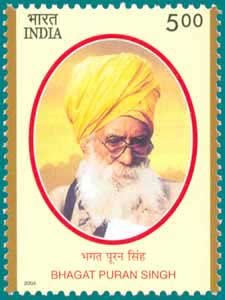
Bhagat Puran Singh (1904-1992)
Technical Data
| Date of Issue | December 10, 2004 |
|---|---|
| Denomination | Rs. 5 |
| Quantity | 450,000 |
| Perforation | comb 13½ |
| Printer | Calcutta Security Printers Ltd |
| Watermark | No Watermark |
| Colors | Multicolor |
| Catalog Codes |
Michel IN 2064 Stamp Number IN 2090 Yvert et Tellier IN 1825 Stanley Gibbons IN 2245 WADP Numbering System - WNS IN050.04 |
| Themes | Anniversaries and Jubilees | Authors | Famous people | Headgear | Literary People (Poets and Writers) | Literature | Men | Optical Instruments |
Apostle of Selfless Service
Bhagat Puran Singh was a remarkable humanitarian who dedicated his entire life to serving the helpless and destitute. Known for his extraordinary compassion and humility, he lived a simple life while tirelessly caring for the aged, disabled, and abandoned. With no financial resources or institutional support, he often begged on the streets and outside places of worship—not for himself, but to gather help for those in need. His unwavering faith in God and humanity enabled him to build the renowned charitable institution Pingalwara, which stands today as a lasting monument to his life’s mission.
Early Life and Education
Bhagat Puran Singh was born on 4 June 1904 in Rajewal in the district of Ludhiana, to Chibu Mal and Mehtab Kaur. He was originally named Ramji Das. In 1923, after embracing Sikhism, he adopted the name Puran Singh.
His mother played a significant role in shaping his character. She taught him to remove harmful objects such as thorns, broken glass, nails, and stones from roads and pathways so that they would not injure pedestrians or animals. This simple act of kindness instilled in him a lifelong sense of compassion and responsibility toward others.
Puran Singh began his education in Khanna and later joined Khalsa High School Lahore. During his time in Lahore, he regularly performed sewa (selfless service) at Gurdwara Dera Sahib and Gurdwara Shahid Ganj, where he helped cook, clean, and care for the elderly and sick who sought refuge at these places.
Love for Knowledge
Apart from service, Puran Singh had a deep love for reading and learning. He frequently visited libraries such as Dayal Singh Library and Dwarka Dass Library. These libraries broadened his outlook on philosophical, humanitarian, and environmental issues.
Among the thinkers who influenced him were John Ruskin, Ralph Waldo Emerson, Henry David Thoreau, and Mahatma Gandhi. He was particularly inspired by Gandhi’s journal Young India.
The Turning Point: Caring for Piara
In November 1934, Puran Singh discovered a four-year-old abandoned boy near the gate of Gurdwara Dera Sahib. The child was mute, mentally challenged, physically deformed, and suffering from dysentery. Puran Singh adopted him and lovingly named him Piara, meaning “the loved one.”
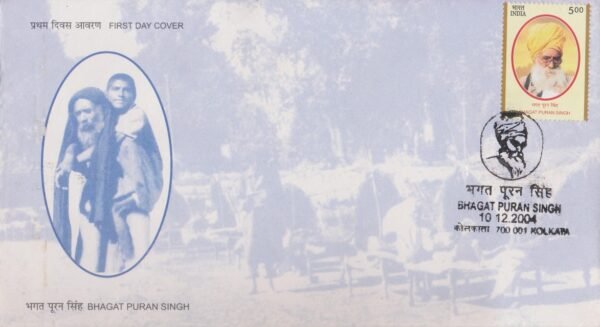
For the next fourteen years, Puran Singh carried Piara on his back wherever he went. This powerful image came to symbolize his lifelong mission—carrying the burdens of the helpless and forgotten members of society.
Partition and Migration
As the Partition of India approached, violence engulfed many cities including Lahore. On 13 August 1947, Gurdwara Shahid Ganj was attacked during the unrest. Puran Singh and Piara escaped because they happened to be at Gurdwara Dera Sahib at the time.
On 18 August 1947, the 43-year-old Puran Singh boarded a refugee truck heading to Amritsar, carrying Piara on his back. Like millions of others displaced during Partition, he arrived in India without family, friends, or financial support.
Establishment of Pingalwara
In Amritsar, Bhagat Puran Singh began caring for destitute individuals, eventually founding Pingalwara, a charitable home for the disabled, abandoned, and impoverished. On 6 March 1957, the All India Pingalwara Society was officially registered with the government.
The term “Pingalwara” is often interpreted as a home for the crippled or handicapped, but for Puran Singh it meant something deeper—the restoration of dignity and hope to those who had been abandoned by society.
Through Pingalwara, he provided food, shelter, medical care, and compassion to countless people. His life embodied the principle that service to humanity is service to God.
Legacy
Bhagat Puran Singh passed away on 5 August 1992, but his spirit continues to live through the ongoing work of Pingalwara. His life remains an inspiring example of selfless service, compassion, and dedication to humanity.
To honour his extraordinary contribution, India Post issued a commemorative postage stamp paying tribute to Bhagat Puran Singh. The First Day Cover of the stamp depicts the early days of Pingalwara and the unforgettable image of Bhagatji carrying Piara on his back—a symbol of his lifelong commitment to serving the most vulnerable members of society.
First Day Cover