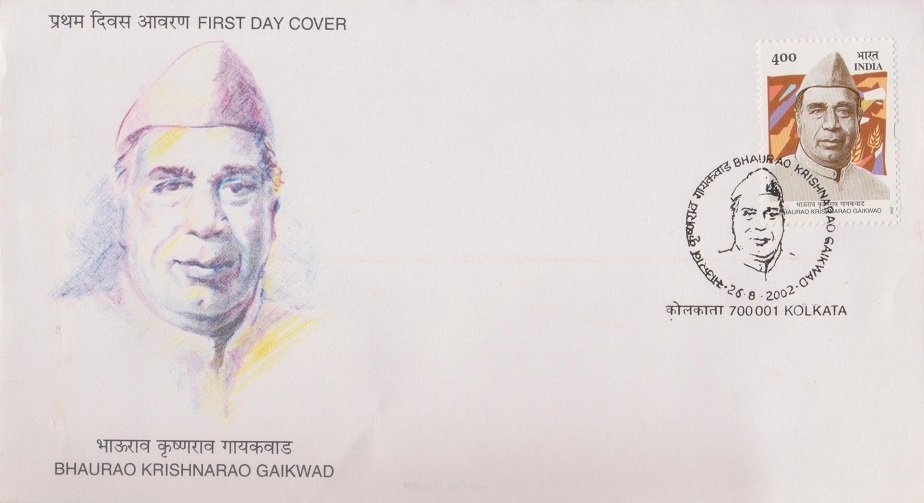
Bhaurao Krishnarao Gaikwad (1902-1971)

Technical Data
| Date of Issue | August 26, 2002 |
|---|---|
| Denomination | Rs. 4 |
| Quantity | 400,000 |
| Perforation | Syncopated 13 x 13¼ |
| Printer | Calcutta Security Printers Ltd |
| Printing Process | Offset Lithography |
| Watermark | No Watermark |
| Colors | Multicolor |
| Credit (Designed By) | Sh. Sankha Samanta |
| Catalog Codes |
Michel IN 1915 Stamp Number IN 1966 Yvert et Tellier IN 1679 Stanley Gibbons IN 2081 WADP Numbering System - WNS IN026.02 |
| Themes | Anniversaries and Jubilees | Famous people | Headgear | Men | Politicians | Reformers |
Champion of Social Justice
Bhaurao Krishnarao Gaikwad (1902–1971), popularly known as Dadasaheb Gaikwad, was a fearless social reformer and leader who dedicated his life to fighting for the rights of the oppressed and marginalized sections of Indian society.
Early Life and Rise to Leadership
Born in the Nashik district, Gaikwad emerged as a powerful voice for social justice at a young age. He first gained prominence during the historic Mahad Satyagraha (1927), where his inspiring speeches against British rule and social discrimination caught the attention of B. R. Ambedkar, with whom he later shared a close and enduring association.
Struggle Against Untouchability
Gaikwad played a key role in several movements aimed at eradicating caste discrimination:
- In 1930, he actively participated in the Kalaram Temple Satyagraha, demanding temple entry rights for the oppressed communities. His involvement led to imprisonment.
- He fearlessly opposed untouchability and caste-based oppression, often facing resistance from orthodox sections of society.
- He organized the Dhamma Parishad at Yeola, where Dr. Ambedkar declared his decision to renounce Hinduism—an event that marked a turning point in India’s social reform movement.
Role in Post-Independence India
After independence, Gaikwad continued his struggle for social and economic equality:
- Led numerous Satyagrahas for the rights of the poor and landless
- Played a significant role in influencing policies for the upliftment of underprivileged communities, especially in Maharashtra
- Traveled extensively across India, mobilizing grassroots support and inspiring mass movements
In 1956, following the path of Dr. Ambedkar, he embraced Buddhism, marking his commitment to social equality and spiritual transformation.
Political Career and Public Service
Gaikwad also contributed through legislative and parliamentary roles:
- Member of the Bombay Legislative Assembly (1937–1946)
- Served as a Member of both the Lok Sabha and the Rajya Sabha
His work extended beyond politics into education and social welfare, where he remained closely associated with various institutions.
Recognition and Legacy
In recognition of his contributions, he was awarded the Padma Shri in 1968.
Dadasaheb Gaikwad’s life stands as a testament to courage, resilience, and commitment to equality. His efforts significantly contributed to the socio-economic upliftment of marginalized communities in India.
To honour his legacy, India Post issued a commemorative postage stamp on the occasion of his birth centenary, celebrating his enduring contribution to social justice and nation-building.
First Day Cover