
Bhausaheb Hiray
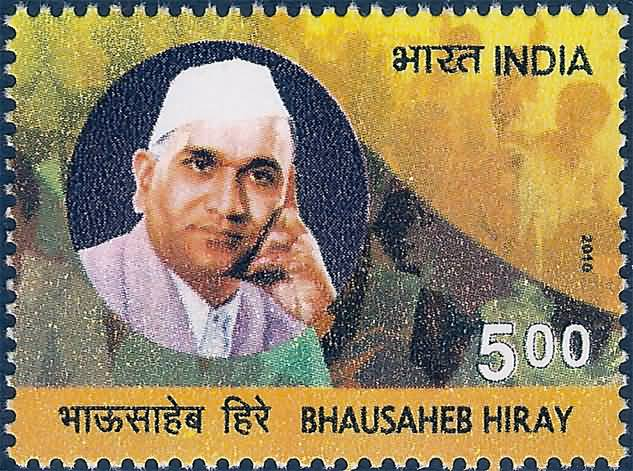
Technical Data
| Date of Issue | December 22, 2010 |
|---|---|
| Denomination | Rs. 5 |
| Quantity | 300,000 |
| Perforation | 13 |
| Printer | India Security Press, Nasik |
| Printing Process | Wet Offset |
| Watermark | No Watermark |
| Colors | Multicolor |
| Credit (Designed By) | Smt. Alka Sharma |
| Catalog Codes |
Michel IN 2540 Stamp Number IN 2478 Stanley Gibbons IN 2780 WADP Numbering System - WNS IN086.2010 |
| Themes | Commemoration | Famous people | Headgear | Men |
Social Reformer and Champion of Education
Shri Bhausaheb Hiray was a distinguished social reformer, freedom fighter, and educationist whose life was dedicated to uplifting the underprivileged through education and social reform. His tireless efforts in promoting tribal welfare, cooperative movements, and rural development left a lasting impact on Maharashtra.
India Post is happy to issue a commemorative postage stamp on Shri Bhausaheb Hiray, honouring his invaluable contribution to society and nation-building.
Early Life and Education
Bhausaheb Hiray was born on 1 March 1905 in Nimgaon, a small village in Nashik district of Maharashtra. He received his primary education in his village and later moved to a nearby town to complete his high school studies. After graduation, he pursued a degree in law (L.L.B.) from Vadodara, equipping himself with the knowledge that would later support his public and social work.
Association with the Sathyashodhak Movement
Shri Bhausaheb Hiray actively participated in the social reform initiatives of the Sathyashodhak Movement launched by Jyotirao Phule. Inspired by the ideals of social equality and justice, he worked toward the upliftment of marginalized communities.
He also took part in the historic Quit India Movement and was imprisoned for fifteen months, demonstrating his commitment to India’s freedom struggle.
Mission for Education and Tribal Welfare
Bhausaheb Hiray firmly believed that education was the most powerful tool to eradicate poverty. Making it his life’s mission to provide access to quality education, he established the “Nimgaon Vibhag Prasarak Mandal” and the Adivasi Sewa Samiti, through which he opened schools and hostels for students from disadvantaged backgrounds.
By 1952, the various educational institutions he had founded were brought together under one umbrella organization named Mahatma Gandhi Vidya Mandir. This institution continues to stand as a testament to his vision of accessible and inclusive education.
Contribution to Social and Economic Development
Shri Bhausaheb Hiray played a commendable role in strengthening the cooperative movement and fostering unity between different communities, including Hindus and Muslims. His efforts extended to supporting tribal movements and advocating for agrarian reforms.
He was instrumental in the implementation of the Tillers Act and supported major development initiatives such as the Koyna Dam Project, which contributed significantly to Maharashtra’s progress.
In 1960, he led a delegation to Japan, where he effectively voiced India’s concerns regarding nuclear proliferation, reflecting his engagement with international issues and national interests.
Legacy and Commemorative Postage Stamp
Shri Bhausaheb Hiray passed away on 6 November 1961, leaving behind a legacy of service, reform, and dedication to the welfare of society.
To commemorate his remarkable life and contributions, India Post issued a commemorative postage stamp on Shri Bhausaheb Hiray. The stamp honours his role as a freedom fighter, educationist, and social reformer who devoted his life to empowering the marginalized and promoting educational advancement.
Enduring Inspiration
The life of Shri Bhausaheb Hiray stands as an inspiring example of how dedication to education and social justice can transform communities. His work in tribal welfare, cooperative development, and rural education continues to influence generations and remains an integral part of Maharashtra’s social history.
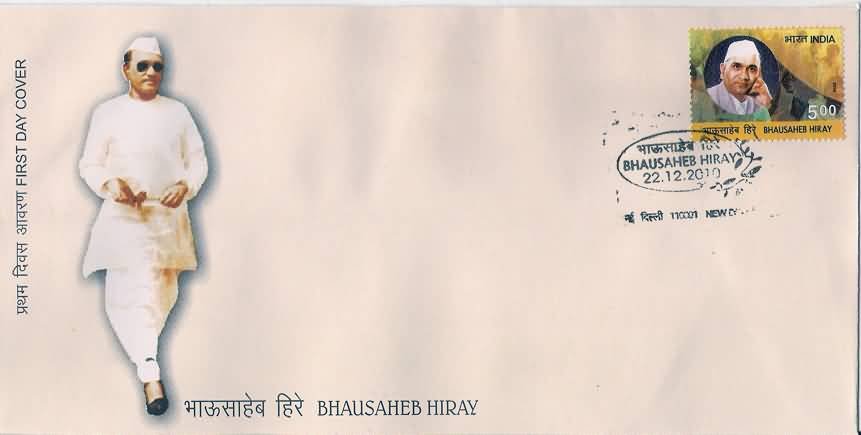
First Day Cover
Leave a Comment
You must be logged in to post a comment.