
Birth Bicentenary of Louis Braille
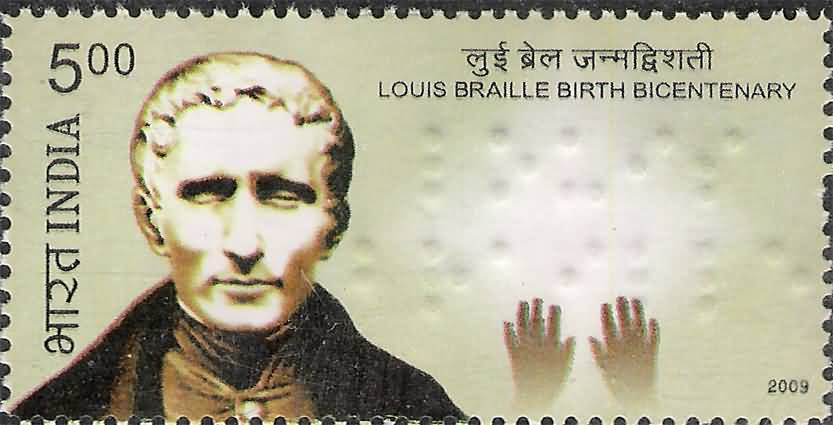
Technical Data
| Date of Issue | January 4, 2009 |
|---|---|
| Denomination | Rs. 5 |
| Quantity | 300,000 |
| Perforation | 13 |
| Printer | India Security Press, Nasik |
| Printing Process | Photo Gravure |
| Watermark | No Watermark |
| Colors | Multicolor |
| Credit (Designed By) | Sh. Sankha Samanta |
| Catalog Codes |
Michel IN 2339 Stamp Number IN 2305 Yvert et Tellier IN 2104 Stanley Gibbons IN 2563 WADP Numbering System - WNS IN001.2009 |
| Themes | Anniversaries and Jubilees | Braille (Writing System) | Famous people | Hands | Men |
Inventor of the Braille Script and Champion of the Visually Impaired
There was a time when people believed that blind individuals could never learn to read or write. Reading was thought to be possible only through sight. This perception changed forever because of one remarkable individual — Louis Braille.
Today, millions of visually impaired people across the world read and write using the Braille script, an embossed system of raised dots named after its inventor.
Early Life of Louis Braille
Louis Braille was born on January 4, 1809, in Coupvray, near Paris, France. His father, Simon Braille, was a harness and saddle maker.
At the age of four, Louis accidentally injured his eye while playing with an awl in his father’s workshop. The injury led to a severe infection, eventually causing complete blindness in both eyes. Despite this life-altering tragedy, young Louis showed exceptional determination and intelligence.
For two years, he attended the local village school alongside sighted children. However, without the ability to read or write, continuing education became nearly impossible.
Education at the Royal Institute for Blind Youth
At the age of ten, Louis Braille received admission to one of the world’s first schools for blind children in Paris — the Royal Institute for Blind Youth.
Conditions at the school were harsh. Discipline was strict, and resources were limited. Students were taught practical trades like chair caning and slipper making so they could earn a living later in life.
Reading was taught through raised letters formed by pressing copper wires into paper. However, this system was extremely difficult to read and impossible for blind students to write themselves. Independence remained out of reach.
Inspiration from Night Writing
In 1821, a French soldier named Charles Barbier visited the school. He introduced a system called “night writing,” developed for soldiers to communicate silently in the dark using twelve raised dots.
Although too complicated for military use, Louis Braille immediately saw its potential.
Development of the Braille Script
Determined to simplify the system, Louis Braille experimented tirelessly. He reduced the twelve-dot system to a six-dot cell, arranged in two vertical rows. This simple yet powerful structure allowed for combinations representing letters, numbers, punctuation, music notation, and mathematics.
By 1827, the first book in Braille was published.
However, the new system was not immediately accepted. Some educators resisted change, and at one point, the use of Braille was even banned in the school. Nevertheless, students continued learning it secretly.
Gradually, the effectiveness of the Braille system became undeniable.
Why Braille Was Revolutionary
Braille was revolutionary because it allowed visually impaired individuals to:
- Read independently
- Write using a stylus and slate
- Learn mathematics and music
- Access education without reliance on others
For the first time in history, blind and partially sighted individuals gained true independence.
It is important to note that Braille is a script, not a language. It consists of six embossed dots arranged in two vertical columns and can be adapted to any language worldwide.
Today, advanced technological devices and software further support Braille writing and printing, but the core six-dot system remains almost unchanged — a testament to Louis Braille’s brilliance.
Later Life and Recognition
Louis Braille became a respected teacher at the same institute where he had studied. Unfortunately, he suffered from poor health and died of tuberculosis in 1852 at the age of 43.
He did not live to see his system widely adopted.
In 1952, on the 100th anniversary of his death, the French government honored him by transferring his remains to the Panthéon in Paris — the resting place of France’s national heroes.
200th Birth Anniversary of Louis Braille
The year 2009 marked the 200th Birth Anniversary of Louis Braille, celebrated across India and the world. The occasion highlighted his immense contribution to education, empowerment, and equal opportunities for visually impaired individuals.
Louis Braille belongs not just to France but to the entire world. His invention transformed millions of lives and continues to do so.
Commemorative Postage Stamp on Louis Braille
To honor his extraordinary contribution, India Post proudly issued a Commemorative Postage Stamp on Louis Braille.
The commemorative stamp recognizes Louis Braille’s pioneering invention and his lasting impact on global education and accessibility. By issuing this stamp, India Post paid tribute to a visionary who empowered millions of visually impaired individuals to read, write, and live independently.
Such commemorative stamps preserve the legacy of great personalities and inspire future generations to value innovation, resilience, and human dignity.
Legacy of Louis Braille
For more than 150 years, the Braille system has remained fundamentally unchanged, despite rapid technological advancement. This enduring relevance reflects Louis Braille’s farsightedness, ingenuity, and deep understanding of human need.
Louis Braille paved the way for knowledge, empowerment, and equality for visually impaired people worldwide. His invention continues to illuminate lives — not through sight, but through touch and understanding.
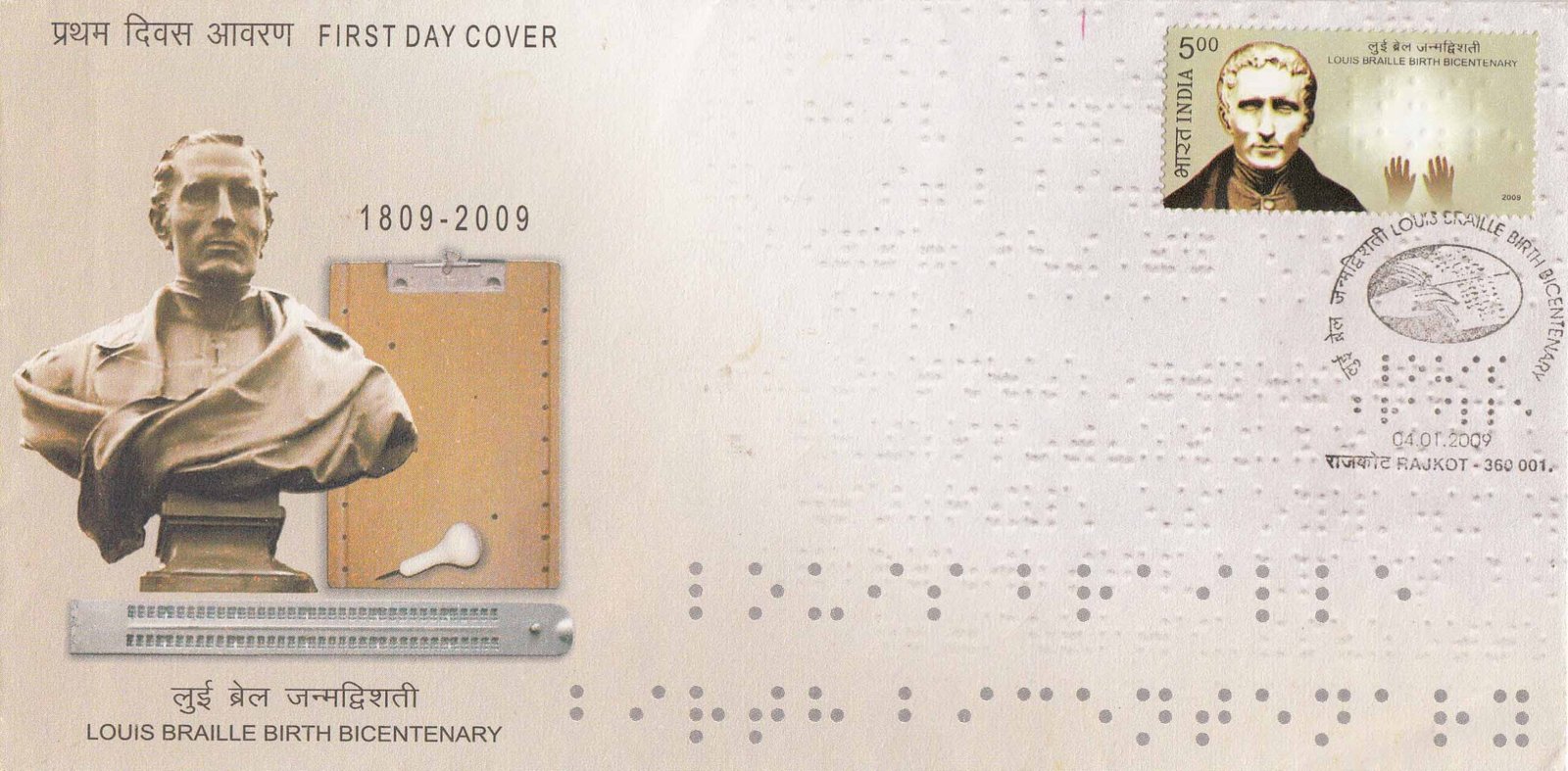
First Day Cover
Leave a Comment
You must be logged in to post a comment.