
Bismillah Khan
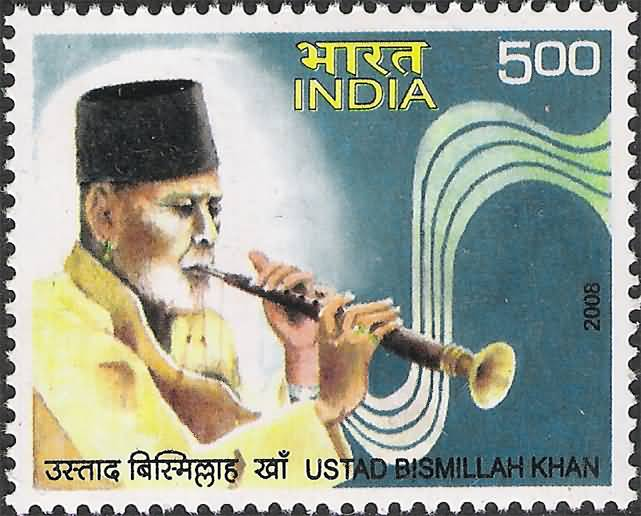
Technical Data
| Date of Issue | August 21, 2008 |
|---|---|
| Denomination | Rs. 5 |
| Quantity | 400,000 |
| Perforation | 13 |
| Printer | Security Printing Press, Hyderabad |
| Printing Process | Wet Offset |
| Watermark | No Watermark |
| Colors | Multicolor |
| Credit (Designed By) | Mr. Chitta Pakrashi |
| Catalog Codes |
Michel IN 2291 Stamp Number IN 2253 Stanley Gibbons IN 2501 WADP Numbering System - WNS IN035.2008 |
| Themes | Commemoration | Famous people | Headgear | Men | Musical Instruments | Musicians |
The concept of Nada (sound) occupies a sacred space in Indian spiritual thought, where classical music is regarded as sadhana—a disciplined quest for self-realization through melody. In the modern era, this mystical pursuit found its most luminous embodiment in Bismillah Khan and his shehnai.
Early Life and Musical Training
Born on 21 March 1916 in Dumraon, in present-day Bihar, into a family of court musicians, Ustad Bismillah Khan was introduced early to the world of music. His father, Paigambar Khan, and mother, Mitthan, nurtured his innate talent. He received rigorous training from his uncle, Ali Bux ‘Vilayatu’, the official shehnai player at the sacred Kashi Vishwanath Temple in Varanasi.
Under this tutelage, he absorbed not only the technical nuances of the shehnai but also the spiritual depth of the khayal tradition of Hindustani classical music. For him, music was a pathway to divine union. He often said that without striving to meet God, a musician may possess kala (art) but not assar (mystical impact).
Elevating the Shehnai
Though he first performed publicly at the age of fourteen at a music conference in Allahabad, it was his performance at the All-India Music Conference in Kolkata in 1937 that transformed both his destiny and that of the shehnai. Until then largely confined to temples and wedding processions, the shehnai evolved under his mastery into a respected classical concert instrument capable of rendering intricate ragas.
Over the next seven decades, the name “Bismillah Khan” became synonymous with the shehnai itself.
A Musician Rooted in Benaras
Deeply attached to Varanasi and its spiritual ethos, Ustad Saheb declined offers to permanently settle abroad—even when assured of relocation for his extended family. His simplicity, frugality, and saint-like detachment reflected the ethos of medieval bhakti poets. For him, music was not a means to fame but a journey toward Anand (divine bliss).
He lovingly referred to his shehnai as “Begum” after the passing of his wife, symbolizing the intimate bond he shared with his instrument.
Historic Performances
Ustad Bismillah Khan holds the rare distinction of performing on India’s Independence Day, 15 August 1947, from the Red Fort, where he rendered Raag Kafi. He also performed on the first Republic Day, 26 January 1950, presenting the composition “Sange dware badhiye baje,” inspired by the rhythms of Benaras boatmen.
For decades, his recital became an integral part of Independence Day celebrations broadcast on Doordarshan, echoing across the nation.
Awards and Honours
In recognition of his extraordinary contribution to Indian classical music, he received numerous prestigious awards:
- Sangeet Natak Akademi Award (1956)
- Padma Shri (1961)
- Padma Bhushan (1968)
- Padma Vibhushan (1980)
- Bharat Ratna (2001)
He was also conferred honorary doctorates by Banaras Hindu University and Visva-Bharati University.
Music Beyond Boundaries
Ustad Saheb believed that music transcends caste, creed, and religion. His home in Benaras, affectionately called “Bismillah Hotel,” was known for feeding any hungry visitor—reflecting his generosity and inclusive spirit.
He briefly appeared in Satyajit Ray’s film Jalsaghar and provided memorable shehnai music for the film Goonj Uthi Shehnai.
Final Years and Legacy
Ustad Bismillah Khan passed away on 21 August 2006 at the age of ninety. Remembered as the “Bismillah of Benaras,” he remains a living metaphor of India’s pluralistic and spiritual traditions. For him, the perfect sur (note) was pure and reflective—“like a mirror in which you see the world.”
His music was not merely performance; it was prayer, meditation, and transcendence.
Commemorative Postage Stamp
In honour of his unparalleled contribution to Indian classical music and his role in elevating the shehnai to global prominence, the Department of Posts has issued a commemorative postage stamp in memory of Bismillah Khan, celebrating the timeless resonance of his divine music.
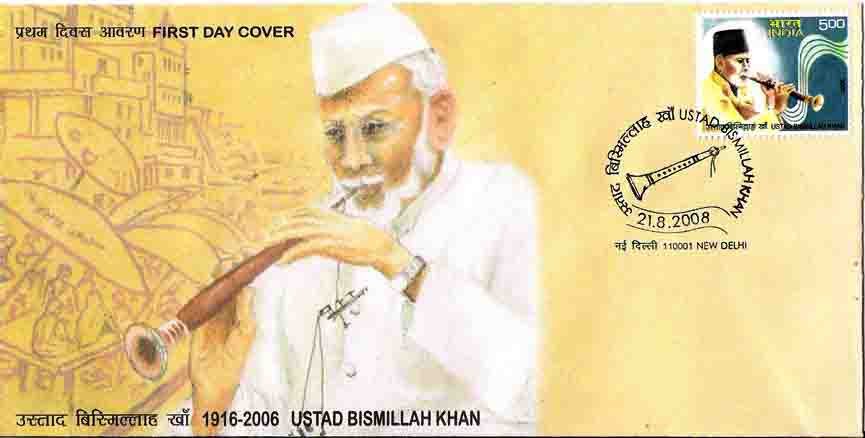
First Day Cover
Leave a Comment
You must be logged in to post a comment.