Brigadier Rajinder Singh (1899-1947)

Technical Data
| Stamp Set | Birth Centenary |
|---|---|
| Date of Issue | October 27, 1999 |
| Denomination | Rs. 3 |
| Quantity | 400,000 |
| Perforation | comb 13¼ x 13½ |
| Printer | Security Printing Press, Nashik |
| Printing Process | Photogravure |
| Watermark | No Watermark |
| Colors | Slate purple |
| Credit (Designed By) | |
| Catalog Codes |
Michel IN 1719 Stamp Number IN 1780 Yvert et Tellier IN 1486 Stanley Gibbons IN 1882 |
| Themes | Anniversaries and Jubilees | Famous people | Men | Military Officers | Uniforms |
The Saviour of Kashmir and India’s First Gallantry Awardee
Brigadier Rajinder Singh (1899–1947), widely known as the Saviour of Kashmir, was a brave soldier who made the ultimate sacrifice while defending the nation during the 1947 invasion of Jammu and Kashmir. His extraordinary courage earned him the distinction of being the first recipient of a gallantry award in independent India.
Early Life and Legacy of Bravery
Born in the village of Bagoona (later renamed Rajinderpura) near Jammu, Brigadier Rajinder Singh came from a lineage of valor and sacrifice. His ancestor, General Baj Singh, had laid down his life nearly a century earlier in the defence of Chitral, continuing a proud tradition of service.
Role During the 1947 Kashmir Invasion
At the time of the invasion, Brigadier Rajinder Singh served as the Chief of Staff of the erstwhile Jammu and Kashmir State Forces under Maharaja Hari Singh.
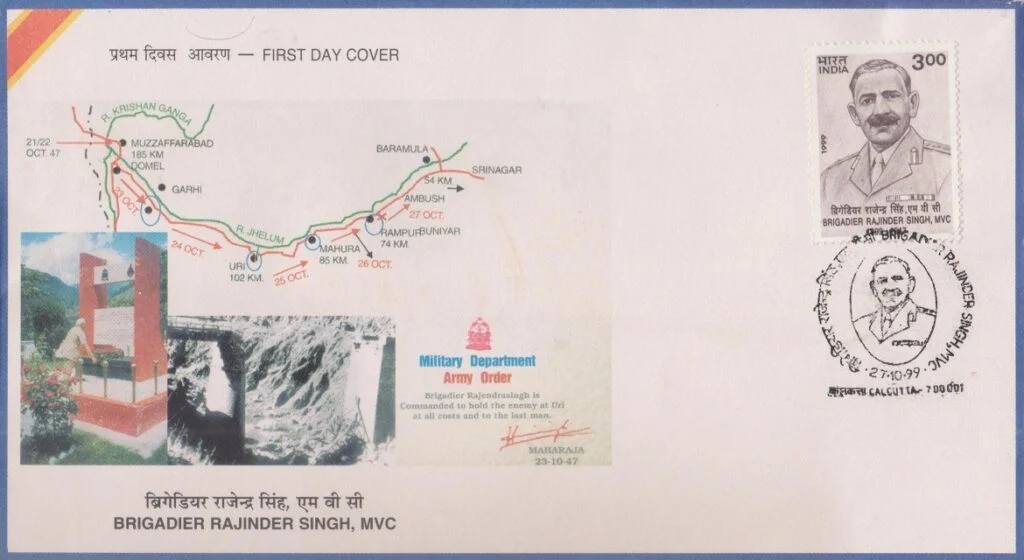
On 21st October 1947, tribal forces backed by Pakistan attacked Muzaffarabad with the objective of capturing the Kashmir Valley. After the fall of Muzaffarabad, the Maharaja personally instructed Brigadier Rajinder Singh to lead a defensive operation towards the Uri sector.
Heroic Defence of Kashmir
On 22nd October 1947, with limited resources, Brigadier Rajinder Singh gathered a small force of just two platoons from Srinagar Cantonment and moved towards Uri.
In a decisive and strategic move, he ordered the destruction of the Uri bridge—an act that significantly delayed the advancing enemy forces. This bold step played a crucial role in protecting the Kashmir Valley.
Despite being heavily outnumbered, he:
- Conducted a fighting withdrawal towards Baramulla
- Delayed enemy forces at Mahora
- Established a defensive position at Rampur Bunyar
His small force resisted the invaders until the early hours of 27th October 1947, buying precious time for India to respond militarily.
Ultimate Sacrifice
During the intense battle near Uri, Brigadier Rajinder Singh was severely wounded by machine-gun fire. Despite his injuries, he continued to lead and motivate his troops.
In a final act of unmatched bravery, with only his personal weapon remaining, he charged at the enemy and attained martyrdom at Bunyar near Uri. His courageous stand delayed the enemy advance by four critical days—time that proved decisive in saving Kashmir.
Recognition and Honour
For his exceptional bravery and leadership, Brigadier Rajinder Singh was posthumously awarded the Maha Vir Chakra, making him the first gallantry awardee of independent India.
A memorial at Bunyar stands as a tribute to his sacrifice, symbolizing courage and patriotism for future generations.
Commemoration
In recognition of his heroic contribution, India Post issued a commemorative postage stamp in his honour. The First Day Cover design features his memorial along with a route map of the historic battle he fought.
Conclusion
Brigadier Rajinder Singh remains a towering figure in India’s military history. His fearless leadership and selfless sacrifice not only delayed the enemy but also played a crucial role in safeguarding the Kashmir Valley. His legacy continues to inspire generations as a symbol of courage, duty, and unwavering patriotism.
First Day Cover