
Buddhadeva Bose

Technical Data
| Date of Issue | November 30, 2008 |
|---|---|
| Denomination | Rs. 5 |
| Quantity | 400,000 |
| Perforation | 13 |
| Printer | India Security Press, Nasik |
| Printing Process | Photogravure |
| Watermark | No Watermark |
| Colors | Multicolor |
| Credit (Designed By) | Sh. Sankha Samanta |
| Catalog Codes |
Michel IN 2316 Stamp Number IN 2275 Stanley Gibbons IN 2529 WADP Numbering System - WNS IN060.2008 |
| Themes | Anniversaries and Jubilees | Authors | Famous people | Journalists | Literary People (Poets and Writers) | Literature | Men |
A Pioneer of Modern Bengali Literature
Buddhadeva Bose, regarded as one of the most versatile and prolific creative geniuses after Rabindranath Tagore, was born on 30 November 1908 in Comilla (then in undivided India, now in Bangladesh). A towering figure in twentieth-century Bengali literature, Bose moved effortlessly across genres—poetry, novels, short stories, plays, literary criticism, travelogues, and memoirs—leaving a profound mark on each.
Throughout his life, he remained deeply immersed in literature as a reader, writer, teacher, editor, and promoter. A distinguished academic, he founded the discipline of Comparative Literature in India at the newly established Jadavpur University in 1956, pioneering a new direction in literary studies.
Champion of Modern Bengali Poetry
A quintessential poet, Bose pioneered the concept of a magazine devoted exclusively to poetry. In the mid-1930s, he established Kavita, a path-breaking literary quarterly that he edited and published for 25 years (1935–1961). He was also the first to use the term “little magazine” for his poetry journal.
The evolution of post-Tagore modernism in Bengali poetry can be traced through the pages of Kavita. Bose played a crucial role in nurturing and promoting major contemporary poets such as Jibananda Das, Amiya Chakraborty, Sudhindranath Dutta, Bishnu De, Samar Sen, and Subhash Mukhopadhyay. He also encouraged younger voices like Sunil Gangopadhyay, Shakti Chattopadhyay, Tarapada Roy, and Pranabendu Dasgupta.
His modest Kolkata residence became a vibrant hub of intellectual exchange and literary “addas.” Sunil Gangopadhyay fondly described him as the “youngest among the young,” acknowledging his openness to debate and dialogue with emerging writers. Rarely in literary history has a major poet devoted so much of his life to fostering multiple generations of fellow poets.
Literary Career and Major Works
Despite enduring financial hardship for much of his life, Bose remained steadfast in pursuing what he called his “Swadharma”—his true calling as a writer. His first major poetry collection, Bandir Bandana, written in his late teens and published in 1930, established him as a bold and gifted poet at just 22 years of age. In the same year, his first novel SaDa was published.
Over time, his literary voice evolved from the powerful flow of youthful passion to the profound depth of mature reflection. The final 15 years of his life are often considered his most creatively rich period. His verse plays reinterpreting episodes from the Mahabharata earned widespread acclaim, culminating in his celebrated analytical study Mahabharater Katha.
Bose authored more than 150 books, and several writings in both Bengali and English remain uncollected.
Awards and Recognition
Among numerous honours in India and abroad, Bose received the Sahitya Akademi Award in 1967 for his Mahabharata-based play Tapasvi O Tarangini. In 1970, he was conferred the Padma Bhushan in recognition of his immense contributions as a litterateur, scholar, and academician.
He passed away on 17 March 1974 at the age of 65, leaving behind a monumental literary legacy.
Commemorative Postage Stamp
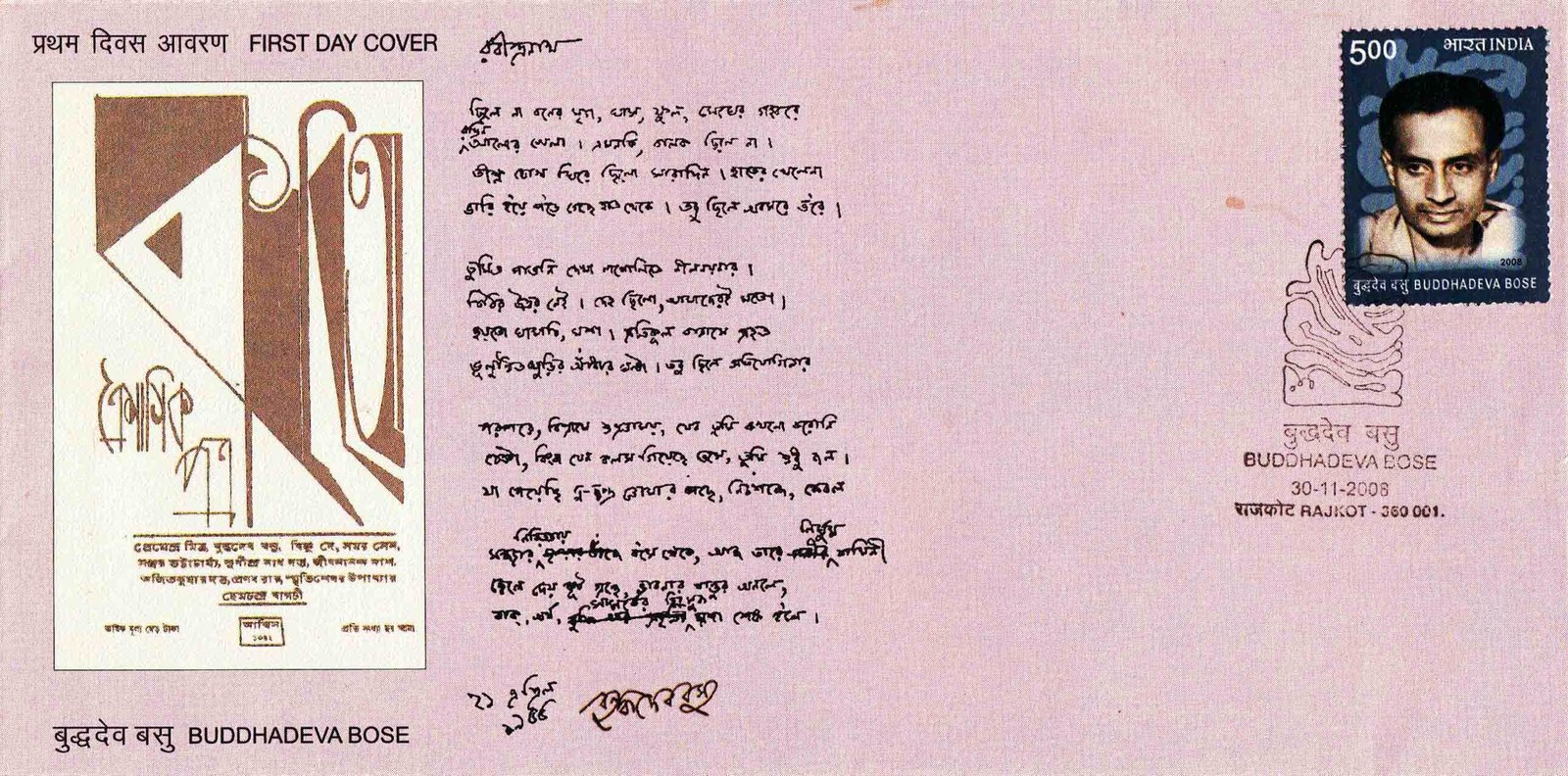
To celebrate the 100th birth anniversary of this exceptional creative genius, India Post issued a commemorative postage stamp on Buddhadeva Bose. The stamp pays tribute to his enduring influence on modern Bengali literature and his lifelong dedication to nurturing poetic expression and literary excellence.
First Day Cover
Leave a Comment
You must be logged in to post a comment.