
C. Subramaniam
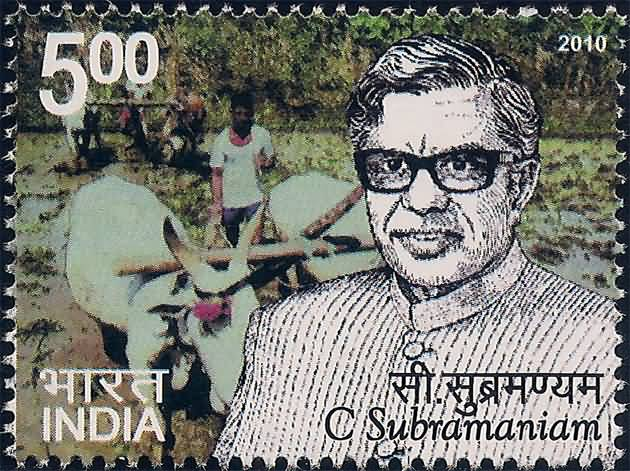
Technical Data
| Date of Issue | November 20, 2010 |
|---|---|
| Denomination | Rs. 5 |
| Quantity | 300,000 |
| Perforation | 13½ |
| Printer | Security Printing Press, Hyderabad |
| Printing Process | Wet Offset |
| Watermark | No Watermark |
| Colors | Multicolor |
| Credit (Designed By) | Mr. Suresh Kumar |
| Catalog Codes |
Michel IN 2528 Stamp Number IN 2466 Stanley Gibbons IN 2767 WADP Numbering System - WNS IN074.2010 |
| Themes | Anniversaries and Jubilees | Famous people | Men | Optical Instruments |
Architect of India’s Green Revolution
Early Life and Education
C. Subramaniam was born on January 30, 1910, in Senguttaipalayam village in Pollachi, Tamil Nadu, to Shri Chidambara Gounder. He received his early education in Pollachi before pursuing higher studies at Presidency College, Chennai, where he earned a B.Sc. degree in Physics. He later completed his law degree at Law College, Chennai.
Although he began a legal career, Subramaniam soon gave it up to actively participate in India’s freedom struggle, dedicating himself to national service.
Political Career in Madras State
In 1952, he was elected to the Madras Legislative Assembly and served as Minister for Education, Law, and Finance in the then Madras State. He worked under two towering Chief Ministers, C. Rajagopalachari and K. Kamaraj.
As Education Minister, he laid a strong foundation for primary education, with special emphasis on the upliftment of children from underprivileged sections. He played a key role in introducing the Noon Meal Scheme in schools, a landmark initiative aimed at improving child nutrition and school enrollment.
He was instrumental in advancing major irrigation projects and catalysed the establishment of premier institutions such as IIT Madras, Neyveli Lignite Corporation, and the Madras Institute of Development Studies (MIDS), strengthening Tamil Nadu’s educational and industrial infrastructure.
Role in National Politics
Elected to the Lok Sabha in 1962, C. Subramaniam went on to hold several key portfolios at the Union level, including Finance, Defence, Steel and Heavy Industries, and Science and Technology.
As Union Minister for Food and Agriculture (1964–66), he spearheaded India’s Green Revolution and is widely regarded as its architect. His visionary leadership transformed India from a food-deficit nation into a self-sufficient and eventually surplus food-producing country. He established the Food Corporation of India to strengthen food procurement and distribution systems.
He also contributed significantly to dairy development, paving the way for the White Revolution, and professionalised agricultural and scientific research institutions to ensure better coordination and efficiency.
As Minister for Steel, he modernised steel plants and expanded units of Bharat Heavy Electricals Limited across the country. He drew up India’s first Science and Technology Plan and articulated the country’s early national security strategy.
International Contributions and Recognition
At the international level, his paper on “Child Nutrition” prepared for the United Nations Secretary-General was widely acclaimed. He served on the Board of Governors of the International Rice Research Institute and the International Maize and Wheat Improvement Center for six years, reflecting global recognition of his agricultural expertise.
He also served briefly as Governor of Maharashtra and was associated with Bharatiya Vidya Bhavan, first as Vice President and later as President from 1990 until his passing.
His immense contributions were recognized with prestigious honours including the U Thant Peace Award, the Borlaug Award, the Y.B. Chavan Award, and India’s highest civilian honour, the Bharat Ratna.
Legacy and Commemorative Stamp
C. Subramaniam passed away on 7 November 2000, leaving behind a remarkable legacy of public service and nation-building.
To commemorate his Birth Centenary and honour his transformative role in ushering in the Green Revolution, India Post issued a commemorative postage stamp. The stamp pays tribute to Bharat Ratna C. Subramaniam, whose leadership as Minister for Food & Agriculture (1964–66), Finance (1975–77), and Defence (1979–80) shaped modern India’s agricultural and economic landscape.
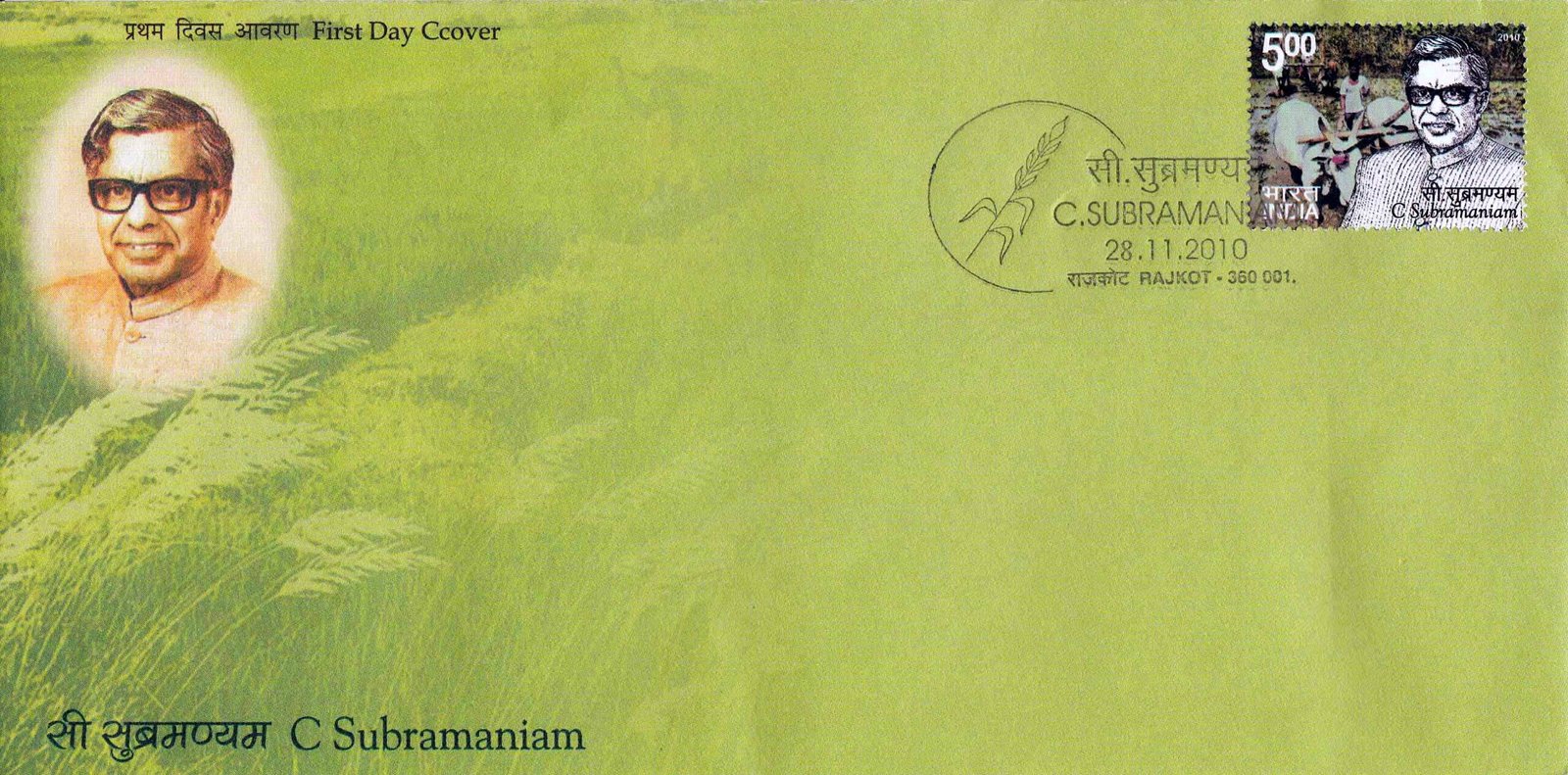
First Day Cover
Leave a Comment
You must be logged in to post a comment.