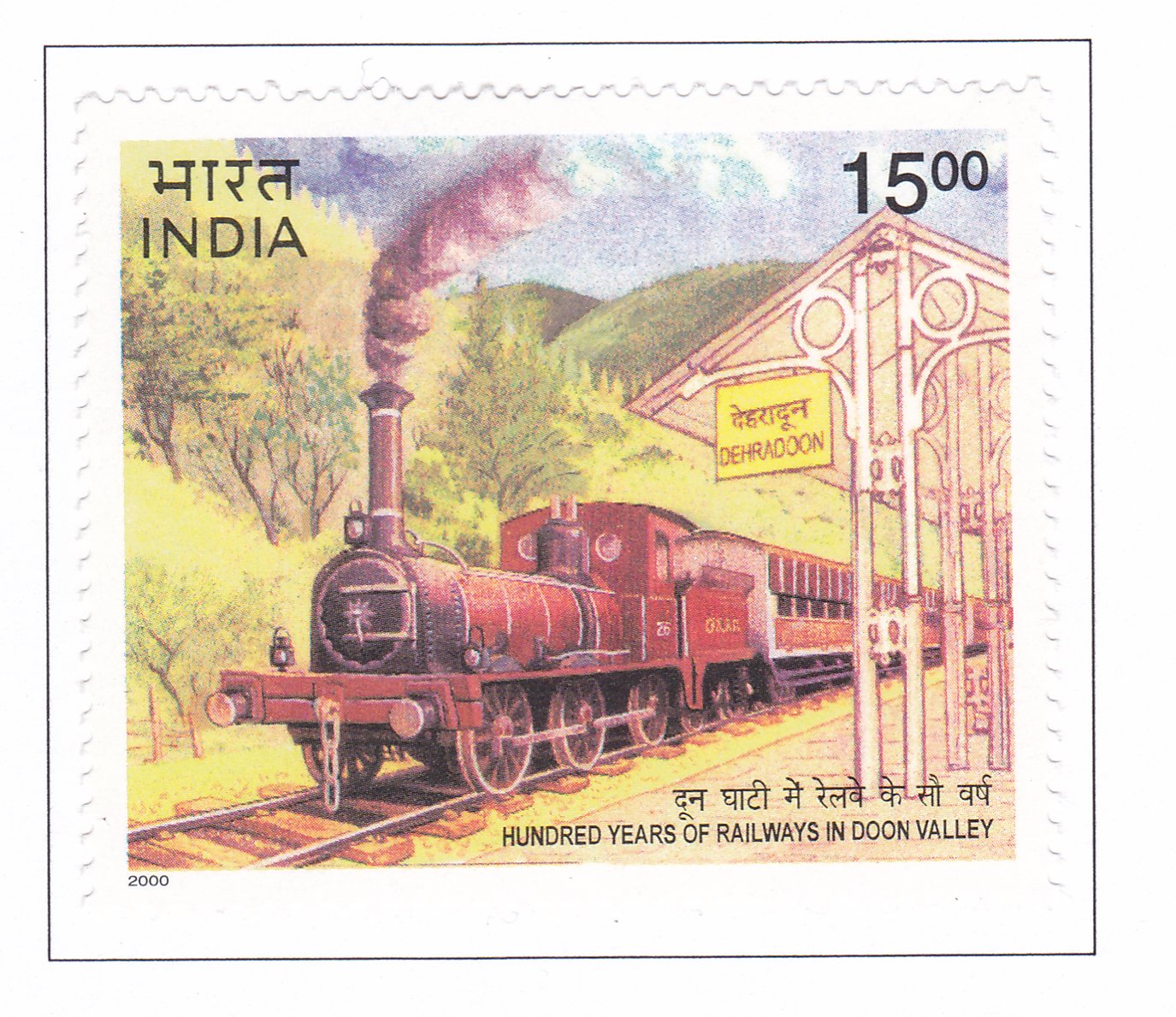
Centenary of Doon Valley Railway
Technical Data
| Stamp Set | Centenary Series |
|---|---|
| Date of Issue | May 6, 2000 |
| Denomination | Rs. 15 |
| Quantity | 700,000 |
| Perforation | comb 13½ |
| Printer | Calcutta Security Printers Ltd |
| Printing Process | Offset Lithography |
| Watermark | No Watermark |
| Colors | Multicolor |
| Credit (Designed By) | Sh. Sankha Samanta |
| Catalog Codes |
Michel IN 1761 Stamp Number IN 1830 Yvert et Tellier IN 1527 Stanley Gibbons IN 1933 |
| Themes | Anniversaries and Jubilees | Locomotives | Railways | Stations | Steam Traction |
A Historic Journey
Introduction to Doon Valley
The picturesque Doon Valley, stretching about 75 km in length and 25 km in breadth, is renowned for its pleasant climate and scenic beauty. It is home to prestigious institutions such as the Forest Research Institute, Indian Military Academy, and Rashtriya Indian Military College, making it an important educational and administrative hub.
Early Travel Challenges
Before the railway era, reaching Dehradun and the nearby hill station Mussoorie was a difficult journey. Despite rail connectivity up to Haridwar and Saharanpur, travelers had to rely on bullock carts, horse-drawn vehicles, and ponies to navigate the steep Shivalik Hills.
Construction of the Doon Valley Railway
The railway line between Haridwar and Dehradun was sanctioned on 18 November 1896, and construction began soon after under the Hardwar–Dehra Railway Company. Completed in early 1900 at a cost of around Rs. 26 lakhs, the line officially opened for traffic on 1 March 1900.
Impact on Regional Growth
The introduction of the railway transformed the region. It significantly boosted trade, tourism, and accessibility, leading to rapid economic growth in Dehradun and surrounding areas. Mussoorie also benefited greatly as travel became easier and more convenient.
Engineering Features of the Railway
The Doon Valley Railway spans 51.26 km and passes through dense forests, now part of the Rajaji National Park. The route includes:
- 15 curves, with the sharpest at 4½ degrees
- A ruling gradient of 1 in 75
- 2 tunnels with a combined length of 478.30 metres
- 236 bridges with a total waterway of 1355 metres
Due to these challenging features, train speeds are limited to 50 km/h, with the New Delhi–Dehradun Shatabdi Express allowed to run at up to 60 km/h.
Railway Operations and Connectivity
Initially operated by the Oudh and Rohilkhand Railways, the line quickly became profitable. Today, Dehradun is well connected to major cities like Mumbai, Howrah, Varanasi, Delhi, and Amritsar, with thousands of passengers using the service daily.
Centenary Commemoration Stamp
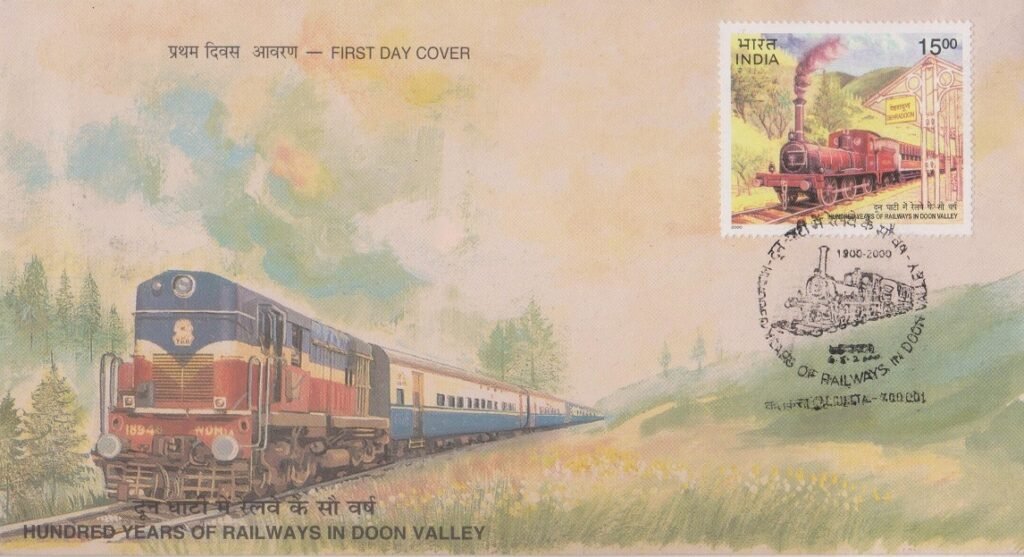
To celebrate 100 years of this historic railway line, the Department of Posts issued a commemorative postage stamp. The design highlights the modern Shatabdi Express running through the scenic valley, symbolizing the enduring legacy of the railway.
Conclusion
The Doon Valley Railway stands as a remarkable achievement in engineering and a vital contributor to the social, cultural, and economic development of the region. Its centenary marks not just a milestone in transportation history, but also a celebration of progress and connectivity in the heart of Uttarakhand.
First Day Cover