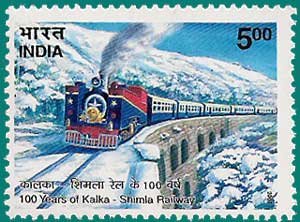
100 years of Kalka-Shimla Railway
Technical Data
| Date of Issue | November 9, 2003 |
|---|---|
| Denomination | Rs. 5 |
| Quantity | 3,000,000 |
| Perforation | comb 13½ x 13 |
| Printer | Eagle Press Ltd. |
| Printing Process | Offset Lithography |
| Watermark | No Watermark |
| Colors | Multicolor |
| Credit (Designed By) | Shri Kamleshwar Singh |
| Catalog Codes |
Michel IN 1992 Stamp Number IN 2032 Yvert et Tellier IN 1757 Stanley Gibbons IN 2166 WADP Numbering System - WNS IN049.03 |
| Themes | Anniversaries and Jubilees | Bridges | Locomotives | Railways | Snow |
Introduction
The Kalka–Shimla Railway is one of India’s most remarkable engineering achievements and a symbol of the country’s rich railway heritage. Built through the rugged Shivalik Hills, the railway offers a scenic journey through mountains, forests and valleys. To commemorate a century of this historic line, India Post issued a special postage stamp marking 100 years of the Kalka–Shimla Railway.
Historical Background
The origins of the railway are closely linked to the development of Shimla, which became an important administrative centre during British rule in India.
In 1816, the region where Shimla stands today was transferred to the East India Company under the Nepalese Peace Treaty. The British soon recognised the pleasant climate and natural beauty of the area, viewing it as a hill retreat similar to England.
Travel to Shimla in the early years involved a difficult 43-mile journey on ponies or in jampans (sedan chairs), which was uncomfortable for the British administrators. As a result, proposals were made to construct a railway line connecting the plains to the hill station.
Construction of the Railway
After railway surveys conducted between 1884 and 1895, a contract was signed in 1898 between the Secretary of State and the Delhi–Umbala Railway Company. Construction began soon afterwards, and the railway line was completed in 1903.
The 96-kilometre railway track was carved through limestone and shale rock formations of the Shivalik Hills after three years of intense labour. Because of the steep terrain, the line was built with a narrow gauge of 2 feet 6 inches. It passes through 102 tunnels and crosses 864 bridges, many built on sharp curves along the mountains.
Scenic Journey Through the Hills
The journey begins at Kalka, from where the famous toy train climbs gradually toward Shimla. As the train enters the foothills, passengers can enjoy breathtaking views of the Kushalya River winding through the landscape.
The railway passes through several picturesque stations and scenic loops at Taksal, Gumman, and Dharampur, offering excellent photographic views. Along the route, the train travels across green meadows, agricultural fields, and charming hill cottages.
Engineering and Operation
The trains usually consist of around seven coaches, carrying nearly 200 passengers. Despite harsh weather conditions ranging from 0°C to 45°C, the trains continue to operate reliably, powered by 700-horsepower diesel engines.
With an average speed of 25–30 km/h, the journey is leisurely, allowing travellers to fully appreciate the surrounding natural beauty.
Rail Motor Cars
For a more exclusive travel experience, the railway also operates historic Rail Motor Cars, each accommodating only 18 passengers. Some of these cars date back to 1927, while another was introduced in 1930. Initially fitted with petrol engines supplied by the Drewry Car Company Ltd., London, they were later equipped with diesel engines from General Motors during the Second World War due to petrol shortages.
Famous Tunnels and Stations
One of the most notable points on the journey is the Barog Tunnel, measuring 1,144 metres in length. It passes through the Panchmunda ridge and is one of the longest tunnels on the route.
The railway also passes scenic stations such as Solan, Kandaghat, Shogi, and Summer Hill. The final stretch runs through forests of deodar and pine, eventually arriving at Shimla beneath Inverarm Hill.
Conclusion
The Kalka–Shimla Railway is not only an engineering marvel but also a cherished part of India’s railway heritage. Its winding track, historic tunnels and breathtaking mountain scenery make the journey one of the most memorable rail experiences in the world. The commemorative stamp issued by India Post celebrates a century of this extraordinary railway and its enduring legacy.
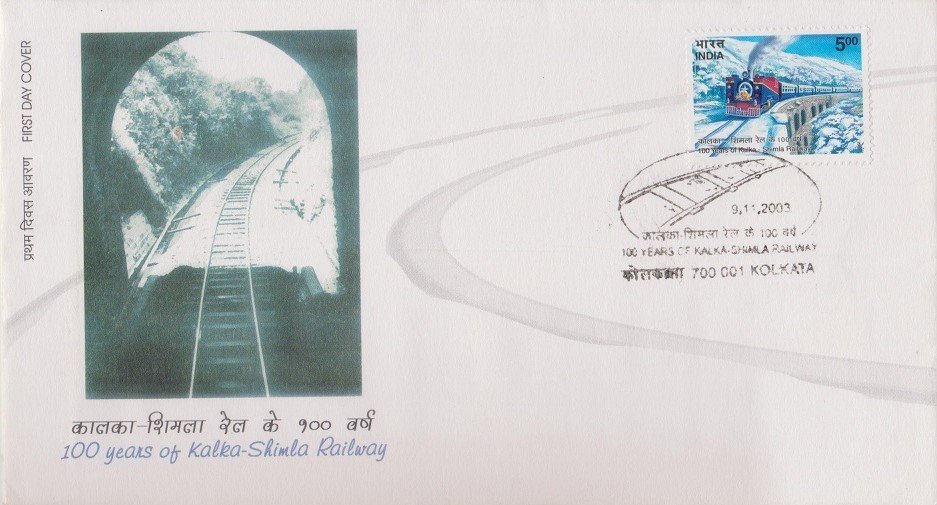
First Day Cover