
50th Anniversary of Central Vigilance Commission
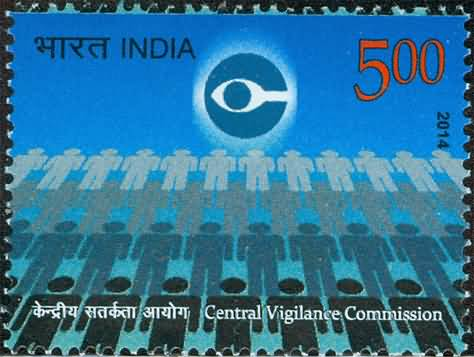
Technical Data
| Date of Issue | February 11, 2014 |
|---|---|
| Denomination | Rs. 5 |
| Quantity | 410,000 |
| Perforation | 13½ |
| Printer | Security Printing Press, Hyderabad |
| Printing Process | Wet Offset |
| Watermark | No Watermark |
| Colors | Multicolor |
| Credit (Designed By) | |
| Catalog Codes |
Michel IN 2818 Yvert et Tellier IN 2573 Stanley Gibbons IN 3000 |
| Themes | Anniversaries and Jubilees | Stylized Figures / Persons |
Introduction
The Central Vigilance Commission (CVC) is the apex integrity institution of India, established with the purpose of preventing corruption in the Central Government. Its jurisdiction covers Central Ministries, Departments, Central Public Sector Enterprises, statutory corporations, government companies, societies, and local authorities owned or controlled by the Central Government.
The CVC was initially set up by a Government of India resolution in 1964.
Independence and Autonomy
The Commission functions independently and is not subordinate to any Ministry or Department of the Central Government. Its autonomy is comparable to that of the Union Public Service Commission (UPSC), ensuring freedom from executive interference in the discharge of its duties.
Statutory Status
The Central Vigilance Commission Act, 2003 conferred statutory status upon the CVC.
Under this Act, the Commission is empowered to:
- Inquire or cause inquiries into offences under the Prevention of Corruption Act, 1988
- Exercise superintendence over the functioning of the Delhi Special Police Establishment (DSPE), now known as the Central Bureau of Investigation (CBI)
- Review the progress of CBI investigations
- Oversee proposals for sanction of prosecution pending with Competent Authorities
Additionally, the CVC exercises superintendence over vigilance administration across all Central Government Ministries and their organizations.
Advisory Functions
The Commission advises the Government on vigilance-related matters referred to it by various Ministries and Departments.
It is mandatory for government organizations to seek the Commission’s advice in cases where a report has been sought by the CVC.
Whistle Blower Protection (PIDPI)
Under the Public Interest Disclosure and Protection of Informers (PIDPI) Resolution, 2004, the Central Government designated the CVC as the agency to receive complaints from whistle blowers.
Key responsibilities include:
- Protecting the identity of whistle blowers
- Safeguarding them from victimization
- Taking action against complainants who file motivated or vexatious complaints
Composition of the Commission
As per the CVC Act, 2003, the Commission comprises:
- Central Vigilance Commissioner (CVC) – Chairperson
- Two Vigilance Commissioners (VCs) – Members
These appointments are made by the President of India, based on recommendations from a high-level committee consisting of:
- The Prime Minister
- The Minister of Home Affairs
- The Leader of the Opposition in the Lok Sabha
Vigilance Units and CVOs
All Departments and Organizations under the CVC’s advisory jurisdiction maintain vigilance units headed by Chief Vigilance Officers (CVOs).
CVOs act as the extended arm of the Commission, representing it in all vigilance matters and ensuring proper implementation of anti-corruption mechanisms.
Philatelic Tribute
The Department of Posts is pleased to issue a Commemorative Postage Stamp on the Central Vigilance Commission, honouring its vital role in promoting integrity, transparency and accountability within the Government of India.
First Day Cover

Leave a Comment
You must be logged in to post a comment.