
Chandra Shekhar
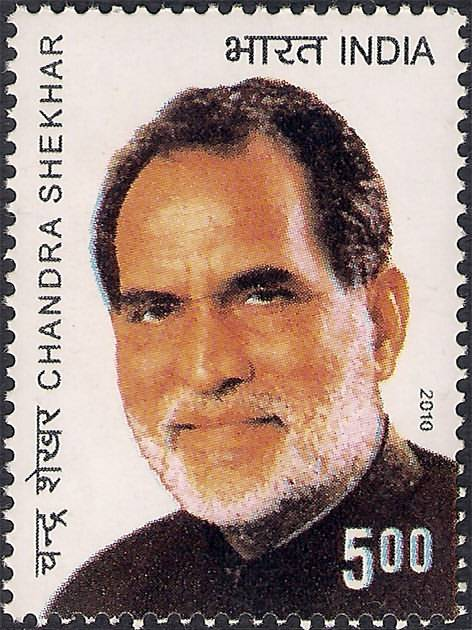
Technical Data
| Date of Issue | April 17, 2010 |
|---|---|
| Denomination | Rs. 5 |
| Quantity | 400,000 |
| Perforation | 13 |
| Printer | India Security Press, Nasik |
| Printing Process | Photo Gravure |
| Watermark | No Watermark |
| Colors | Multicolor |
| Credit (Designed By) | Sh. Brahm Prakash |
| Catalog Codes |
Michel IN 2477 Stamp Number IN 2415 Yvert et Tellier IN 2240 Stanley Gibbons IN 2706 WADP Numbering System - WNS IN022.2010 |
| Themes | Commemoration | Famous people | Men | Politicians |
Early Life and Education
Chandra Shekhar was born on 1 July 1927 in village Ibrahimpatti, District Ballia, Uttar Pradesh, into a farmer’s family. After completing his Master’s degree in Political Science from University of Allahabad, he gave up plans for a doctoral degree and joined the socialist movement in the early 1950s.
Deeply influenced by Acharya Narendra Dev, a leading figure of the Indian Socialist Movement, he became General Secretary of the U.P. State Praja Socialist Party during 1955–56.
Parliamentary Career and Political Ideals
In 1962, Chandra Shekhar was elected to the Rajya Sabha from Uttar Pradesh. He joined the Indian National Congress in 1965 and became General Secretary of the Congress Parliamentary Party in 1967.
A strong advocate for the downtrodden, he opposed the disproportionate growth of monopoly houses supported by State patronage and consistently demanded rapid social change. Known for his courage, conviction, and integrity, he founded and edited the weekly magazine Young Indian in 1969, where his insightful editorials on political, social, and economic issues earned widespread respect.
Defender of Democracy
Chandra Shekhar’s commitment to democratic norms and parliamentary values made him one of the most respected parliamentarians of his era. He strongly upheld secularism and India’s pluralistic ethos, both through his speeches and actions in Parliament. For his distinguished service, he received the Outstanding Parliamentarian Award in 1995.
During the period of the Emergency (1975–77), he was imprisoned for his steadfast opposition to authoritarianism. After the Emergency was lifted, he was chosen to lead the Janata Party in the 1977 General Elections.
Prime Minister of India
Chandra Shekhar briefly served as the Prime Minister of India from 1990 to 1991. R. Venkataraman, then President of India, praised his objectivity, sobriety, and dignity in handling the responsibilities of high office.
Bharat Yatra and Mass Contact
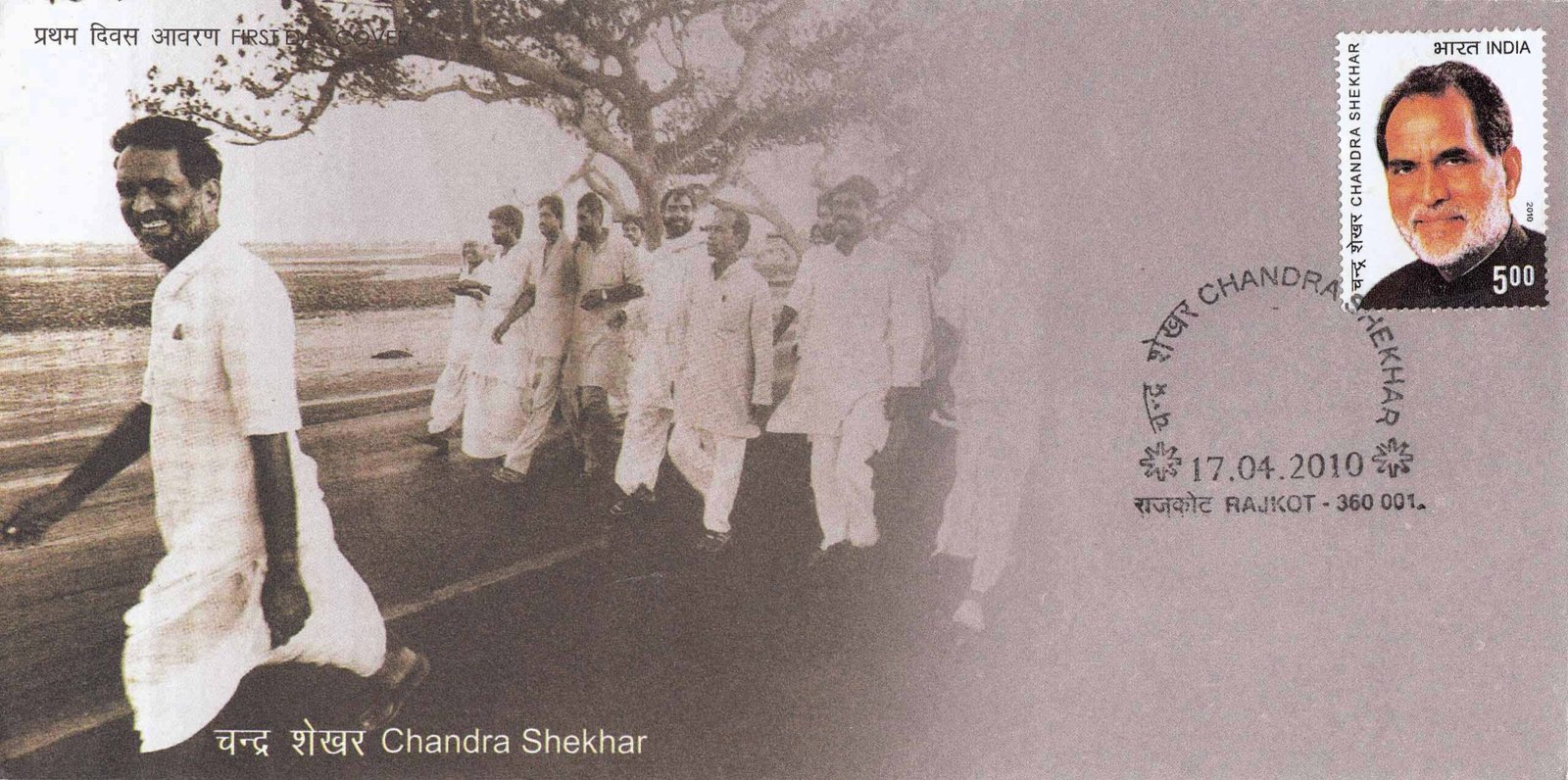
A defining moment of his political life was his historic Padayatra (foot march) from Kanyakumari to Rajghat in New Delhi, covering nearly 4,260 kilometers between 6 January and 25 June 1983. This journey helped him reconnect with the masses and understand grassroots issues. He subsequently established Bharat Yatra Centres across the country to train social and political workers for rural development and public education.
Legacy
Chandra Shekhar also contributed significantly to India’s industrial policy, including support for progressive economic measures such as the nationalization of major private commercial banks. He remained a member of the Lok Sabha until his passing on 8 July 2007.
In recognition of his lifelong service to the nation, India Post issued a commemorative postage stamp in honour of Chandra Shekhar, celebrating his enduring legacy in Indian public life.
First Day Cover
Leave a Comment
You must be logged in to post a comment.