
Chatrapati Shri Shivaji Maharaj
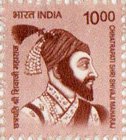
Technical Data
| Date of Issue | March 1, 2016 |
|---|---|
| Denomination | Rs. 10 |
| Perforation | 13 |
| Watermark | Asokan Capital Multiple [Up] |
| Colors | Red Brown |
| Catalog Codes |
Michel IN 2934 Stamp Number IN 2804 Yvert et Tellier IN 2673 Stamp Number IN 3088 |
| Themes | Famous people | Headgear | Men |
The Legendary Maratha King
The name of Chhatrapati Shivaji has inspired generations across India—young and old, common citizens, and freedom fighters alike. His brave deeds and strategic genius have been immortalized in countless stories and songs in several Indian languages. A visionary ruler, fearless soldier, and devoted patriot, Shivaji is celebrated for his successful struggle against overwhelming odds to liberate his homeland and restore dignity to his people.
Early Life and Influences
Chhatrapati Shivaji was born in April 1627 at Shivneri, a hill-fort near Poona (present-day Pune, Maharashtra). His father, Shahaji Bhosle, was a renowned warrior whose services were highly valued by the Muslim rulers of the time. From the Sultan of Bijapur, Shahaji obtained a small jagir (land grant) around Poona, where Shivaji spent his childhood.
Two key figures shaped young Shivaji’s character: his mother, Jijabai, and his Dewan, Dadaji Kondadeo. Jijabai, a woman of strong religious and moral values, instilled in Shivaji a sense of justice, pride in India’s past glory, and a burning desire to free his land from foreign rule. Dadaji Kondadeo trained Shivaji in reading, writing, the use of arms, and the essential skills of administration necessary for ruling a kingdom.
Rise to Power
Shivaji began expanding his jagir at an early age. In 1644, he captured the fort of Sinhagad near Poona. Three years later, he seized the forts of Torna, Chakan, and Purandhar, while building others and consolidating control over surrounding territories. At Torna, he discovered buried treasure, which he used to strengthen his army.
His daring exploits soon earned him legendary status. Reports of divine support for his mission spread, attracting soldiers from all corners. He skillfully defeated forces sent by the Adil Shahi rulers and overcame the army of Afzul Khan, establishing himself as a formidable leader.
Conflict with the Mughal Empire
As Shivaji’s power grew, he inevitably came into conflict with the mighty Mughal Empire, which sought to absorb the southern kingdoms. This struggle lasted over fifty years. In 1663, Shivaji’s strategic brilliance led to the defeat of Shaista Khan. Facing continued pressure from Raja Jai Singh, he temporarily surrendered half of his kingdom and visited the Mughal Emperor at Agra. Suspecting foul play, Shivaji daringly escaped and returned to Maharashtra to continue his relentless campaign.
By 1674, Shivaji controlled a vast territory and was crowned Chhatrapati Shivaji in a grand ceremony at Raigad Fort.
Administration and Legacy
During the last six years of his life, Shivaji focused on strengthening his administration, expanding his territories into Karnataka, and consolidating his kingdom. He passed away on 4th April 1680.
Shivaji’s administration was notable for its efficiency and fairness. Though he delegated responsibilities to eight ministers, he personally guided the work of his cabinet. He was deeply concerned about the welfare of his people, especially peasants.
Historian Jadunath Sarkar praised Shivaji, saying:
“His reign brought peace and order, assured the protection of women’s honor and religious freedom for all sects, extended royal patronage to the truly pious of every creed, and opened public service to talent regardless of caste or religion—a model policy for a diverse country like India.”
Chhatrapati Shivaji on Indian Stamps
In recognition of his enduring legacy, the Department of Posts, India issued a definitive stamp commemorating Chhatrapati Shivaji, honoring his contributions to Indian history and inspiring future generations.