
Children’s Day 2003
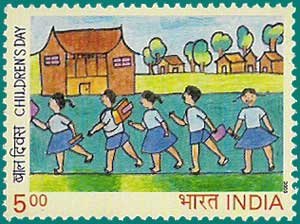
Technical Data
| Date of Issue | November 14, 2003 |
|---|---|
| Denomination | Rs. 5 |
| Quantity | 3,000,000 |
| Perforation | comb 13½ x 13 |
| Printer | Calcutta Security Printers Ltd |
| Printing Process | Offset Lithography |
| Watermark | No Watermark |
| Colors | Multicolor |
| Credit (Designed By) | Sh. P. R. Modi |
| Catalog Codes |
Michel IN 1997 Stamp Number IN 2037 Yvert et Tellier IN 1762 Stanley Gibbons IN 2172 WADP Numbering System - WNS IN054.03 |
| Themes | Children | Drawings |
Introduction
Children represent the future of a nation and nurturing them is a collective responsibility of parents, society and the State. The birth of a child brings immense joy but also carries the duty of ensuring proper care, education and protection so that the child grows into a responsible member of society. Children’s Day serves as a reminder of this responsibility and highlights the importance of safeguarding the rights and welfare of children.
Significance of Children’s Day
In India, Children’s Day is celebrated every year on 14 November. The date marks the birth anniversary of Jawaharlal Nehru, who had a deep affection for children. Because of his love and warmth toward them, children fondly called him “Chacha Nehru.”
The celebration provides an opportunity to reflect on the well-being of children and to renew efforts toward fulfilling their needs, rights and aspirations.
Children and Self-Development
Human needs are often described in a hierarchy that begins with basic physiological needs and progresses through safety, social belonging and esteem, ultimately reaching self-actualisation—the realization of one’s true potential. For children, proper nurturing, education and care are essential to help them grow into self-fulfilled individuals who can contribute meaningfully to society.
Constitutional Provisions for Children
The welfare of children has been recognised in the Constitution of India through the Directive Principles of State Policy.
- Article 39 directs the State to ensure that children are protected from exploitation and not forced into occupations unsuitable for their age and strength.
- Article 45 emphasises the goal of providing free and compulsory education for all children up to the age of fourteen.
These provisions reflect the vision of creating a welfare state where childhood is safeguarded and children receive opportunities for growth and development.
Philatelic Commemoration
Every year, India Post issues a special commemorative postage stamp to mark Children’s Day. These stamps are unique because their designs are selected from entries created by children during national Stamp Design Competitions.
The themes portrayed by children often highlight issues such as nutrition, shelter, children’s literature and the empowerment of the girl child. One such stamp designed by Prasen R. Modi depicts children going to school, emphasizing the importance of education and drawing attention to the constitutional ideal of universal literacy.
Conclusion
Children’s Day is more than a celebration—it is a reminder of the responsibility to ensure every child receives education, protection and opportunities to flourish. By working together toward complete literacy and the welfare of children under fourteen, society can build a strong foundation for the nation’s future.